 MARC
MARC
Try this today. Take your website, cover your logo and swap in your biggest competitor’s. Would anyone notice? For most companies I work with, the honest answer is no. Everyone says quality, service, innovation and trusted partner. When everyone says the same thing, customers decide on the only thing left: price.
I’ve seen this in boilers, water heaters, door hardware, coffee equipment and healthcare. The fix is the same every time. You have to find what makes you different, prove it, and say it the same way everywhere.
What is marketing differentiation?
Marketing differentiation is what makes a customer choose you over the other options. To count, it has to pass two tests. Customers have to care about it. And competitors can’t easily claim it. Miss either test and it isn’t a differentiator. It’s just a nice thing to say.
The problem is bigger than most leaders think
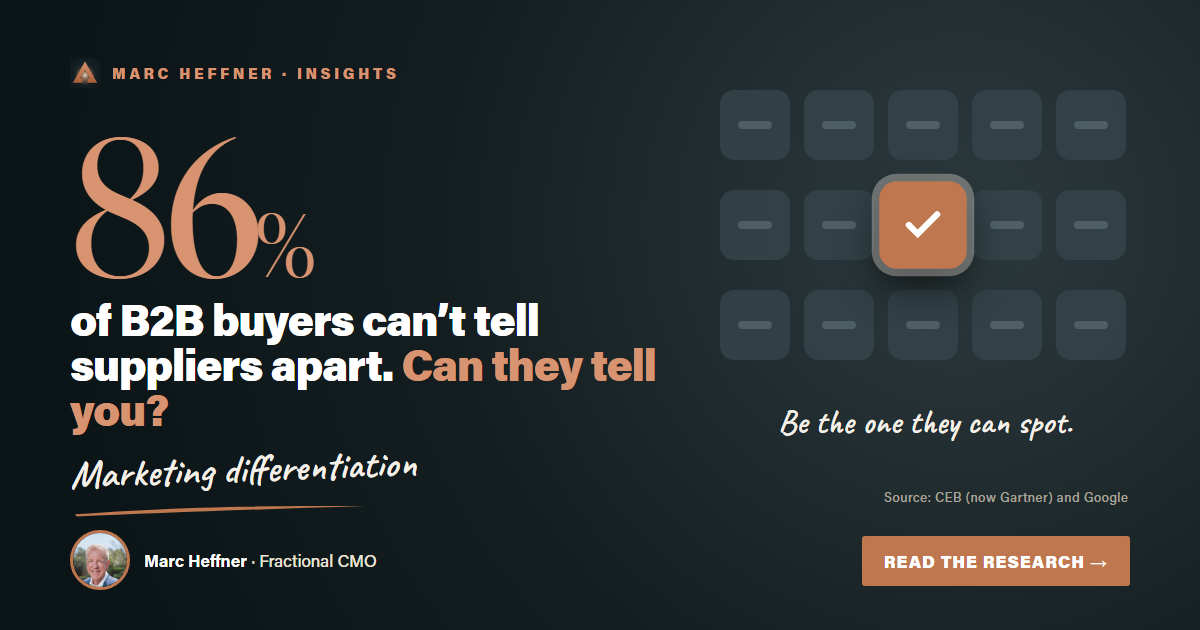
Research from CEB, now part of Gartner, working with Google, found that only about 14% of B2B buyers see a real difference between suppliers that they value enough to pay for (CEB, Google and Motista, 2013). That means 86% of buyers see you as interchangeable with your competitors.
Byron Sharp’s team at the Ehrenberg-Bass Institute found something similar with consumer brands. On average, only about 18% of a brand’s own buyers say it’s “different from others” (Ehrenberg-Bass and Millward Brown, 2011). Their takeaway is important: being easy to recognize and remember matters as much as being different. So your differentiators have to be clear, simple and repeated.
And the cost of looking the same is real. McKinsey found that a 1% price increase, with steady volume, can lift operating profit by about 8% (McKinsey, 2003). Differentiation is what gives you the right to charge that 1%.
Buyers decide before they talk to you
Here’s why this matters more every year. Gartner found that B2B buyers spend only about 17% of their buying time meeting with all potential suppliers combined. The rest goes to researching on their own and debating inside their own buying group (Gartner, 2018).
And in 2025, Gartner found 61% of B2B buyers prefer a buying experience with no sales rep at all. 73% avoid suppliers whose outreach feels irrelevant. And 69% see mismatches between what a supplier’s website says and what its sellers say (Gartner, 2025).
So if your website, your sales deck and your distributor brochure all tell a different story, buyers notice. And if none of them says something a competitor can’t, you’re just one more name on the list.
The four boxes
- Table stakes: customers care, but everyone claims it. Think “reliable” or “good support.” You still need these, but they won’t win the deal.
- Noise: everyone says it and nobody cares. “Innovative solutions.” Cut it.
- Trivia: true and unique, but customers don’t care. A fun fact, not a reason to buy.
- Your differentiators: customers care and only you can prove it. Build everything around these.
Don’t forget the person behind the purchase
This is the part most B2B companies miss. The same CEB and Google research found that personal value, like making the buyer look good, saving them stress or helping their career, has twice the impact of business value. Buyers who saw personal value were 71% likely to buy and 69% willing to pay more. Buyers who didn’t were 23% and 9% (CEB, Google and Motista, 2013).
Bain’s research on the B2B Elements of Value backs this up. Suppliers who did well on more of the 40 elements buyers value had Net Promoter Scores about 60% higher (Bain, 2018). Differentiation isn’t just specs. It’s how you make people’s jobs easier and their lives better.
Seven places to find your differentiators
- Product or technology that does something others can’t.
- Speed: faster delivery, setup, service or answers.
- Service and support people can feel, not just a promise on a page.
- Specialization: being the expert for one kind of customer.
- Business model: how you price, package, warranty or guarantee.
- Proof and track record: results, share, awards and customer names.
- People and experience: the team behind the work.
Sometimes the differentiator is hiding in plain sight. At Schlage, I learned that shoppers decide at the shelf in seconds, so packaging was a real point of difference. A packaging redesign helped a new deadbolt reach #1 in its category at big home-improvement retailers within six months. Same lock. Better story at the moment of choice.
How to find yours, step by step
- List every claim you make today, from the website, decks, ads and brochures.
- Ask customers why they chose you and what almost made them pick someone else. Talk to a few you lost, too.
- Check competitors. Cross off anything three or more of them also say.
- Pick one to three that are left and that customers care about most.
- Prove them. Put a number, name or result next to each one.
- Repeat them everywhere. Website, sales deck, trade show, proposals and job posts. Recognition comes from repetition.
Words to retire
Quality. Innovative. Best-in-class. Solutions. Trusted partner. Customer-centric. World-class. If a word could appear on any company’s website, it isn’t doing work for you. Replace it with something specific and provable. “Same-day parts in 48 states” beats “excellent service” every time.
The bottom line
Most markets are full of companies that sound the same. That’s good news for you. It means a clear, proven difference, said the same way everywhere, stands out fast. Only about 5% of B2B buyers are in the market at any given moment (LinkedIn B2B Institute and Ehrenberg-Bass, 2021). Your job is to be the brand the other 95% remember when it’s their turn.
Differentiation is the heart of your brand platform and your messaging framework. It’s also one of the first things I tackle as a fractional CMO.
Sources
- CEB (now Gartner), Google and Motista, From Promotion to Emotion: Connecting B2B Customers to Brands, 2013.
- Gartner, Survey Finds 61% of B2B Buyers Prefer a Rep-Free Buying Experience, 2025.
- Gartner, via CRM Magazine, Buyer Enablement Is the Key to B2B Sales, 2018.
- Bain & Company, Harvard Business Review, The B2B Elements of Value, 2018.
- Ehrenberg-Bass Institute (Byron Sharp) and Millward Brown, Confirmation of differentiation findings, 2011.
- McKinsey & Company, The Power of Pricing, 2003.
- LinkedIn B2B Institute and Ehrenberg-Bass, via Marketing Week, The 95:5 rule, 2021.