 MARC
MARC
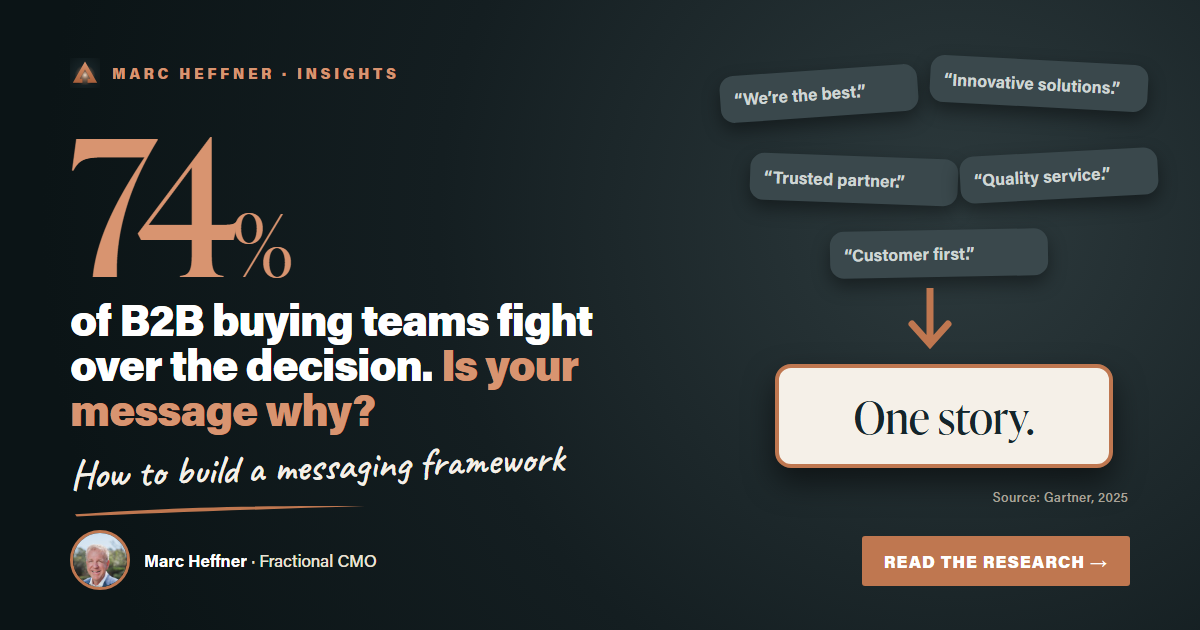
Here’s a test I run in the first week with almost every leadership team. I ask five people the same question: “What do we do, and why should a customer pick us?” I usually get five different answers. Sales says one thing. The website says another. The CEO tells a third story on a podcast. And the customer? They’re left trying to piece it together.
That gap costs real money. It slows deals, confuses buying teams and makes good companies sound like everyone else. The fix isn’t a new tagline or a thicker brand book. It’s a messaging framework: one page that tells everyone what to say, who to say it to, and why it’s true.
I’ve built these for heating and water heater makers, coffee equipment companies, door hardware brands and healthcare groups. The industries change. The problem doesn’t. Let’s walk through what a messaging framework is, why it matters more than ever, and how to build one in a half day.
What is a messaging framework?
A messaging framework is a simple document that lays out your target customer, your core promise, the three reasons to believe it, and the proof behind each one. Sales, marketing, customer service, leadership and new hires all use the same page. So the company tells one story, everywhere.
Think of it as the source code for every sales deck, web page, trade show booth, email and job posting. When it’s right, people stop rewriting the story from scratch. They start telling it better.
Why inconsistent messaging is so expensive
Most leaders feel the pain before they can put a number on it. The research puts a number on it.
- Customers expect one voice. Salesforce found that 79% of customers expect consistent interactions across departments (Salesforce, 2023).
- Buying teams fight. Gartner found that 74% of B2B buyer teams show unhealthy conflict during the buying decision (Gartner, 2025).
- Sellers are buried. 77% of sellers say they struggle to get their assigned work done efficiently (Gartner, 2023).
- Content goes to waste. Forrester estimates 65% of the content marketing creates goes unused because it isn’t relevant (Forrester, 2021).
- The brand drifts. 60% of companies say they deal with off-brand content (Marq, 2021).
Put those together and you get a picture most CEOs will recognize. Customers want one clear story. Buying teams are already arguing. Sellers don’t have time to reinvent the pitch. And most of the content marketing makes never gets used.
One story wins the room
Here’s the part that surprised me. In a 2025 study, Gartner found that messaging built for the whole buying group raised agreement inside that group by 20%. Messaging aimed at individuals, a different pitch for each person, cut agreement by 59%. And buying groups that reached agreement were 2.5 times more likely to say they got a high-quality deal (Gartner, 2025).
That’s a big deal for anyone selling to more than one decision maker. In manufacturing, you might be selling to an engineer, a contractor, a distributor and a facility manager all at once. If each one hears a different story, they can’t agree. If they all hear the same core promise, told in a way that fits their role, they can.
Gartner also found that buyers who feel overwhelmed by contradictory information from suppliers are 153% more likely to settle for a smaller deal than they planned (Gartner, 2019). Confusion doesn’t just slow the sale. It shrinks it.
The five parts of a messaging framework
1. The customer
Pick one primary customer. Not everyone who might buy, the one who matters most to your growth. Then write their problem in their own words, the way they’d explain it to a friend over lunch. If you can’t do that, you need more customer conversations before you need more copy.
2. The core promise
One sentence that says what you do for that customer and why it matters. My test is simple: could a competitor put their logo on it? If yes, keep working. “Quality products and great service” fails. Everyone says it. Nobody believes it.
3. Three pillars
These are your reasons to believe. Three is the limit. When I see five or seven pillars, I know nobody will remember any of them. Each pillar should be an outcome the customer cares about, not a feature you’re proud of.
4. Proof points
This is where most frameworks fall apart. Every pillar needs proof: a number, a customer name, a result, a guarantee or an award. Without proof, a pillar is just a nice opinion. When I led marketing at Lochinvar, our brand research showed we were the top boiler brand in every commercial market we studied. That’s the kind of proof that lets a sales team lead with confidence.
5. Voice
How you sound. Plain or technical? Warm or formal? Write three or four “we are this, not that” lines. For example: “We’re confident, not cocky. We’re clear, not clever.” Now every writer, agency and salesperson sounds like the same company.
A quick example
Say you make commercial water heaters for hospitals and hotels. A first draft might look like this:
- Customer: facility directors who can’t afford downtime.
- Core promise: hot water that never becomes your emergency.
- Pillars: built to last, easy to service, local support that answers the phone.
- Proof: warranty length, average service response time, the share of engineers who specify you.
- Voice: calm, practical, no hype.
Now every sales deck, web page, distributor brochure and trade show booth has the same backbone. The engineer hears about reliability and specs. The facility director hears about uptime. The CFO hears about lifetime cost. Same promise, told for each role.
How I build one in a half day
- Gather the inputs. Customer interviews, win and loss notes, sales call recordings, reviews and support tickets. The exact words customers use are gold.
- Draft the promise. Write ten versions fast. Then cross out any a competitor could say.
- Pick the pillars. Group everything you could say into themes. Keep the three customers care about most.
- Attach proof. If a pillar has no proof, find some or drop the pillar.
- Test it. Read it to your best salesperson and two customers. If they nod, you’re close. If they squint, go back to step two.
You don’t need a big agency or six months. You need the right people in a room, real customer words and someone willing to cut. That’s exactly what my messaging and brand workshop is built to do.
Mistakes I see over and over
- Writing by committee. Everyone adds a word until it says nothing. Give one person the pen and the final call.
- Features instead of outcomes. Customers don’t buy a 96% efficient boiler. They buy lower bills and fewer callbacks.
- No proof. Claims without evidence sound like every competitor.
- Too many audiences. Start with one primary customer. Add tailored versions later.
- Finishing it and filing it. A framework only works if it shows up in the sales playbook, website brief, agency briefs and new-hire onboarding.
Roll it out so it sticks
Here’s how I make sure the framework actually gets used:
- Turn it into a one-page talk track for sales, with the promise, pillars and two proof points each.
- Rewrite the homepage and top three web pages around it first.
- Brief every agency from it. If their work doesn’t fit the framework, it doesn’t run.
- Teach it in onboarding, so new hires tell the story right from day one.
- Check it every quarter against win and loss notes. Keep what’s working. Fix what isn’t.
It also pays off in trust. Edelman and LinkedIn found that 73% of decision makers trust a company’s thought leadership more than its marketing materials when judging its capabilities (Edelman and LinkedIn, 2024). Clear, consistent ideas earn that trust. A messaging framework is where those ideas start.
The bottom line
A messaging framework is one of the cheapest, fastest ways to make every marketing dollar work harder. It helps buyers agree. It helps sellers sell. And it keeps your brand from drifting every time you hire a new agency. Companies in one study said they’d expect revenue to rise 10% to 20% if their brand were consistent (Marq, 2021). I can’t promise that number, but I can promise you’ll stop paying for five different stories.
If you want help, this is often my first deliverable as a fractional CMO, and it’s a great place to start before a launch, a rebrand or a new sales push.
Sources
- Gartner, Survey Finds 74% of B2B Buyer Teams Demonstrate Unhealthy Conflict During the Decision Process, 2025.
- Gartner, Gartner Reveals New B2B Sales Approach to Win in Today’s Market, 2019.
- Gartner, Survey Finds 77% of Sellers Struggle to Complete Their Assigned Tasks Efficiently, 2023.
- Salesforce, State of the Connected Customer: customer touch points, 2023.
- Forrester, The B2B Content Guide: Make Sales Your Ally in Content Marketing, 2021.
- Marq (formerly Lucidpress), The State of Brand Consistency, 2021.
- Edelman and LinkedIn, 2024 B2B Thought Leadership Impact Report, 2024.