 MARC
MARC
A great CMO can change the direction of a company. The wrong one costs you a year, a budget and usually a few good people along the way. I’ve sat on both sides of this table. I’ve been the marketing leader being hired, and I’ve been the leader building teams and hiring marketers. Here’s what I’d tell any CEO, board or PE operating partner before they start the search.
First, do you need a CMO yet?
You probably need senior marketing leadership if:
- Growth has stalled and nobody can explain why.
- You spend real money on marketing but can’t tie it to revenue.
- Sales and marketing blame each other.
- Agencies are running your strategy because nobody inside owns it.
- You’re planning a launch, an acquisition or a sale.
But needing senior leadership isn’t the same as needing a full-time CMO. Most companies move through stages.
The jump from stage 2 to stage 4 is where many companies get hurt. They go straight from “a manager and some agencies” to a full executive hire, before they know what the role should own. That’s a big bet with a lot of unknowns.
Why CMO hires are hard to get right
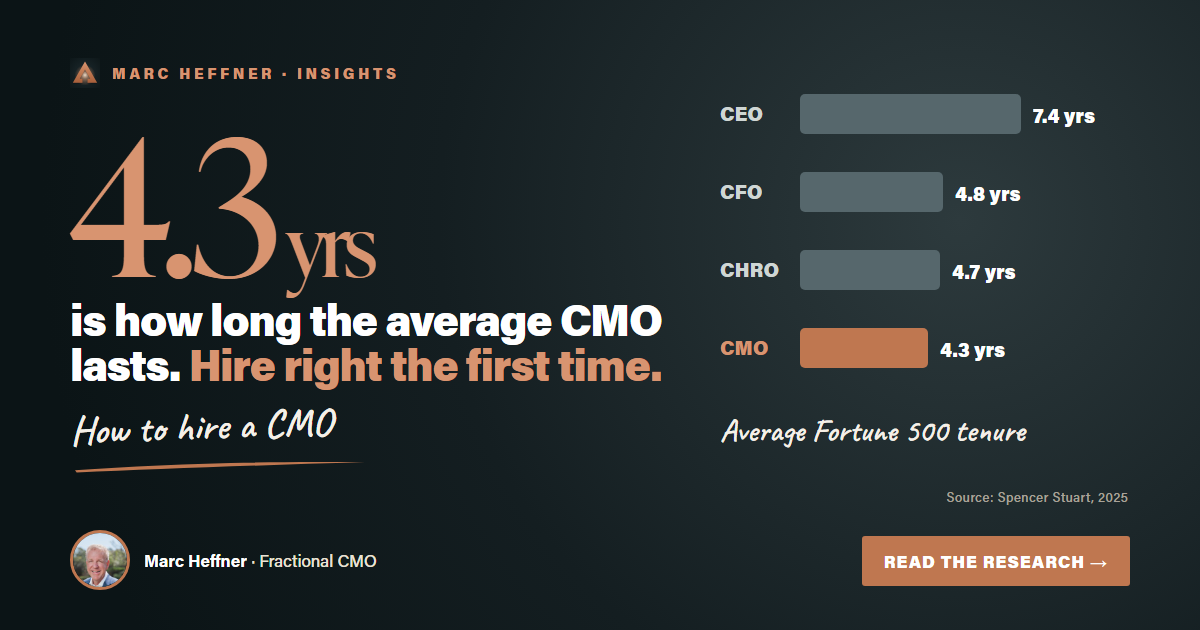
The numbers explain why CEOs are nervous. Spencer Stuart found the average Fortune 500 CMO stays 4.3 years, compared with 7.4 years for CEOs and 4.9 years across the whole C-suite (Spencer Stuart, 2025). Their 2026 study of the S&P 500 put CMO tenure at 4.1 years, and found 31% of those companies have no CMO at all (Spencer Stuart, 2026).
A big reason is role confusion. McKinsey and the ANA found that only 70% of CEOs now say marketing’s role is clearly defined, down from 90% in their earlier survey. And while 70% of CEOs judge marketing on revenue growth and margin, only 35% of CMOs track that as a top metric (McKinsey and the ANA, 2025).
Harvard Business Review reported the same pattern years earlier. In a review of 170 CMO job descriptions, only 22% said how the CMO would be measured (Whitler and Morgan, HBR, 2017). If you can’t say how the job will be judged, you can’t hire for it.
And getting any executive transition right is tough. McKinsey found that two years in, between 27% and 46% of executive transitions are seen as failures or disappointments (McKinsey, 2018).
Fractional or full-time?
A full-time CMO makes sense when marketing is large and complex: a big team, a big budget, several products or markets, and a board that expects a marketing executive in the room every day. For context, Gartner’s 2026 CMO Spend Survey puts the average marketing budget at 7.8% of company revenue (Gartner, 2026), and The CMO Survey puts it at 9.0% (Duke Fuqua, Deloitte and the AMA, 2026). If your budget is in that range and growing, a full-time leader may be the right call.
A fractional CMO makes sense when you need senior strategy and leadership now, but not five days a week. It fits when the budget isn’t there for a full executive salary, or when you aren’t sure yet what the full-time role should look like. A fractional CMO can build the plan and the team, prove what works, then help you hire the full-time leader with a clear scorecard.
More companies are choosing that path. Lightcast found about 34,000 US workers now have “fractional” in their job title, up 265% since 2019, and fractional job postings more than doubled in 2025 (Lightcast, 2026).
In a transition, like a sudden departure, an acquisition or a sale, consider an interim CMO to keep things moving while you search.
Six things to look for in a CMO
- Strategy you can understand. They should explain their plan in plain words. If you’re lost after five minutes, your team will be too.
- Comfort with numbers. Revenue, margin, customer acquisition cost, pipeline. A CMO who can’t talk P&L can’t earn the board’s trust.
- A team builder. Ask who they’ve hired and where those people are now. Great leaders leave a trail of people who grew.
- A true partner to sales. Look for shared goals, not a handoff wall.
- Real customer insight. Great CMOs talk to customers themselves, not just through research reports.
- Fluency in tools and AI. Not a coder, but someone who knows where technology pays off and where it doesn’t. The CMO Survey found AI use in marketing has more than doubled in two years (Duke Fuqua, Deloitte and the AMA, 2026).
Five interview questions that work
- “Walk me through a result you drove. What did you decide, and what would you do differently?”
- “What would you look at in your first 30 days here?”
- “Tell me about a time marketing and sales disagreed. How did you fix it?”
- “How would you report marketing results to our board?”
- “What would you stop doing here?”
Red flags
- Every answer is about tactics and channels, never customers or revenue.
- Results with no numbers, or numbers with no story behind them.
- A ready-made plan before they’ve learned your business.
- Blaming every past problem on someone else.
- No questions about your customers, margins or sales team.
Set them up to win
Agree on a 90-day scorecard before day one: what they’ll learn, what they’ll fix and which numbers they’ll move. Measure the same things the CEO cares about, usually revenue growth and margin. Give them access to customers, data and the leadership table. A CMO without a seat at the table is just an expensive campaign manager.
The bottom line
Hiring a CMO is one of the biggest bets a CEO makes. Be clear on the stage you’re in, define how the role will be measured, and don’t rush to a full-time hire before you know what you need. Sometimes the smartest first step is a fractional or interim leader who builds the foundation and helps you hire right.
Not sure which option fits your company? I’ll give you a straight answer, even if it’s not me.
Sources
- Spencer Stuart, Fortune 500 C-Suite Snapshot 2024: Profiles in Functional Leadership, 2025.
- Spencer Stuart, CMO Tenure 2026: Snapshot of an Expanding Role for Marketing Leaders, 2026.
- McKinsey & Company and the ANA, The CMO’s comeback: Aligning the C-suite to drive customer-centric growth, 2025.
- McKinsey & Company, Successfully transitioning to new leadership roles, 2018.
- Harvard Business Review (Whitler and Morgan), Why CMOs Never Last, 2017.
- Gartner, 2026 CMO Spend Survey, 2026.
- Duke Fuqua, Deloitte and the AMA, The CMO Survey, 2026, 2026.
- Lightcast, The Rise of Fractional Leadership, 2026.