 MARC
MARC
Most CEOs I meet have a logo, a tagline and a website. Fewer have a brand platform. You can usually tell. Their marketing changes direction every time they hire a new agency. The sales team rewrites the deck. The website says one thing and the trade show booth says another.
That’s not a creative problem. It’s a leadership problem. A brand platform is how leaders decide, once, who the company is. Then everyone builds on it.
What is a brand platform?
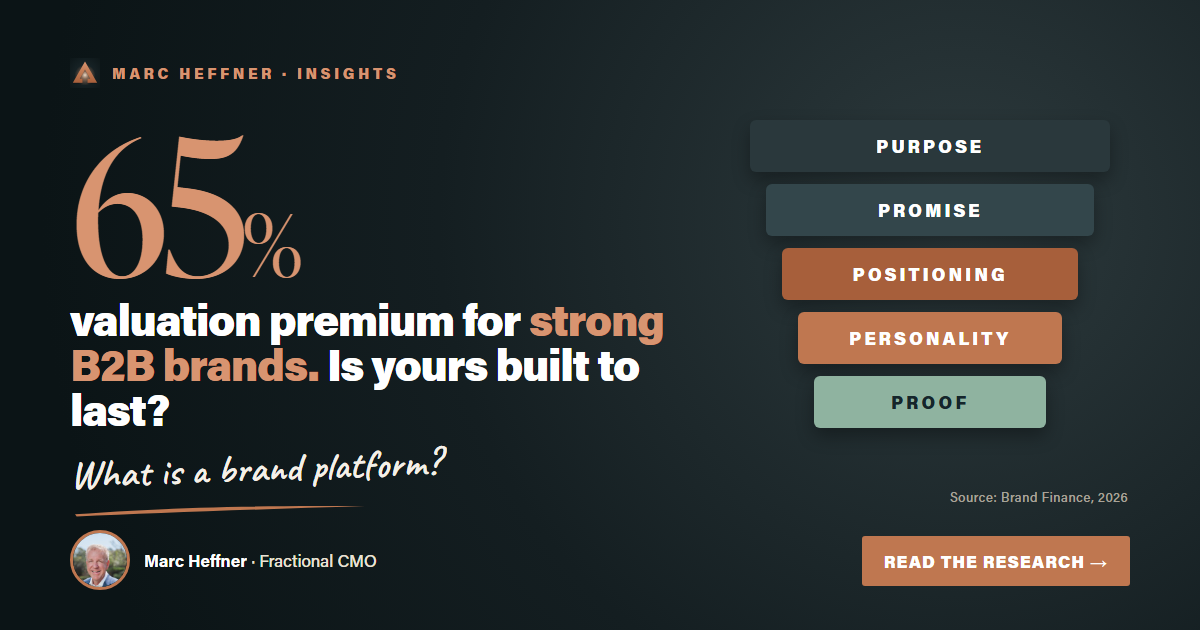
A brand platform is the short set of decisions that defines who your company is: why you exist, what you promise, who you serve and why you win, how you behave, and the proof that backs it all up. Everything else sits on top of it, from ads and product names to hiring and customer service.
It’s different from a messaging framework. The platform is who you are. The messaging framework is what you say to a specific customer. You need the platform first, or your messaging floats.
Why CEOs should care: brands are a financial asset
Some leaders still see branding as decoration. The numbers say otherwise.
- Kantar’s BrandZ research shows strong brands have outperformed both the S&P 500 and the MSCI World Index over time (Kantar, 2024).
- Brand Finance found that stronger B2B brands command a 65% premium in forward price-to-earnings ratios (Brand Finance, 2026).
- McKinsey found B2B companies with strong brands outperform weak ones by 20% (McKinsey, 2013).
If you lead a PE-backed company, that valuation premium is the whole ballgame. If you lead a manufacturer, it shows up as pricing power with distributors and preference with engineers. A brand platform is where that value starts.
The five parts of a brand platform
1. Purpose: why you exist
Purpose is why you exist beyond making money. Keep it real. “We make sure no hospital ever runs out of hot water” beats “We empower excellence through innovation” every time.
Here’s the catch. McKinsey found that 82% of employees say purpose is important, but only 42% say their company’s purpose statement actually makes a difference (McKinsey, 2021). Most purpose statements are wallpaper. Yours has to change decisions, or it’s not worth writing.
Done right, it pays. Deloitte found purpose-driven companies grow about three times faster on average than their competitors (Deloitte, 2020).
2. Promise: what customers can always count on
Your promise is the one thing you won’t break, even on a bad day. It’s the reason customers come back. For a commercial equipment maker, it might be “we answer the phone and fix it fast.” For a professional services firm, “no surprises on scope or price.”
Promises are about trust, and trust drives buying. Edelman found 81% of people say trusting a brand to do what’s right is a key reason to buy. But only about one in three trust most of the brands they use (Edelman, 2019).
3. Positioning: who you serve and why you win
Positioning answers three questions: Who is this for? What are they comparing us to? Why do we win? Good positioning makes some customers say “that’s for me” and others say “not for me.” Both are good outcomes. Trying to appeal to everyone is how brands end up sounding like everyone. If you want to go deeper, read my piece on marketing differentiation.
4. Personality: how you look, sound and act
This is your voice, your visual style and how your people treat customers. Consistency here is what makes a brand feel trustworthy. If your website is formal, your ads are goofy and your sales reps are pushy, customers don’t know who you are.
5. Proof: the evidence that it’s all true
Proof is what turns claims into belief: results, share, awards, customer names, guarantees, research. When I led marketing at Lochinvar, our brand study showed we were the top boiler brand in all five commercial markets we measured, more than double the next-best brand. That kind of proof belongs in the platform. It lets everyone lead with confidence instead of adjectives.
Brand building and sales are not either-or
A lot of leadership teams treat brand as the nice-to-have and leads as the must-have. The best research says you need both. The IPA’s landmark work by Les Binet and Peter Field found the best balance for most brands is about 60% brand building and 40% sales activation (IPA, 2013). For B2B, their work with LinkedIn put it at about 46% brand and 54% activation (LinkedIn B2B Institute, 2019).
Why? Most buyers aren’t ready to buy today. When they are, they pick the brands they already know and trust. A clear brand platform makes every brand dollar build the same memory, instead of a different one each quarter.
Signs your brand platform isn’t working
- Your sales team rewrites every deck because the official one doesn’t sound right.
- Each agency gives you a different look and message.
- Customers describe you by what you sell, not why they chose you.
- You compete mostly on price.
- New hires can’t explain what makes you different after a month.
- Your leadership team argues about who your best customer is.
If you checked two or more, your platform needs work. That’s normal. Most growing companies outgrow their brand before they notice.
How to build a brand platform
- Listen first. Talk to customers, lost prospects, employees and partners. Ask why they chose you and what would make them leave.
- Map the competition. Write down what every competitor claims. The gaps are your opportunities.
- Draft the five parts on one page. Short is good. If it doesn’t fit on a page, it won’t get used.
- Pressure-test it. Share it with your leadership team and a few trusted customers. Does it ring true? Is it different?
- Roll it out. Build your messaging framework, website, sales tools and hiring around it.
- Protect it. Make one leader the owner. Review it once a year, not every time someone gets bored.
The bottom line
A brand platform is a leadership tool, not a design project. It tells your team who you are, so they can stop guessing. It helps customers trust you. And over time, it shows up in your pricing, your pipeline and your valuation.
If your brand has drifted, or you’re heading into a launch, an acquisition or a sale, this is one of the first things I fix as a fractional CMO.
Sources
- Kantar BrandZ, Using Kantar BrandZ to make the case for long-term brand-building investment, 2024.
- Brand Finance, Strong B2B branded businesses command 65% valuation premium, 2026.
- McKinsey & Company, B2B business branding, 2013.
- McKinsey & Company, Purpose before profits? Employees say yes, please, 2021.
- IPA (Binet and Field), The next chapter for The Long and the Short of It, 2013.
- LinkedIn B2B Institute (Binet and Field), How B2B marketing really drives growth, 2019.
- Edelman, Trust Barometer Special Report: In Brands We Trust?, 2019.
- Deloitte, 2020 Global Marketing Trends, 2020.