 MARC
THE SHORT ANSWER
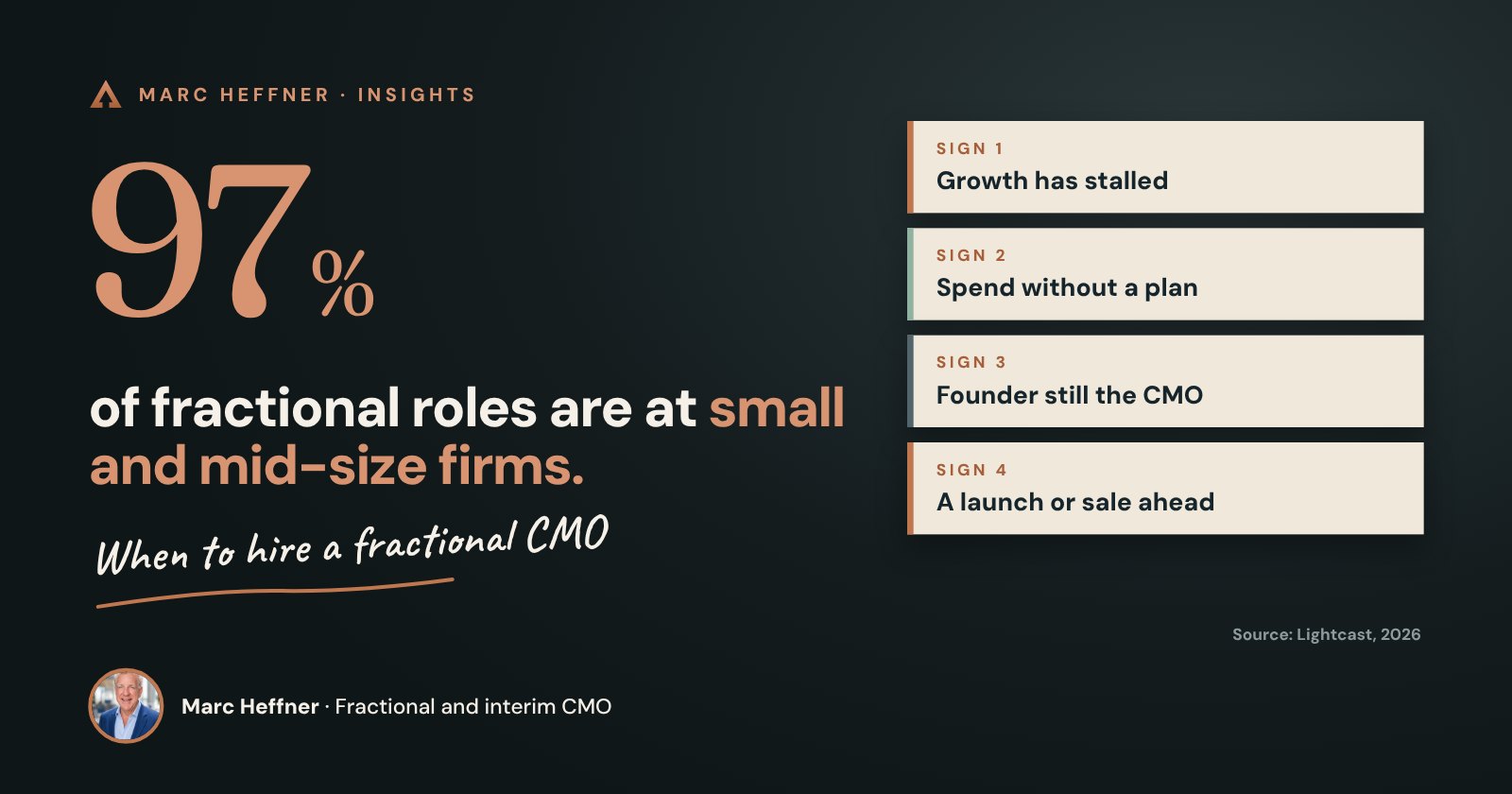
Hire a fractional CMO when marketing needs senior judgment but not a full-time executive. The clearest signs: growth has stalled, you’re spending without a plan, the founder is still acting as CMO, or a launch, raise or sale is coming. If the plan is already clear and you just need hands, hire a doer instead.
Most CEOs don’t wake up and decide to hire a CMO. They notice something’s off. Leads are flat. The agency is busy, but nothing moves. A big launch is coming, and no one owns it. Here’s how to tell when that feeling means it’s time for a fractional CMO.
The 7 signs it’s time
1. Growth has stalled, and no one can say why
Sales are flat or slipping. Everyone has a theory. No one has a plan. A fractional CMO starts with the numbers, finds where buyers drop off and fixes the biggest leak first.
2. You’re spending on marketing without a plan
You pay for ads, an agency, maybe a trade show, but no one can tie the spend to revenue. You’re not alone. McKinsey and the ANA found 70% of CEOs judge marketing on revenue and margin, but only 35% of CMOs track that as a top metric (McKinsey and ANA, 2025). Someone needs to close that gap.
3. The founder is still the CMO
In a lot of growing companies, the CEO or founder still makes every marketing call. That works for a while. Then it becomes the bottleneck. A fractional CMO takes that load off without a full-time hire.
4. A launch, raise or sale is coming
Big moments need senior help for a set stretch of time: a product launch, a new market, a funding round or getting ready to sell. You want an executive for the next 6 to 12 months, not forever.
5. Your team is good, but no one is leading it
You have a coordinator, a designer, maybe a manager. They’re busy and capable. But they’re taking orders, not setting direction. A fractional CMO gives them a plan and coaches them up.
6. Sales and marketing don’t agree
Sales says the leads are bad. Marketing says sales doesn’t follow up. Someone has to set shared goals and settle it with data.
7. You need a CMO but aren’t ready for a full-time one
Maybe the budget isn’t there yet, or you’re not sure what the role should be. A fractional CMO can do the job now and help you hire the full-time leader later.
When a fractional CMO is the right size
It comes down to two questions. How much senior judgment do you need? And how many hours a week? If you need a lot of judgment but not a full week, that’s the fractional sweet spot.
You’re in good company. Lightcast found postings for fractional leaders more than doubled in 2025, and 97% came from small and mid-size companies (Lightcast, 2026). Growing companies are learning they can get senior help without a full-time hire.
3 signs it’s not time yet
- There’s no budget to act on a plan. A strategy with no money behind it just sits on a shelf.
- You need hands, not direction. If the plan is clear and working, hire a doer or an agency.
- You need someone in the building every day to run a big team. That’s a full-time CMO or VP job.
I’ll tell you straight if one of these fits. It’s better for both of us.
What happens after you hire one
A good fractional CMO starts by listening. In the first few weeks, I look at the numbers, talk to sales and customers and find the one or two things holding growth back. Then we build a plan and start working it. The point is momentum, fast.
That’s how big results start. At Lochinvar, I led the product and marketing teams that launched the FTXL boiler, and it took 42% of its category in 15 months. See more results.
Questions CEOs ask
How do I know if I need a fractional CMO or a full-time CMO?
Look at hours and team size. If you need senior strategy a few days a week, go fractional. If you need someone running a large team every day, you need full time.
How early is too early?
If you don’t yet have a product people buy, or any budget to act on a plan, it’s probably too early. Once you have real customers and want to grow on purpose, it’s not.
How long do companies keep a fractional CMO?
Often 6 to 18 months. Some stay longer. Others use the time to build a team and hire a full-time leader.
Can a fractional CMO work with my agency?
Yes. Most do. The CMO sets the direction, and the agency makes the work.
What should I have ready before I call one?
Your sales numbers, what you spend on marketing and what you want to be true a year from now. That’s enough to start.
The bottom line
Hire a fractional CMO when marketing needs senior judgment, but not a full-time executive. Stalled growth, spend without a plan, a founder stuck in the CMO seat or a big moment ahead are the clearest signs. If a few sound familiar, let’s talk.
Sources
- McKinsey & Company and the ANA, The CMO’s comeback: Aligning the C-suite to drive customer-centric growth, 2025.
- Lightcast, The Rise of Fractional Leadership, 2026.