 MARC
“So what would you actually do all week?” A CEO asked me that on our first call. Fair question. The title sounds vague. Part-time executive? Consultant? Agency guy? None of those is quite right. So here’s the plain answer, based on how I run these engagements.
What is a fractional CMO?
A fractional CMO is a senior marketing executive who leads your marketing part time. Usually one to three days a week. You get the strategy, the leadership and the accountability of a chief marketing officer, without the full-time salary. It’s a real seat on your leadership team, not a project.
That second column matters. If you want someone to write every post and run every ad, you want a marketing manager or an agency. If you want someone to decide what those posts and ads should be for, and to be on the hook for the results, you want a CMO. The fractional part only changes how many days a week you pay for.
The six things I own
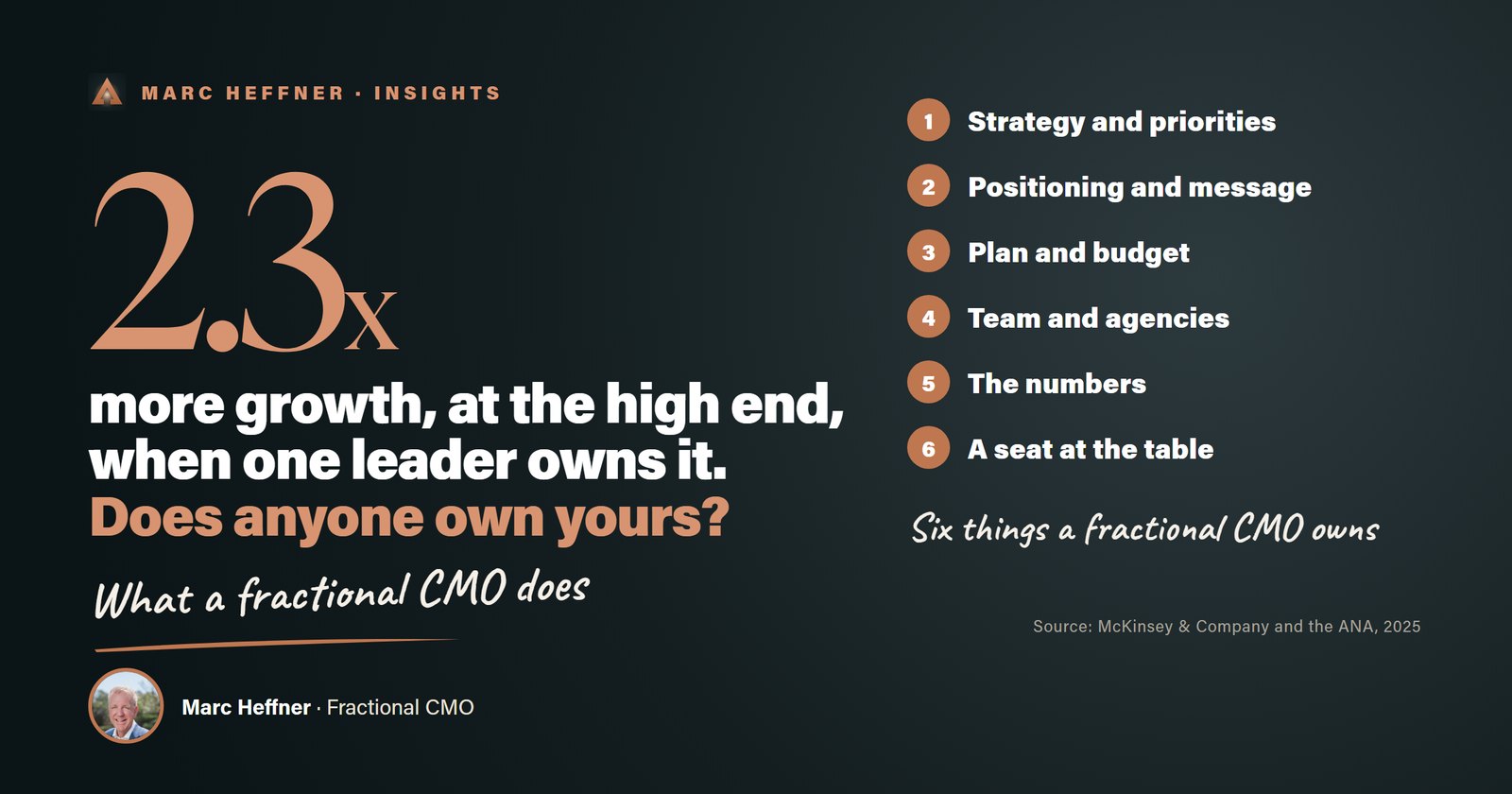
1. The strategy
Who we sell to, what we promise them and why they should believe us. Most companies I walk into have a lot of activity and no clear answer to those three questions. That’s the first thing I fix. It usually fits on one page.
2. The message
Once the strategy is set, I make sure everyone says the same thing. Sales, the website, the trade show booth, the CEO on a podcast. One story. I’ve written about how I do that in how to build a messaging framework.
3. The plan and the budget
What we’ll do this quarter, what it costs and what it should return. I’d rather run five things well than fifteen things badly. The budget follows the plan, not the other way around.
4. The team and the agencies
Your marketing people need a leader who can coach them and clear the road for them. Your agencies need a client who gives clear direction and holds them to results. I do both. Often the first win is simply getting three vendors to stop pulling in three directions.
5. The numbers
I build the dashboard the CEO cares about. Leads, pipeline, cost per customer, revenue tied back to marketing. Then I review it every week. No slide decks full of impressions. Numbers the CFO would sign off on.
6. The seat at the table
I sit in the leadership meeting. I hear what sales is seeing and what operations is struggling with. Marketing that lives in its own corner never works. This is the part a consultant can’t give you.
What a week actually looks like
One thing to clear up first. Fractional doesn’t mean part-time attention. I’m available to my clients Monday through Friday. The “two days” are the days I’m in the business, in the meetings, with the team. The other three I’m on call for decisions, questions and anything that can’t wait. Here’s a normal week.
Monday. Leadership meeting. I report on pipeline and what marketing shipped last week, and I listen for what sales needs next. Then a pipeline review with the sales leader. Which leads turned into meetings? Which campaigns are producing junk? We adjust spend right there.
Tuesday. Team time. One-on-ones with the marketing manager and the coordinator. Agency call to review the next campaign. I kill one idea, approve two and ask for a rewrite on the third.
Wednesday and Thursday. On call. If the sales leader needs a decision on a trade show, or the agency needs a yes on creative, they get it the same day. I also use this time for the thinking work: the strategy page, the message, the plan.
Friday. Numbers. I check the dashboard, note what moved and send a short Friday update to the CEO. Three bullets, no deck.
One rule I keep: at least one customer conversation every week. A sales call, a lost deal review, a support ticket read out loud. McKinsey and the ANA (the Association of National Advertisers) found only 15% of companies consistently bring customer input into their decisions (McKinsey and the ANA, 2025). That gap is where most marketing problems start.
The first 120 days
My first engagement with a client is 120 days. Ninety days to build and prove, then 30 days to decide together whether to step up to a longer engagement. I’d rather earn the long contract than ask for it up front. Here’s how the time breaks down.
Days 1 to 30: learn and fix the leaks. I talk to customers, read the data, meet the team and look at where the money goes. I almost always find waste in the first two weeks: a vendor nobody manages, a campaign nobody measures, leads nobody calls back. I stop that bleeding right away.
Days 31 to 60: decide. The one-page strategy. The message. The 90-day plan with a budget. A scorecard the CEO and I both agree on. This is where I earn the title.
Days 61 to 90: execute and prove. Campaigns are live. The dashboard is running. We share the first results, good and bad, with the leadership team.
Days 91 to 120: review and decide. We look at the scorecard together. What moved, what didn’t and what the next six to twelve months should look like. If the numbers are there, we extend. If they aren’t, you’ve lost four months, not a year and a search fee.
Here’s a real example. At a 14-office dental group, I found in the first month that the phones were the problem, not the ads. Patients called and nobody answered. We fixed the call handling and tracked it. Missed calls fell 91% and answered calls grew 72%. Not one new ad. That’s what “fix the leaks” means.
Why more companies are doing this
This used to be unusual. Not anymore. Lightcast counted about 34,000 US workers with “fractional” in their title in 2025, up 265% since 2019. Fractional job postings more than doubled in 2025, and the first seven months of 2026 already passed all of 2025 (Lightcast, 2026).
And it’s a mid-market thing. In 2026, 97% of fractional postings came from small and medium companies (Lightcast, 2026). That makes sense. A company doing $10 million to $100 million in revenue needs executive-level marketing thinking. It often doesn’t need, or can’t justify, a full-time executive salary. Gartner’s 2026 survey puts the average marketing budget at 7.8% of revenue, and half of CMOs work with 6% or less (Gartner, 2026). At that size, a full-time CMO can eat a big chunk of the whole budget.
The problem I usually walk into
The companies that call me almost always have the same issue. Nobody agrees on what marketing is for.
McKinsey and the ANA found that only 70% of CEOs now say marketing’s role is clearly defined, down from 90%. And while 70% of CEOs judge marketing by revenue growth and margin, only 35% of CMOs track that as a top metric (McKinsey and the ANA, 2025). Think about that. Most marketing leaders are being graded on a test they aren’t studying for.
It goes back further than that. When Harvard Business Review reviewed 170 CMO job descriptions, only 22% said how the CMO would be measured (Whitler and Morgan, HBR, 2017). You can’t hit a target nobody wrote down.
So the first real deliverable of a fractional CMO isn’t a campaign. It’s agreement. What marketing owns, what it’ll be measured on and what good looks like in 90 days. I write that down with the CEO in week one.
There’s a payoff for getting this right. McKinsey found companies with one clear owner of growth see up to 2.3 times more growth than companies that spread it across several roles (McKinsey and the ANA, 2025). One owner. One scorecard.
What you should expect to see
If you hire a fractional CMO and don’t see these within a quarter, ask hard questions.
- A one-page strategy you could explain to your board.
- A messaging framework your sales team actually uses.
- A 90-day plan with a budget and a reason for every line.
- A dashboard that connects marketing to pipeline and revenue.
- Clear direction for the team and agencies, and fewer vendors than you started with.
- Weekly presence in your leadership meeting, with opinions.
What you shouldn’t expect: a 60-page deck, a rebrand in month one or a promise that everything will double. Anyone who promises that hasn’t seen your data yet.
A second example: when the leak is the website
At Rahn Industries, a manufacturer, the sales team told me the web leads were worthless. They were half right. The leads were real, but the website asked for a quote and then sent the request into a shared inbox that nobody owned. By the time someone replied, the buyer had moved on.
We rebuilt the site around the quote request and gave every lead an owner and a clock. Web quotes went from closing 2.2% of the time to 16.6%, and the team worked 449 warm leads in six months. Same traffic, same salespeople, seven times the close rate. None of that was a marketing campaign in the usual sense. It was a leadership decision about who owns a lead and how fast we answer it. That’s the kind of decision a fractional CMO is there to make.
How to get the most out of a fractional CMO
The engagements that work best share a few habits on the company side, and they’re easy to set up.
- Give real authority. If I can’t redirect budget or change an agency without three approvals, I’m a consultant with a nicer title.
- Put me in the room. Leadership meetings, sales meetings, board prep. The best marketing insight usually comes from a conversation that wasn’t about marketing.
- Share the numbers. Revenue by product, margin by customer, pipeline by source. I can’t tie marketing to money I can’t see.
- Agree on the scorecard early. Three to five numbers we both watch, reviewed every month without fail.
- Expect candor. Part of what you’re paying for is someone who’ll say the campaign isn’t working, or that the product has a problem marketing can’t fix.
What a fractional CMO is not
Not a consultant. A consultant gives you a plan and leaves. I give you a plan and then run it with your team.
Not an agency. Agencies make things. They’re great at that. They’re not built to decide your strategy or manage your other agencies.
Not a marketing manager. A manager runs campaigns. A CMO decides which campaigns deserve to exist, and answers to the CEO for the result.
Not an interim CMO. Interim is full time for a short stretch, usually while you search or go through a sale. Fractional is part time for the long run.
When it stops being the right answer
A good fractional CMO should tell you when you’ve outgrown them. The signs: marketing decisions are stacking up between visits, the team has grown past eight or ten people, or the board wants a marketing executive in the room every day. At that point I help you hire the full-time person and hand off cleanly. I’ve written more on that choice in fractional CMO vs. full-time CMO.
One more data point. The average CMO in the S&P 500 lasts about four years, and 31% of those companies changed their CMO in a single year (Spencer Stuart, 2026). Executive hires are hard to get right across the board. McKinsey found that 27% to 46% of executive transitions are judged a failure or a disappointment after two years (McKinsey, 2018). A fractional engagement is a low-risk way to learn exactly what you need before you make the big hire.
Questions CEOs ask
How many days a week do I get?
Most engagements run one to three days in the business each week, and I’m available Monday through Friday for decisions and questions. We set the days by how many decisions marketing needs, not by how busy the calendar looks, and we can change it as the business changes.
How long is a typical engagement?
My first engagement is 120 days: 90 days to build and prove, then 30 days to review the scorecard and decide together whether to extend. Most clients then step up to a six- or twelve-month engagement.
Who manages my agencies?
I do. Giving them clear direction and holding them to results is one of the biggest wins in the first 90 days.
Does a fractional CMO do the hands-on work?
Some, when it’s fast and it matters. But my job is to lead the work, not to be the whole team. If you have no team at all, we’ll talk about what execution capacity you need first.
How is this different from a consultant?
A consultant hands you a plan. I own the plan and the results, sit on your leadership team and run marketing with your people every week.
The bottom line
A fractional CMO owns your marketing strategy, message, plan, team, numbers and a seat at your leadership table, available every weekday and in the business a few days a week. The first 120 days should produce agreement on what marketing is for, a plan you can read in five minutes and results you can measure. If that sounds like what’s missing, let’s talk.
Sources
- McKinsey & Company and the ANA, The CMO’s comeback: Aligning the C-suite to drive customer-centric growth, 2025.
- Lightcast, The Rise of Fractional Leadership, 2026.
- Gartner, 2026 CMO Spend Survey, 2026.
- Spencer Stuart, CMO Tenure 2026: Snapshot of an Expanding Role for Marketing Leaders, 2026.
- Harvard Business Review (Whitler and Morgan), Why CMOs Never Last, 2017.
- McKinsey & Company, Successfully transitioning to new leadership roles, 2018.