 MARC
THE SHORT ANSWER
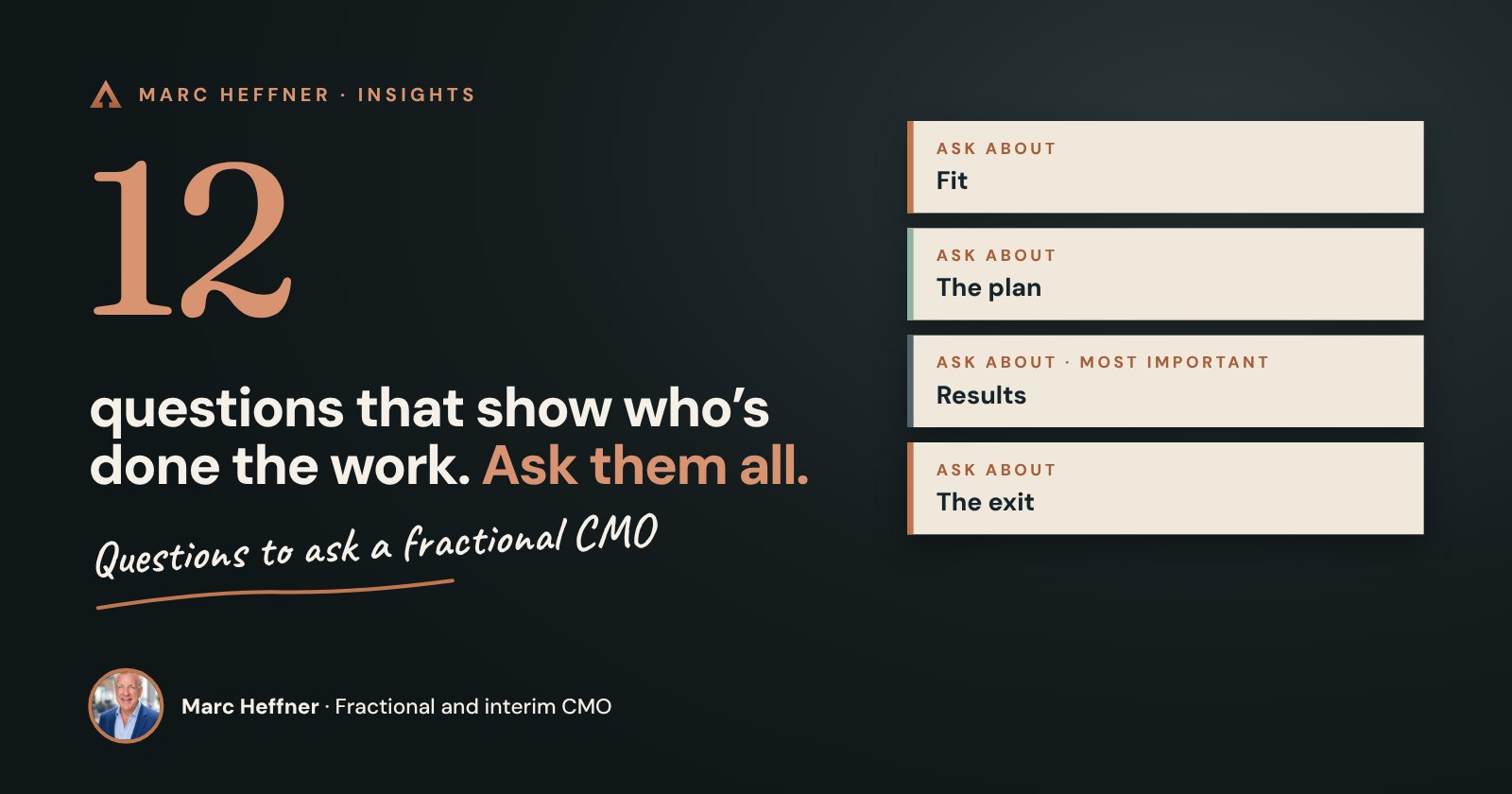
Ask about four things: fit, plan, results and exit. Has this person solved your exact problem before? What will they do in the first 30 days, and who does the work? What will they measure? How does it end, and what do you keep? Push for real stories, not years of experience. Stories tell you far more.
When you’re hiring a fractional CMO, the interview is where you find out who’s done the work. Here are the 12 questions I’d ask if I were in your seat. They’re grouped into four buckets, with what a good answer sounds like.
Fit: have they solved your problem?
- Tell me about a company like mine you’ve helped. What changed?
A good answer: a specific story with a before and after, a close match to your industry, size or problem, and a number that moved. - What would you do if you were me right now?
A good answer: questions first. A good CMO wants to see your numbers before giving advice. - Who’s a bad fit for you?
A good answer: a clear, quick answer. People who know their strengths know where they don’t fit.
Why stories and not years? A large review of hiring research found years of experience, on its own, is a weak predictor of how someone will perform (Schmidt and Hunter, 1998). What someone has actually done, and how they talk about it, tells you more.
Plan: what happens first, and who does it?
- What will you do in the first 30 days?
A good answer: listen, learn the numbers, talk to sales and customers, then name one or two priorities. - Who does the work: you, my team or someone else?
A good answer: a clear split of what they do, what your team does and what goes to an agency. - How many days a week will I get, and how do I reach you?
A good answer: a set schedule, a response time and how they handle urgent things.
Results: what will they measure?
- What will you measure, and how often will we look at it?
A good answer: revenue, pipeline and a few leading numbers, reviewed every month. Not just clicks. - When should I expect to see results?
A good answer: an honest range. Some quick wins in the first 90 days, bigger results over 6 to 12 months. - Tell me about a time something didn’t work.
A good answer: a real miss, what they learned and what they changed.
This bucket matters most. McKinsey and the ANA found only 35% of CMOs track revenue and margin as a top metric, even though 70% of CEOs judge marketing that way (McKinsey and ANA, 2025). Make sure the person you hire measures what you care about.
At Rahn Industries, we tracked web quotes all the way to closed sales. Rebuilding the website and lead flow took them from closing 2.2% of the time to 16.6%. See more results.
Exit: how does it end?
- How does this end?
A good answer: a clear end date or check-in point, and no long lock-in. - What do I keep when you leave?
A good answer: the plan, the dashboards, the playbooks and a team that can run them. - Will you help me hire my next marketing leader?
A good answer: yes, with a hiring scorecard, interviews and an onboarding plan.
A good fractional CMO is building toward the day you don’t need them as much. If they can’t describe that day, keep looking.
How to use these questions
Ask every candidate the same questions, and write down the answers. Then call two or three references and ask a few of the same ones. Reference checks predict job performance better than years on a resume (Schmidt and Hunter, 1998). It only takes a few calls.
Questions CEOs ask
How many fractional CMOs should I interview?
Two or three is usually enough if you ask each one the same questions. More than that and they start to blur.
Should I ask for a sample plan?
Ask how they’d approach your first 30 days. Don’t ask for a full free plan. A good CMO needs your data to build a real one.
What’s the biggest mistake in these interviews?
Hiring for a big logo on the resume instead of a match to your problem. Ask for stories about companies like yours.
Should I check references?
Yes. Ask what changed while they were there and whether they’d hire them again.
What if they can’t answer a question?
That’s useful too. An honest “I don’t know yet” is fine. Vague or slick answers aren’t.
The bottom line
Ask about fit, plan, results and exit. Push for real stories and clear numbers. The right fractional CMO will welcome hard questions. If you want to practice them on me, let’s talk.
Sources
- Schmidt and Hunter, Psychological Bulletin, The Validity and Utility of Selection Methods in Personnel Psychology: Practical and Theoretical Implications of 85 Years of Research Findings, 1998.
- McKinsey & Company and the ANA, The CMO’s comeback: Aligning the C-suite to drive customer-centric growth, 2025.