 MARC
When someone asks me what a fractional CMO costs, I could say “it depends” and leave it there. That’s a cop-out. You deserve real numbers and a clear picture of what moves them. So here they are.
How much does a fractional CMO cost?
A fractional CMO is priced as a monthly retainer tied to days per week. Published rate cards in the US mostly land between a few thousand dollars a month for one day a week and the low tens of thousands a month for three days with a full scope. The short version: for one to three days a week, expect roughly a fifth to a little over half of what a full-time CMO costs, with no search fee and no severance.
That’s the answer. The rest of this article is about what you’re comparing it to, what drives the number up or down, what’s included, and how to tell whether you’re getting value.
Start with the number you’re comparing against
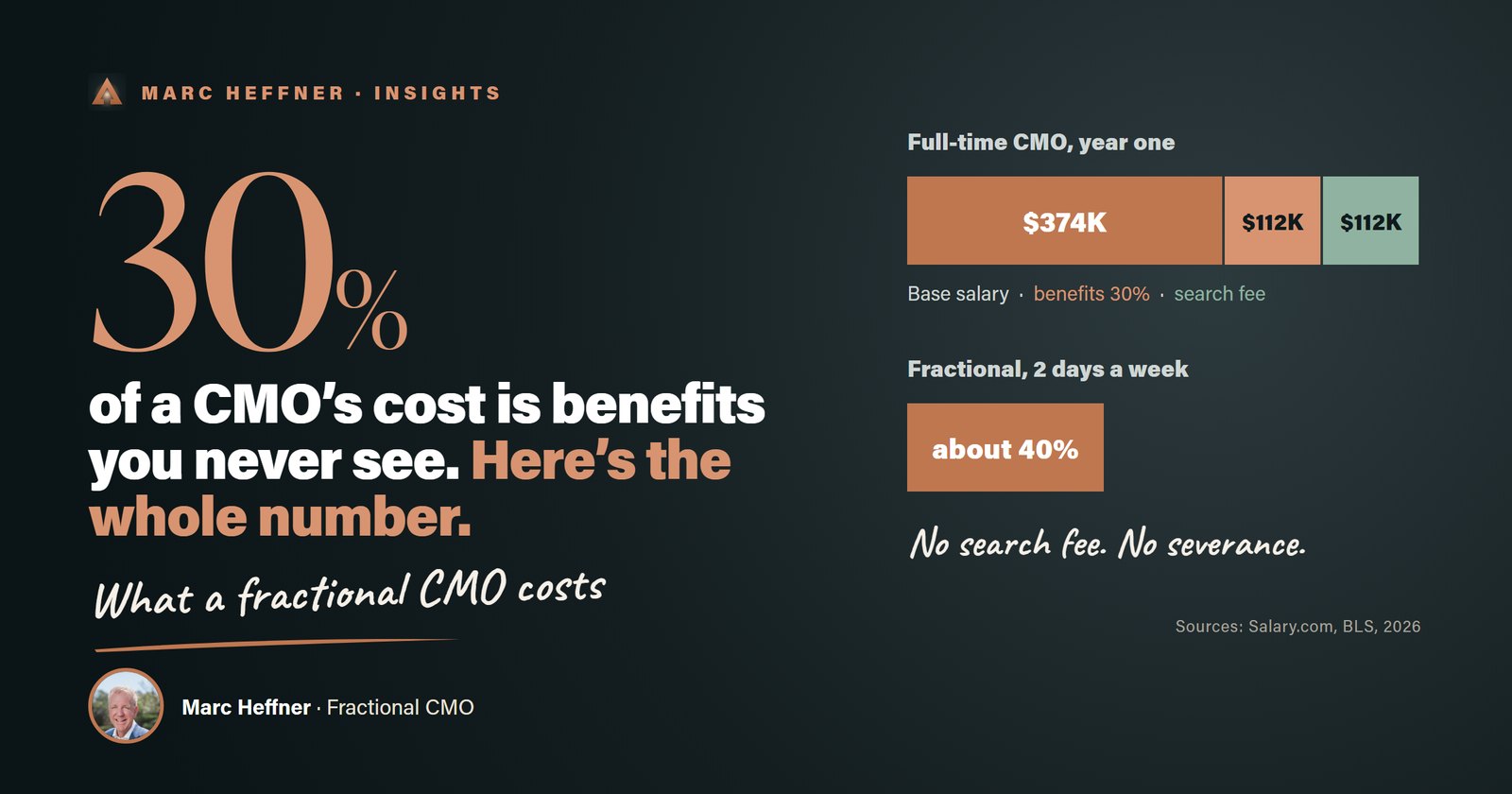
Salary.com puts the median US chief marketing officer base salary at about $374,000, with the middle half between $336,000 and $418,000 (Salary.com, 2026). That’s before anything else.
Benefits add about 30%. The Bureau of Labor Statistics reports benefits make up 30.0% of total compensation for private-industry workers (BLS, June 2026). Health insurance, retirement match, payroll taxes, paid time off. On a CMO salary, that’s roughly $110,000 more.
Then there’s finding the person. Retained executive search firms typically charge 25% to 35% of first-year compensation, with minimums of $75,000 to $100,000 at top firms (The Good Search, 2026). Call it another $110,000.
Add it up and a full-time CMO runs close to $600,000 in year one. Bonus and equity push it higher. And none of that is marketing budget. It’s just the leader.
Now put that next to the marketing budget. Gartner’s 2026 survey found the average company spends 7.8% of revenue on marketing, and half of CMOs work with 6% or less (Gartner, 2026). For a $25 million company, that’s roughly $1.5 million to $2 million total. A full-time CMO would eat a third of it before a single campaign runs. That’s the math that sends mid-market CEOs to fractional.
How fractional pricing works
Fractional CMOs price by time and scope, not by project. The usual shape:
- One day a week. Strategy, the monthly plan, a weekly leadership check-in. Good for a company with a strong manager who needs direction. Whatever the day count, you should be able to reach your fractional CMO Monday through Friday.
- Two days a week. The most common setup. Strategy plus leading the team and agencies, the dashboard and a seat in the leadership meeting.
- Three days a week. Close to a full operating role: everything above plus hiring, launches and heavy sales support. Often a bridge to a full-time hire.
Some fractional CMOs quote hourly. I don’t, and I’d be careful with anyone who does. Hourly rewards slow work. A retainer tied to days and deliverables rewards getting things done.
The index chart above is a fair guide. One day a week lands around a fifth of a full-time CMO’s loaded cost. Two days is roughly 40%. Three days is a little over half. And there’s no $110,000 search fee at the front, no severance at the back.
What drives the price up or down
Days per week. Obvious, but it’s most of the number. Two days costs about twice one day.
Scope. “Strategy and a monthly review” is a smaller job than “strategy, plus manage two agencies, coach three people and own the pipeline dashboard.” Name the scope first, then price it.
Seniority and track record. Someone who has run marketing for a public company, launched products at scale or led a turnaround will cost more than a first-time CMO. Usually worth it, if the experience matches your problem.
Industry fit. A leader who already knows your buyers, your channel and your trade shows saves you six months of learning. That’s worth a premium. A leader who has never sold through distributors will cost you that six months, however cheap the rate.
Term. A six-month or annual agreement usually prices lower per month than month to month. Both sides can plan. My own engagements start at 120 days, long enough to prove results, and most clients step up to a longer term from there.
What’s in the retainer, and what isn’t
A fractional CMO retainer covers the leader’s time and judgment: strategy, positioning and message, the plan and budget, direction of the team and agencies, the dashboard and the monthly review, leadership meetings, and help hiring the team.
It does not cover the work itself. Ad spend, agency fees, design and video, marketing software, a coordinator. Those are separate lines, exactly as they would be with a full-time CMO. A good fractional CMO usually lowers those lines in the first quarter by cutting vendors that aren’t producing and spend that isn’t tracked. I’ve rarely walked into a company and not found money to save in the first 30 days.
One more thing the retainer doesn’t include: a team. If you have no marketers at all, budget for at least one strong manager or coordinator. Otherwise you’re paying executive rates for someone to schedule social posts.
How to judge value, not just price
Price only matters next to results. Here’s how I’d judge whether a fractional CMO is worth it.
Tie the retainer to a number the CEO already watches. McKinsey and the ANA (the Association of National Advertisers) found 70% of CEOs judge marketing on revenue growth and margin (McKinsey and the ANA, 2025). So pick a revenue-linked measure: qualified pipeline, close rate on marketing leads, revenue from new customers. Agree on it in week one.
Expect the first wins to come from fixing leaks, not from new spend. At a 14-office dental group, the first thing I fixed was the phones. Missed calls fell 91% and answered calls grew 72%, with no new ad budget. At Rahn Industries, a manufacturer, we rebuilt the website around quote requests. Web quotes went from closing 2.2% of the time to 16.6%, seven times better, with the same traffic. Those kinds of results pay for a retainer many times over, and they show up in the first quarter.
Count what you stop spending. Vendors you drop, software nobody used, campaigns with no tracking. I’d be surprised if a good fractional CMO didn’t find their own retainer in waste within 90 days.
The cost of not deciding
There’s a third option CEOs rarely price: doing nothing. Keeping the CEO as the part-time CMO. Letting agencies set the strategy. Hoping the manager grows into it.
That option has a cost too. Gartner found labor’s share of marketing budgets rose from 21.9% to 24.5% in one year (Gartner, 2026). You’re already paying for people. Without a leader, they do more activity and less of what matters. McKinsey and the ANA found only 30% of CMOs believe their company has a clear view of marketing ROI (McKinsey and the ANA, 2025). Without someone who owns that question, you’re spending 6% to 8% of revenue and can’t say what it returns.
And if you jump straight to a full-time hire to solve it, remember the risk: McKinsey found 27% to 46% of executive transitions are judged a failure or a disappointment after two years (McKinsey, 2018). A wrong full-time hire can cost a year and a second search fee. A wrong fractional hire costs a month’s notice.
Three companies, three price points
Real numbers depend on scope, so here are three shapes I see often. The dollar ranges are illustrative, not quotes.
A $12 million services company with one marketing coordinator. They need a strategy, a message and someone to direct two agencies. One day a week does it. Expect the low end of the range. The first deliverable is usually cutting one of the two agencies.
A $40 million manufacturer with a marketing manager and a trade show calendar. They need pipeline, distributor programs and a dashboard the CFO trusts. Two days a week. Mid-range. This is the most common engagement I run, and the one where the retainer most often pays for itself in waste found during the first quarter.
A $90 million multi-location healthcare group preparing for a sale. They need a clean marketing story for buyers, fixed patient flow and a team that can run without the founder. Three days a week for nine months, sometimes as an interim CMO. Top of the range, and still well under a full-time hire plus search fee.
Notice what sets the price in each case. Not the company’s revenue. The number of decisions, the size of the team and how fast things need to move.
Fractional vs. interim pricing
People mix these up. Fractional is part time for the long run, priced monthly by days per week. Interim is full time for a short stretch, usually three to nine months, during a search, a sale or a sudden departure. Interim is priced closer to a full-time monthly cost, because it is one, but with no search fee, no benefits load and a clear end date. If your problem has a deadline, interim may be the better buy even at a higher monthly number.
A simple scope sheet
When you compare proposals, put them on the same page. Mine has seven rows:
| Row | What to write down |
|---|---|
| Days per week | And which days. Yours should be predictable. |
| Monthly retainer | One number. Ask what would change it. |
| Deliverables by day 90 | Strategy page, message, plan and budget, dashboard, team direction. |
| Authority | What they can decide alone: budget moves, agency changes, campaign calls. |
| Who they lead | Named people and agencies. |
| Review rhythm | Weekly check-in, monthly scorecard review. |
| Exit | Notice period and what gets handed over. |
Two proposals with different prices often look very different on this sheet. The one with more days, clearer authority and named deliverables is usually the better deal, even when it costs more.
Questions CEOs ask
Is a fractional CMO cheaper than an agency?
They do different jobs. An agency makes things. A fractional CMO decides what to make and holds the agency to it. Most companies need both, and a good fractional CMO usually makes the agency spend work harder.
Can I start small and grow?
Yes. Many engagements start at one or two days a week. Mine start as a 120-day engagement so we can prove results before committing to a longer term. The scope sheet makes changes easy.
What about a fractional CMO plus a VP of Marketing?
That combination often costs less than one full-time CMO and gives you both executive strategy and a full-time operator. It’s a strong setup for companies between $20 million and $100 million.
Do you charge hourly?
No. I work on a monthly retainer tied to days per week and named deliverables. You always know the number.
The bottom line
A full-time CMO costs about $600,000 in year one before bonus or budget. A fractional CMO at one to three days a week costs roughly a fifth to a little over half of that, with no search fee and no severance. Days per week, scope, seniority, fit and term set where you land. Judge the price against a revenue number you already watch, and expect the first wins to come from fixing leaks. Let’s talk if you want a real quote for your situation.
Sources
- Salary.com, Chief Marketing Officer Salary in the United States (as of October 1, 2026), 2026.
- U.S. Bureau of Labor Statistics, Employer Costs for Employee Compensation, June 2026, 2026.
- The Good Search, Executive Search Firm Fees and Pricing: The Definitive Guide, 2026.
- Gartner, 2026 CMO Spend Survey, 2026.
- McKinsey & Company and the ANA, The CMO’s comeback: Aligning the C-suite to drive customer-centric growth, 2025.
- McKinsey & Company, Successfully transitioning to new leadership roles, 2018.
- Lightcast, The Rise of Fractional Leadership, 2026.