 MARC
Most CEOs ask me this the wrong way. They ask which one is cheaper. The better question is which one fits the number of decisions your marketing needs each week, the size of the team and the stage of the company. Get that right and the cost question answers itself.
What’s the difference?
A full-time CMO is a salaried executive who runs marketing five days a week, builds and manages a team, and usually carries a big budget.
A fractional CMO is the same level of executive, working for you one to three days a week on a retainer. Same seat at the leadership table. Same accountability for results. Fewer days.
Both are leaders, not doers. If what you need is more hands, neither one is the answer. You need a manager and an agency. I covered what the job actually includes in what a fractional CMO actually does.
Count decisions, not days
Here’s the test I use. Write down the marketing decisions that came up last month that needed an executive. Not “should we post this,” but “should we enter this market,” “should we fire this agency,” “why did pipeline drop,” “what do we tell the board.”
If you count five or six a month, a fractional CMO handles that with room to spare. If you count five or six a day, you need someone there every day. Most companies between $10 million and $100 million in revenue land in the first group. They just don’t know it, because nobody has been making those decisions at all.
When fractional fits
Fractional tends to be the right call when:
- You have no marketing strategy owner. Campaigns happen, but nobody decides why.
- Your team is small. One to five marketers, plus agencies. They need a leader, not a department head.
- The budget is real but not huge. Gartner puts the average marketing budget at 7.8% of revenue, and half of CMOs work with 6% or less (Gartner, 2026). On a $30 million company, that’s about $2 million. A full executive salary would be a quarter of it.
- You need someone now. A retained search for a CMO can take four to six months. A fractional CMO can start in two weeks, and you’re reachable Monday through Friday from day one.
- You’re not sure what the role should be yet. Fractional lets you find out with real data before you write a full-time job description.
Lightcast found 97% of fractional postings in 2026 came from small and mid-size companies, and only 0.3% of fractional workers list a Fortune 1000 employer (Lightcast, 2026). That’s not a knock on fractional. It’s a sign of who it’s built for.
When full-time is the stronger choice
Don’t let anyone sell you fractional when you need a full-time leader. Full-time wins when:
- Marketing is big. Ten or more marketers, several agencies, multiple products or regions.
- Decisions pile up daily. Pricing, launches, PR, partnerships, all landing at once.
- The board expects an executive in the room every day. Especially in public companies or late-stage private equity.
- Brand is the business. Consumer companies where marketing is the main growth engine usually need a full-time owner.
- You’re building a marketing culture from scratch across hundreds of employees. That’s a full-time job.
In those cases, a fractional CMO can still help as a bridge while you search, or as an interim CMO during a transition. But the destination is a full-time hire.
Execution capacity changes the answer
Here’s the part people skip. A CMO of either kind leads the work. Somebody still has to do it. Before you pick a model, be honest about who will write the emails, build the pages, run the ads and manage the trade show.
If you have a capable manager and a decent agency, a fractional CMO plugs in on top and the whole thing hums. If you have nobody, a full-time CMO will spend the first six months doing manager work at an executive salary, and a fractional CMO will spend two days a week trying to lead a team that doesn’t exist. In that case, hire the manager first or at the same time. The best setup I see in growing companies is one strong marketing manager, one or two good agencies and a fractional CMO who directs all of them.
Gartner’s data shows why this matters more every year. Labor’s share of marketing budgets rose from 21.9% to 24.5% in one year, while the share going to marketing technology fell from 26.6% in 2021 to 19.4% (Gartner, 2026). Marketing is getting more people-heavy again. The question is which people you need full time.
Compare the same costs
Now the money. Compare the full cost, not just the salary.
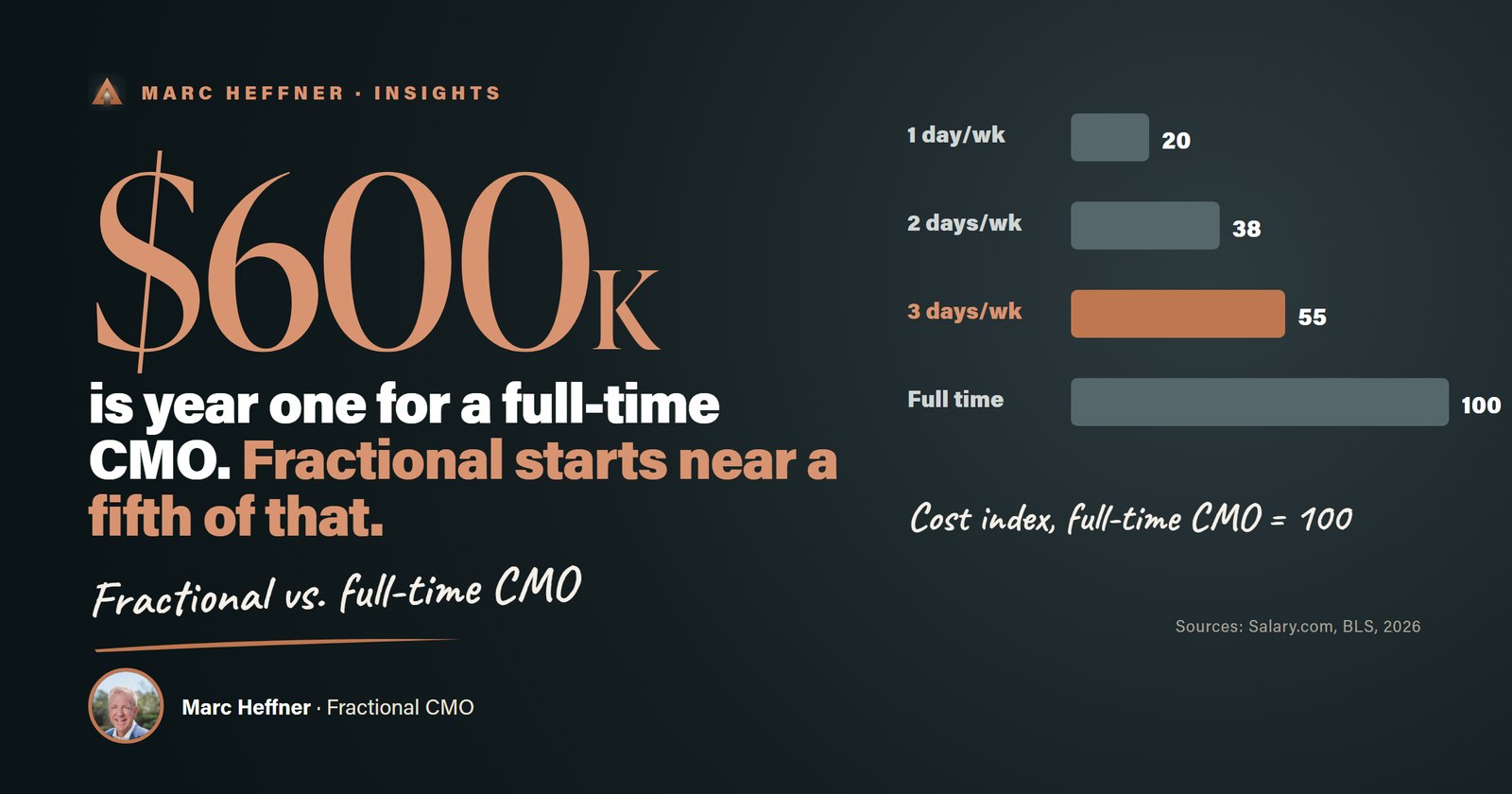
Salary.com puts the median US chief marketing officer base salary at about $374,000, with the middle half between $336,000 and $418,000 (Salary.com, 2026). Benefits add about 30% on top. The Bureau of Labor Statistics reports benefits are 30.0% of total compensation for private-industry workers (BLS, June 2026). Retained search firms typically charge 25% to 35% of first-year compensation to fill an executive seat (The Good Search, 2026). Add it up and a full-time CMO is close to $600,000 in year one before bonus, equity or a single dollar of marketing spend.
A fractional CMO is priced by days per week. Published rate cards mostly land between a few thousand and the low tens of thousands a month, depending on scope. I break down what drives that number in how much a fractional CMO costs. The short version: for one to three days a week, you’re usually looking at a quarter to a third of the full-time cost, with no search fee and no severance if it doesn’t work out.
The right comparison isn’t cheaper versus more expensive. It’s what each dollar buys. Full-time buys presence and capacity. Fractional buys judgment and leadership at the hours you actually need.
Don’t treat tenure as a failure statistic
You’ll hear that CMOs don’t last. The numbers back it up: the average Fortune 500 CMO stays 4.3 years, compared with 7.4 for CEOs. Spencer Stuart’s 2026 look at the S&P 500 put CMO tenure at 4.1 years, and 31% of those companies changed their CMO in one year (Spencer Stuart, 2025 and 2026).
But short tenure isn’t the same as failure. Some of those CMOs got promoted. Some left for bigger jobs. The real problem is the companies that hire a CMO without agreeing what the job is. McKinsey and the ANA (the Association of National Advertisers) found only 70% of CEOs say marketing’s role is clearly defined, down from 90%, and only 35% of CMOs track revenue and margin as a top metric even though 70% of CEOs grade them on it (McKinsey and the ANA, 2025).
That mismatch kills full-time and fractional engagements alike. Whichever model you choose, write down what marketing owns and how you’ll measure it before anyone starts.
Three companies, three answers
A $20 million industrial manufacturer. Two marketers, three agencies, great product, flat sales. The CEO has been the de facto CMO for ten years. Decisions that need an executive: a handful a month. Answer: fractional, two days a week. Build the strategy, fix the pipeline, lead the team. Revisit in a year.
A $150 million consumer brand. Twenty marketers, a big media budget, retail partners, a board that asks about brand every quarter. Answer: full-time CMO. Use a fractional or interim leader only to bridge the search.
A 14-location healthcare group. Marketing is mostly agencies and a coordinator. Phones, reviews and patient flow matter more than ads. Answer: fractional, with a hard focus on operations that touch revenue. At one group like this, fixing how calls were handled cut missed calls 91% in a few months. No new ad spend needed.
Use fractional to de-risk the full-time hire
Executive hires miss more often than boards expect. McKinsey found that two years in, between 27% and 46% of executive transitions are judged a failure or a disappointment (McKinsey, 2018). For a CMO that can mean a lost year, a search fee paid twice and a team that stops trusting leadership.
A fractional engagement lowers that risk. You learn what the role really needs. You build the strategy and the scorecard first. Then, if you do hire full time, the new leader walks into a working system instead of a blank page. I’ve done that handoff more than once, and the full-time hire thanks you for it.
Set the transition triggers now
If you go fractional, agree up front on what would change the answer. My usual triggers:
- Marketing headcount passes eight to ten people.
- Decisions that need an executive are stacking up between visits.
- You’re entering a new market or launching a second product line.
- Revenue crosses a point where a full-time salary is a small share of the marketing budget.
- The board asks for a full-time marketing executive.
When two of those hit, we start the search. A good fractional CMO will raise it before you do.
What boards and PE sponsors should ask
If you sit on a board or run a portfolio, the question isn’t fractional or full time. It’s whether anyone owns growth. McKinsey found companies with one clear owner of growth see up to 2.3 times more growth than those that spread it across several roles (McKinsey and the ANA, 2025). Ask three things:
- Who owns the marketing number, by name?
- What are the three metrics they’re judged on, and does the CEO agree?
- How fast can we change the answer if the business changes?
A fractional CMO answers the third one well. You can add a day, drop a day or move to full time without a severance package. For a portfolio company between funding rounds, that flexibility is often worth more than the savings.
Test the arrangement against a hard week
Before you decide, picture your worst marketing week of the year. A product recall, a competitor’s launch, a board meeting and a trade show, all at once. Who do you need on the phone? If the answer is “a sharp executive for three hours and a team to execute,” fractional works. If the answer is “someone in the building all week running the war room,” hire full time.
Questions CEOs ask
Can a fractional CMO manage a team?
Yes, within reason. One to five people and a few agencies is normal. Past ten, you’re usually ready for full time.
What about a VP of Marketing instead?
A VP is a strong choice when you need a full-time operator who runs campaigns and a team. Pair a VP with a fractional CMO if you also need executive strategy. That combination often costs less than one full-time CMO.
How long do fractional engagements last?
Mine start as a 120-day engagement: 90 days to build and prove, then 30 days to review the scorecard and decide together. Most then step up to six or twelve months. Some end in a full-time hire I help make.
Is fractional a step down in quality?
No. The same people who’ve run marketing for large companies do fractional work. You’re buying fewer hours of the same experience.
The bottom line
Choose by decisions, people, dollars and timing, not by title. Fractional fits most growing companies with small teams and real budgets. Full-time fits large, complex marketing organizations. Either way, define the role and the scorecard first. That’s what makes any CMO last.
Sources
- Salary.com, Chief Marketing Officer Salary in the United States (as of October 1, 2026), 2026.
- U.S. Bureau of Labor Statistics, Employer Costs for Employee Compensation, June 2026, 2026.
- Spencer Stuart, CMO Tenure 2026: Snapshot of an Expanding Role for Marketing Leaders, 2026.
- McKinsey & Company and the ANA, The CMO’s comeback: Aligning the C-suite to drive customer-centric growth, 2025.
- McKinsey & Company, Successfully transitioning to new leadership roles, 2018.
- Gartner, 2026 CMO Spend Survey, 2026.
- Lightcast, The Rise of Fractional Leadership, 2026.
- The Good Search, Executive Search Firm Fees and Pricing: The Definitive Guide, 2026.