 MARC
The meeting that changed how I measure marketing
I've sat in a lot of marketing meetings. One of them changed how I measure everything.
It was at an industrial manufacturer. The marketing update was full of good news. Web traffic was up. The social following was growing. New forms came in every week. Every chart went up and to the right.
Then someone on the business side asked the only question that mattered: "What did that sell?"
Nobody in the room could answer. Not because the team was hiding anything. Because nobody had ever connected a form fill to a quote, a quote to a work order, or a work order to a dollar. Marketing reported reach. The business wanted revenue. The two conversations never met.
I see the same thing today, in companies of every size. A CEO gets the agency's monthly PDF. Leads are up. Cost per lead is down. "Record month." Then the CEO opens the bank account, and revenue looks about the same as last year.
If that sounds like your business, here's what I've learned measuring marketing for manufacturers, healthcare groups and service companies, first as the marketing leader and now as a fractional CMO: your agency is measuring its work. Marketing ROI measures your business. Those are two different scoreboards, and only one of them pays the bills.
KEY TAKEAWAYS
- Marketing ROI = (gross profit marketing created, minus the full cost of marketing) ÷ the full cost of marketing.
- Count unique people and customers, not contacts and leads.
- Measure in gross profit, not revenue, and put agency fees, software and people in the cost.
- Only count sales marketing actually created. Some buyers were coming anyway.
- Judge each month at the same age: 30, 90 and 180 days.
What is marketing ROI?
Short answer: Marketing ROI (return on investment) is how much profit your marketing creates for every dollar you spend on it. A marketing ROI of 200% means every $1 of marketing brought back $2 of profit after paying for itself.
It's different from the numbers most agency reports lead with: leads, clicks, cost per lead and return on ad spend (ROAS). Here's the difference in one line. ROAS asks, "How much revenue did the ads get credit for?" ROI asks, "Did the business make money on marketing?"
At that manufacturer, we fixed it by building one pipeline that sales and marketing read the same way: reach, qualified interest, quote, order, revenue. We split warm leads (people who'd already touched the company) from purchased lists. And we stopped reviewing page views. Quote volume, quote-to-order conversion and average order value became the scorecard. For the first time, the company could see which digital investments deserved more money.
That's what measuring marketing ROI really is: a shared scoreboard that ends at the bank, not at the click.
The marketing ROI formula (and how to calculate it)
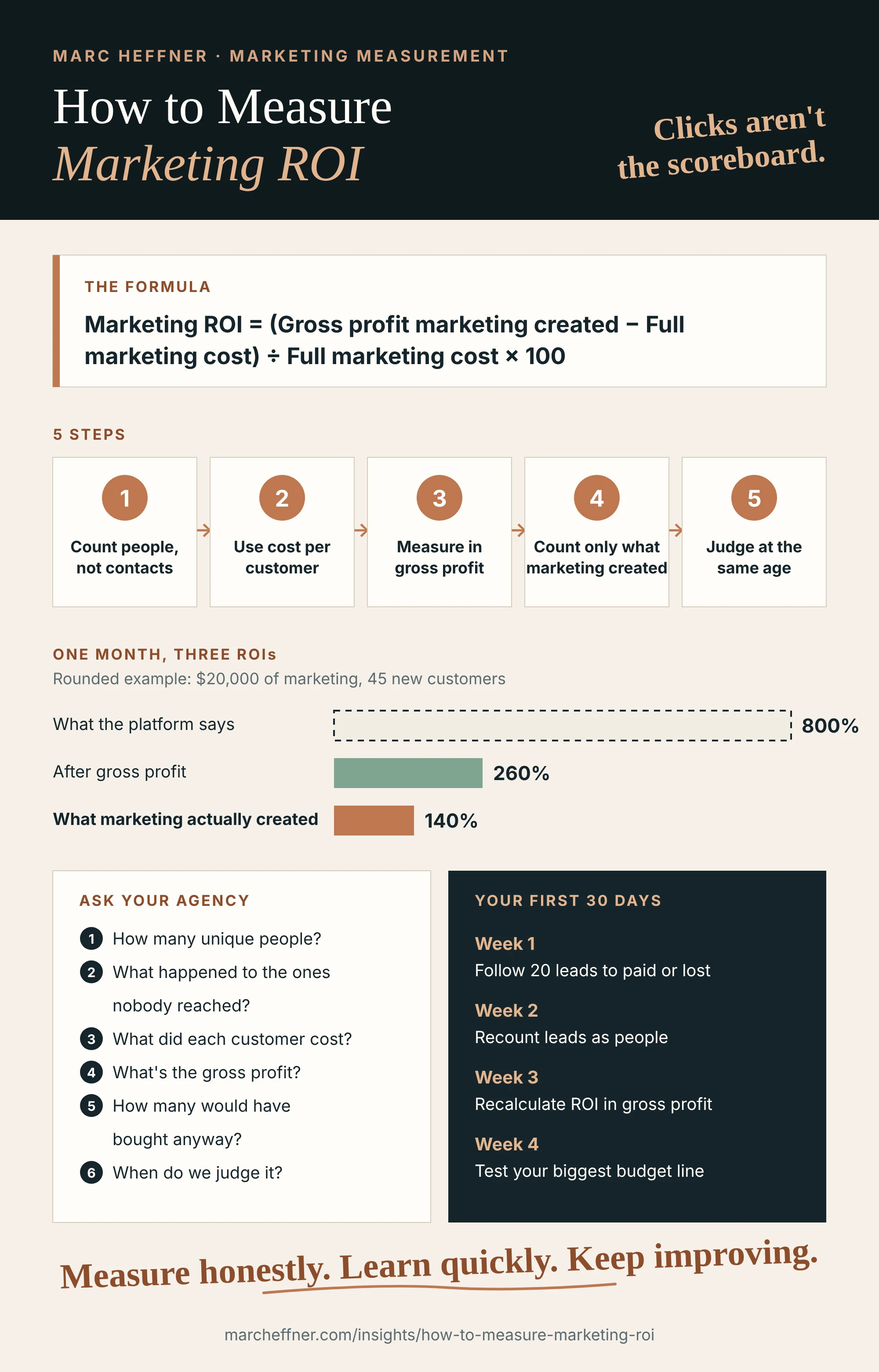
Marketing ROI = (Gross profit from sales marketing created − Full marketing cost) ÷ Full marketing cost × 100
Three parts of that formula do all the work:
- Gross profit, not revenue. A dollar of sales isn't a dollar you keep. The U.S. Securities and Exchange Commission's beginner's guide to financial statements draws the line between revenue, cost of sales and gross profit. [1]
- Sales marketing created, not sales it got credit for.
- The full marketing cost: ad spend, agency retainers, software and the people running it. Not just the media budget.
Most agency reports skip all three. That's not always bad faith. Their tools only see their slice of the funnel. Want to run your own numbers? My marketing ROI calculator does the math in about two minutes.
How to measure marketing ROI in 5 steps
To show the math, I'll use one example the whole way through. The numbers are rounded to show how it works.
A company spends $20,000 a month on marketing, all in. The agency's report says: 400 leads, $50 cost per lead, $180,000 in revenue "influenced," and a 9 to 1 return on ad spend. That report isn't lying. It just stops early.
Step 1: Count people, not contacts
An agency counts contacts: every call, form and chat. You need to count people. One buyer who calls, fills out a form and sends a message is one buyer, not three.
When I ran marketing and the patient call center together at a 14-office healthcare group, this was the first fix. Once we counted every lead source the same way and tied it to booked appointments, lead-to-booking conversion across all 14 offices went from 16% to 37% in the first year. Same phones. Same offices. A scoreboard everyone trusted, and a team coached to it every day.
Liine's benchmark of more than 630,000 healthcare leads found only about half became a scheduled appointment, and the most common reasons were fixable ones, like staff taking a message instead of booking. [2] I've seen that pattern in every industry I've worked in, from commercial boilers to dental chairs.
Ask your agency: "How many unique people did we get last month, and how do you know?"
Step 2: Swap cost per lead for cost per customer
Cost per lead is the agency's favorite number. It's easy to move and easy to brag about. Cost per customer is yours.
- Cost per lead: $20,000 ÷ 400 = $50
- Cost per customer: $20,000 ÷ 45 = about $444
Same spend. A number nine times bigger. And here's the trap: an agency can cut your cost per lead in half by buying cheaper leads while your cost per customer goes up, because those leads never buy. I go deeper on this in CAC vs. cost per lead.
Step 3: Measure in profit, not revenue
Back to the "record month." This company keeps about 40 cents of every sales dollar after the cost of making and delivering the product (its gross margin).
- Revenue credited: $180,000
- Gross profit (40%): $72,000
- Minus full marketing cost: $20,000
- Marketing ROI: ($72,000 − $20,000) ÷ $20,000 = 260%
Still strong. But a long way from 9 to 1.
Step 4: Count only the sales marketing actually created
Some of those 45 buyers would have bought anyway. They got a referral, searched your company by name and clicked an ad on the way in. The ad got the credit. That's attribution. What you want is incrementality: the sales that would not have happened without the marketing.
Say a simple test (pausing ads in a few markets, or holding out a group of customers) shows about a third would have come anyway:
- Incremental gross profit: $72,000 × 2/3 = $48,000
- Incremental marketing ROI: ($48,000 − $20,000) ÷ $20,000 = 140%
| What's measured | ROI |
|---|---|
| Revenue the platform credited | 800% |
| Gross profit | 260% |
| Gross profit marketing actually created | 140% |
140% is still a great return. The point isn't that marketing failed. The point is you can only manage the right number. Budget off 800% and you'll overspend. Budget off 140% and you'll know exactly how hard you can push.
Step 5: Judge results at the same age
This month's sales often come from people who first showed up months ago. Google's guidance on conversion lag (the time between the first click and the sale) warns that recent results can look worse than they'll end up. [3]
At the healthcare group, we judged every channel on a 120-day view, and that's what showed us the truth about our spend. One lead vendor was eating more than half the budget and returning about 1.4 times its cost. Our own Facebook and Google programs returned three to eight times. A 30-day report would have hidden that. We rebuilt the mix around the evidence, cut the vendor, and cut marketing spend by roughly half as a share of revenue.
So judge each month's marketing at 30, 90 and 180 days, and write the review date down before the campaign starts. That stops two expensive mistakes: killing something that was working, and funding something that never will.
What is a good marketing ROI?
Short answer: A good marketing ROI returns more gross profit than the full marketing cost within your normal sales cycle. There's no single number for every business. High margins and repeat customers can win at a lower first-sale ROI than a business that sells once.
Context helps. Gartner's 2025 CMO Spend Survey found marketing budgets averaged 7.7% of company revenue, and half of CMOs reported 6% or less. [4] If you're spending well above that, your ROI needs to earn it. If you're spending far less, you may be leaving growth on the table. Either way, the answer comes from your own gross profit, measured at the same age, not from an industry average.
Marketing attribution vs. marketing ROI
Short answer: Marketing attribution is the rule that decides which ad or channel gets credit for a sale. Marketing ROI is whether the business made money. Attribution helps you compare channels. It can't tell you if the sale would have happened without the ad.
The research here is humbling. Economists Randall Lewis and Justin Rao studied 25 large advertising experiments and found ad effects are small next to the normal ups and downs in sales, so it takes large, careful tests to measure them. [5] And Nielsen's 2025 ROI research found 85% of marketers say they're confident they can measure total marketing ROI, while only 32% measure traditional and digital media together. [6] Confidence is high. Proof is thinner.
For the full story on credit vs. causation, see Why Isn't Marketing Driving Revenue? 5 Hidden Gaps.
How do I know if my marketing agency is working?
Short answer: Ask for unique people, cost per customer, gross profit created and results at 30, 90 and 180 days. If your agency can only show leads, clicks and cost per lead, it's measuring its own work, not your business.
Take your agency's last report and ask these six questions. If the answer to any of them is "we don't track that," you've found your gap.
- How many unique people did we get, after duplicates?
- What happened to the ones nobody reached?
- What did each new customer cost, all in?
- What's the gross profit on those customers, not the revenue?
- How many would have bought anyway, and how do we know?
- When will we judge this month's spend, and by what number?
You don't need to fire anyone to ask. Gartner found 39% of CMOs plan to cut agency spending, starting with unproductive relationships. [4] Asking better questions is how you find out which kind you have. If you're choosing a new agency, ask these six before you sign. The good ones will welcome them.
Who should own marketing ROI?
Not the agency. They'd be grading their own homework.
Marketing ROI crosses four teams. Marketing owns the spend. Sales owns what happens after the lead. Finance owns the margin and the full cost. Operations owns whether you can deliver. Someone has to sit over all four, agree on the definitions and make the call when they disagree.
I learned that at a manufacturer that was paying every year for a CRM its sales team ignored. Web traffic, trade-show contacts, agency campaigns and sales calls all lived in different worlds. Leadership could see the activity. It couldn't see the revenue. My rule there: a system people don't use is a cost, not a capability. We wired marketing automation into the CRM so every lead was followed to a win or a loss, defined the KPIs once and reported them the same way to sales and marketing. Online sales grew 22%. Forecast accuracy improved 63%. The system paid for itself in two months instead of the eight we'd planned.
What I've learnedA system people don't use is a cost, not a capability. The same goes for a report nobody acts on.
In a big company, the CMO owns this. In a company doing $5 million to $100 million, it's often nobody, so the agency's report becomes the scoreboard by default. Closing that gap is a big part of what a fractional CMO does.
The CMO Survey, run by Duke's Fuqua School of Business with Deloitte and the American Marketing Association, found marketing leaders name "demonstrating impact on financial outcomes" as their top challenge. [7] If the people running marketing find it hard, it's no surprise owners do.
Your first 30 days
- Week 1: Pull 20 recent leads. Follow each one from first contact to paid or lost, using call recordings, your CRM and invoices, not the ad dashboard.
- Week 2: De-duplicate. Recount leads as people. Recalculate cost per customer.
- Week 3: Get gross margin from finance. Recalculate marketing ROI in profit, on the full marketing cost.
- Week 4: Pick your biggest budget line and plan one test of what it actually creates. Set the review date and the number that decides it.
One month. Four steps. You'll know more about your marketing than most agency reports will ever tell you.
Back in that meeting
Go back to the manufacturer. Nothing about the traffic chart changed. What changed was the question. We stopped asking, "Is marketing working?" and started asking, "How many quotes did marketing start, how many became orders, and what were they worth?" That question has an owner and an answer.
Measure honestly. Learn quickly. Keep improving. Marketing is a team sport, and ROI is the scoreboard the whole team can read.
Questions CEOs ask
What is marketing ROI?
Marketing ROI is the profit marketing creates for every dollar spent on it. Subtract the full marketing cost from the gross profit marketing created, divide by the full marketing cost and multiply by 100. A 200% ROI means each $1 brought back $2 of profit after paying for itself.
How do you measure marketing ROI?
Count unique customers, not leads. Use gross profit, not revenue. Include ads, agency fees, software and people in the cost. Count only the sales marketing actually created, and judge each month at the same age, such as 30, 90 and 180 days.
What is a good marketing ROI?
A good marketing ROI returns more gross profit than the full marketing cost within your normal sales cycle. If customers buy again for years, a lower first-sale ROI can still be a strong investment.
How do I calculate marketing ROI?
Marketing ROI = (gross profit from sales marketing created minus full marketing cost) divided by full marketing cost, times 100. Example: $72,000 of gross profit on $20,000 of marketing is a 260% ROI.
What's the difference between ROAS and marketing ROI?
ROAS (return on ad spend) divides revenue credited to ads by ad spend only. Marketing ROI uses gross profit and the full marketing cost. The same month can show a 9 to 1 ROAS and a 140% marketing ROI.
What's the difference between marketing attribution and marketing ROI?
Attribution decides which channel gets credit for a sale. ROI shows whether the business made money. Attribution can't tell you if the sale would have happened without the ad. That takes a test, like a holdout group.
How do I know if my marketing agency is delivering revenue, not just leads?
Ask for unique people, cost per customer, gross profit created and results at 30, 90 and 180 days. If the agency can only show leads, clicks and cost per lead, it's measuring its own work, not your business.
How long does it take to see marketing ROI?
It depends on your sales cycle. Fast purchases show up in 30 days. Long B2B sales can take 6 to 12 months. Set the review date before you start so you don't kill a channel too early or fund one too long.
References and context
- U.S. Securities and Exchange Commission. Beginners’ Guide to Financial Statements. Revenue, cost of sales, gross profit and operating expenses.
- Liine. Specialty Healthcare Marketing Benchmark Report, 2024 Edition. More than 630,000 new patient leads from 2023; 54.3% became a scheduled appointment. Liine’s 2026 edition, covering 2025, reports 59%.
- Google Ads Help. About conversion lag reporting. Product documentation on delayed conversions.
- Gartner. 2025 CMO Spend Survey, May 2025. 402 CMOs and marketing leaders in North America, the UK and Europe. Budgets averaged 7.7% of company revenue; half reported 6% or less; 39% planned to cut agency spending.
- Lewis, R. A., and Rao, J. M. “The Unfavorable Economics of Measuring the Returns to Advertising.” The Quarterly Journal of Economics, 2015, 130(4), 1941 to 1973, doi:10.1093/qje/qjv023.
- Nielsen. The Marketing ROI Blueprint: Unlocking the full value of marketing investments, October 2025, from the 2025 Nielsen Global Annual Marketing Survey.
- The CMO Survey (Duke University’s Fuqua School of Business, with Deloitte and the American Marketing Association), Spring 2025 edition.
The $20,000 example uses rounded numbers to show how the math works. The manufacturer and healthcare stories come from my own work, with companies left unnamed. Results from my own work are stated as I recorded them at the time. Research findings are separate from my recommended process.