 MARC

THE SHORT ANSWER
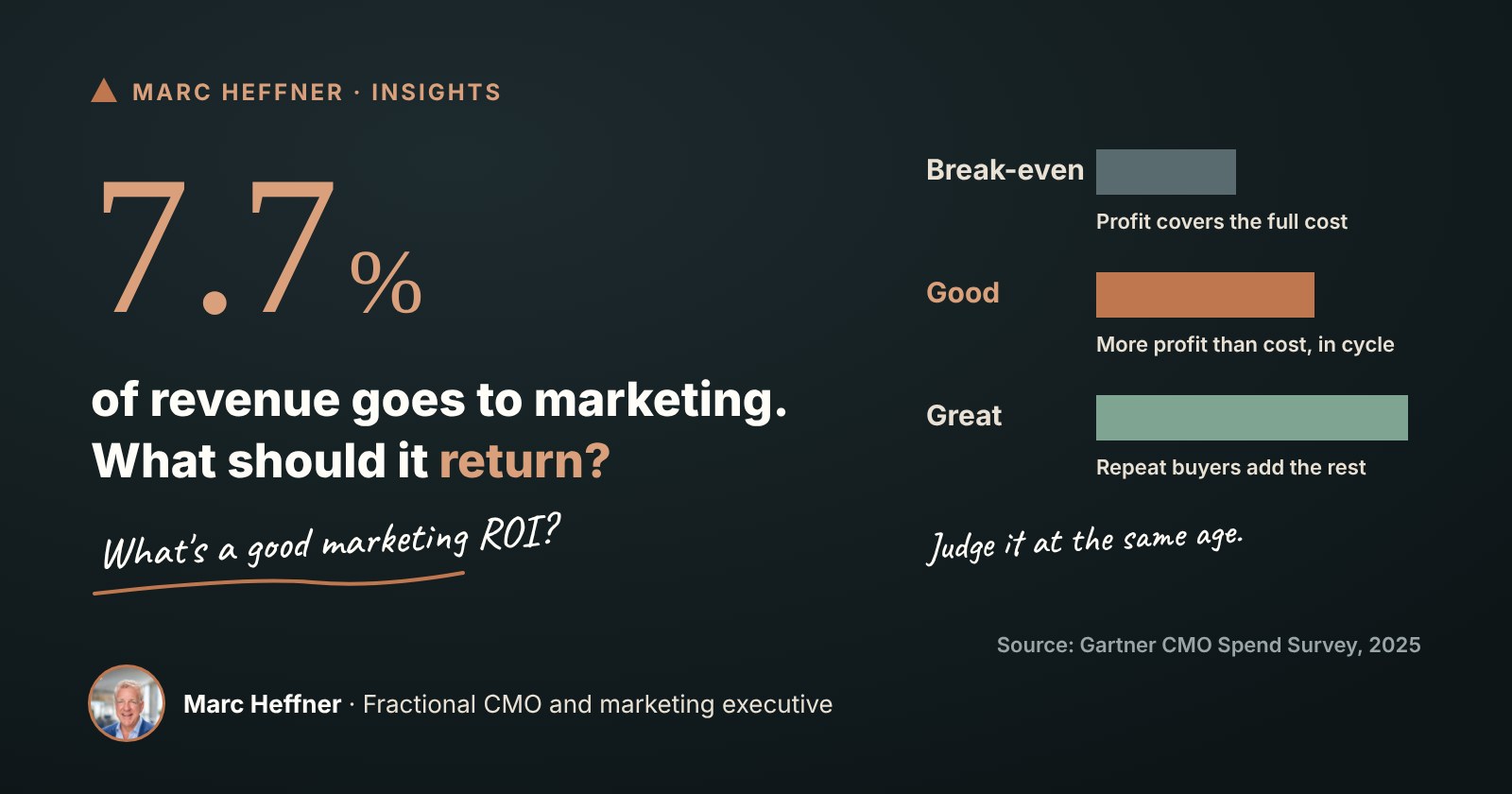
A good marketing ROI returns more gross profit than the full marketing cost within your normal sales cycle. There's no single number that fits every business. High margins and repeat customers can win at a lower first-sale ROI than a business that sells once. Measure it in profit, judge it at the same age every time (30, 90 and 180 days), and compare channels against each other, not against an industry average.
CEOs ask me for a number. "Is 3 to 1 good? Is 5 to 1?" The honest answer is that it depends on what you keep from each sale and how long customers stay. Here's how I set the bar instead.
Is there a benchmark for a good marketing ROI?
Not one you should trust on its own. Most published benchmarks use revenue, not profit, and they mix businesses with very different margins. A 5 to 1 return on revenue can lose money for a low-margin company and be a home run for a high-margin one.
What's useful is knowing what companies spend. Gartner's 2025 CMO Spend Survey found marketing budgets averaged 7.7% of company revenue, and half of CMOs reported 6% or less.[1] If you spend well above that, your ROI needs to earn it.
The simple test I use
- Break-even: gross profit from new customers covers the full marketing cost within your sales cycle. That's the floor.
- Good: it clears that bar with room to spare, measured on sales marketing actually created.
- Great: repeat purchases and referrals keep paying after the first sale.
If customers buy again for years, a lower first-sale ROI can still be a strong investment. If they buy once, the first sale has to carry it.
Why timing changes the answer
When I ran marketing and the patient call center at a 14-office healthcare group, we judged every channel on a 120-day view. That view showed one lead vendor was eating more than half the budget and returning about 1.4 times its cost, while our own Facebook and Google programs returned three to eight times. A 30-day report would have hidden that.
We rebuilt the mix around that evidence, cut the vendor and cut marketing spend by roughly half as a share of revenue. "Good" wasn't a benchmark. It was the best channel next to the worst one, judged at the same age.
Nielsen's 2025 ROI research found 85% of marketers say they're confident they can measure total marketing ROI, while only 32% measure traditional and digital media together.[2] Before you decide what's good, make sure everything's measured on the same scoreboard.
Questions CEOs ask
What is a good marketing ROI?
One that returns more gross profit than the full marketing cost within your normal sales cycle. Repeat customers can make a lower first-sale ROI worth it.
Is 5 to 1 a good marketing ROI?
It depends on whether that's revenue or profit. A 5 to 1 return on revenue can lose money at low margins. Convert it to gross profit on the full cost before you decide.
How much should a company spend on marketing?
Gartner's 2025 survey found budgets averaged 7.7% of company revenue. Your right number depends on growth goals, margins and the ROI you can prove.
How long should I wait to judge marketing ROI?
Set it by your sales cycle. Look at 30, 90 and 180 days, and set the review date before the campaign starts.
The bottom line
A good marketing ROI is more gross profit than the full marketing cost, within your sales cycle, on sales marketing actually created. Skip the industry average. Compare your channels at the same age and move money to what's working. Book a call and we’ll look at your numbers in 30 minutes.
Sources
- Gartner, 2025 CMO Spend Survey, May 2025 (402 CMOs and marketing leaders in North America, the UK and Europe).
- Nielsen, The Marketing ROI Blueprint: Unlocking the full value of marketing investments, October 2025.
The healthcare group story comes from my own work, and the company stays unnamed. Results are stated as I recorded them at the time.