 MARC

THE SHORT ANSWER
Marketing ROI = (gross profit from sales marketing created − full marketing cost) ÷ full marketing cost × 100. Use gross profit, not revenue. Put agency fees, software and people in the cost, not just ads. And count only the sales marketing actually created. A 200% ROI means every $1 of marketing brought back $2 of profit after paying for itself.
I get this question from CEOs all the time, usually right after an agency report says something like "9 to 1." Here's the formula I use, and a worked example so you can see where the big numbers come from.
What is the marketing ROI formula?
Three parts do all the work:
- Gross profit, not revenue. A dollar of sales isn't a dollar you keep. The SEC's beginner's guide to financial statements draws the line between revenue, cost of sales and gross profit.[1]
- Sales marketing created, not sales it got credit for. Some buyers were coming anyway.
- The full marketing cost: ad spend, agency retainers, software and the people running it.
How do you calculate marketing ROI? A worked example
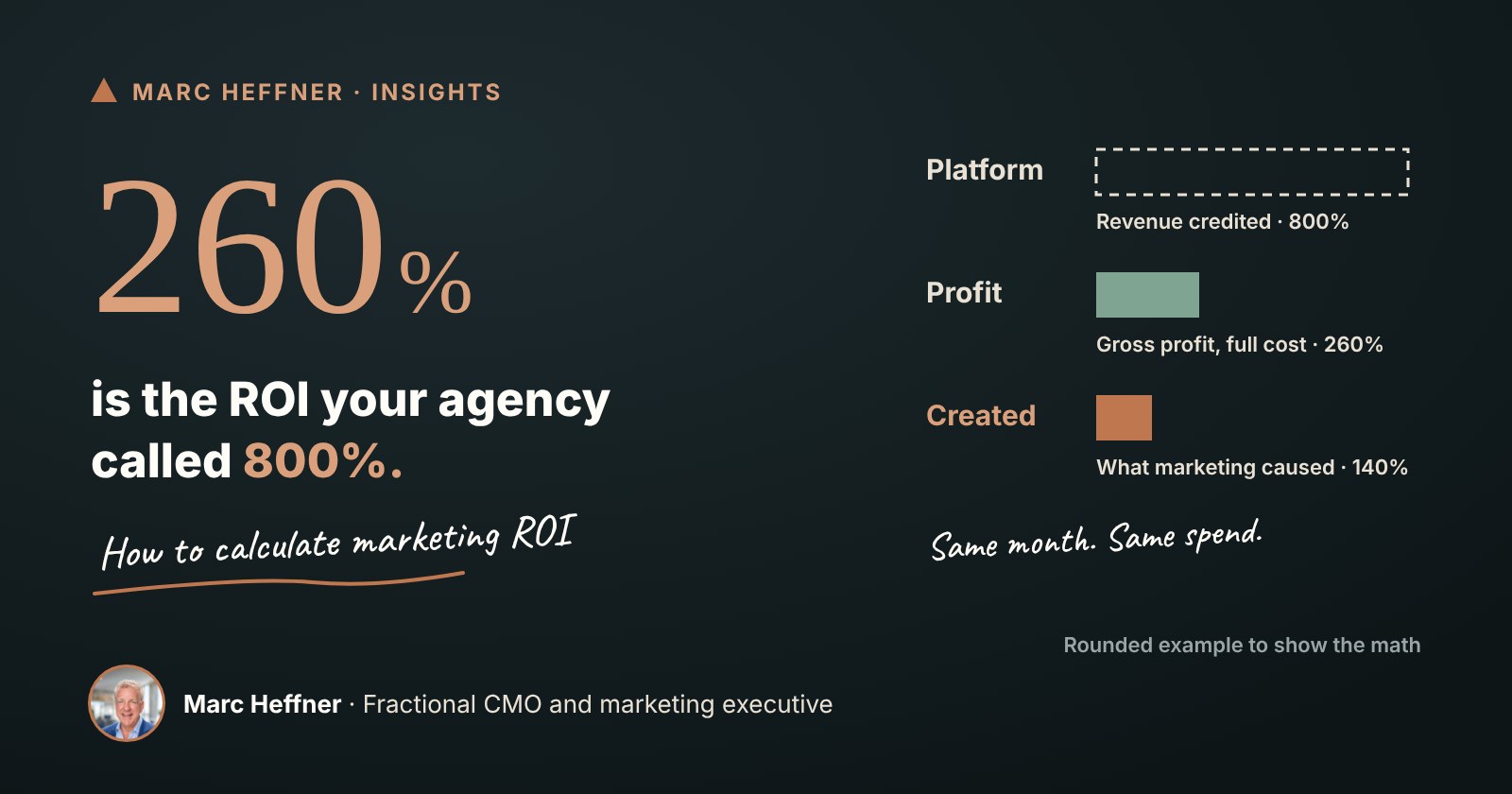
Here's one month, with numbers rounded to show how the math works. A company spends $20,000 on marketing, all in. The ad platform credits $180,000 in revenue. That's the "9 to 1" on the report.
| Step | Math | Result |
|---|---|---|
| 1. Revenue credited | From the ad platform | $180,000 |
| 2. Gross profit | $180,000 × 40% margin | $72,000 |
| 3. Profit ROI | ($72,000 − $20,000) ÷ $20,000 | 260% |
| 4. Only what marketing created | A test shows a third would have bought anyway: $72,000 × 2/3 = $48,000 | |
| 5. Created ROI | ($48,000 − $20,000) ÷ $20,000 | 140% |
Same month. Same spend. The platform's math says 800%. Your business made 140%. That's still a great return. The point is you can only manage the right number. Budget off 800% and you'll overspend.
Three mistakes that inflate marketing ROI
- Using revenue instead of gross profit. It makes every channel look about twice as good as it is.
- Counting ad spend only. Agency fees, software and people are part of what marketing costs you.
- Taking credit for buyers who were coming anyway. Brand searches and repeat customers often get counted as new wins. Economists Randall Lewis and Justin Rao found ad effects are small next to normal swings in sales, so it takes careful tests to measure them.[2]
Want to skip the spreadsheet? My marketing ROI calculator does this math in about two minutes.
Questions CEOs ask
What is the formula for marketing ROI?
Marketing ROI = (gross profit from sales marketing created minus the full marketing cost) divided by the full marketing cost, times 100.
Should marketing ROI use revenue or profit?
Gross profit. Revenue makes every channel look better than it is, because you don't keep every dollar of sales.
What costs go into marketing ROI?
Ad spend, agency fees, software, creative and the people running marketing. Agree on the list with finance and keep it the same every month.
Is ROAS the same as marketing ROI?
No. ROAS divides credited revenue by ad spend. Marketing ROI uses gross profit and the full marketing cost, so it's usually much lower and much more useful.
The bottom line
Marketing ROI is gross profit marketing created, minus the full marketing cost, divided by that cost. Use profit, count all the costs and only count what marketing caused. Then you're managing your business, not the agency's report. Book a call and we’ll look at your numbers in 30 minutes.
Sources
- U.S. Securities and Exchange Commission, Beginners’ Guide to Financial Statements.
- Lewis, R. A., and Rao, J. M., “The Unfavorable Economics of Measuring the Returns to Advertising,” The Quarterly Journal of Economics, 2015, doi:10.1093/qje/qjv023.
The $20,000 example uses rounded numbers to show how the math works.