 MARC
MARC

I asked a young dental CEO about Peter Drucker. He didn't know him. But he swears by the book Traction.
Editor’s Note: We spend a lot of time in this newsletter talking about the future, Generative AI, predictive analytics, and what’s next for dentistry.
But sometimes, to move forward, you have to look back.
We are launching a new series called "The Source Code." We are digging up the original architects of business, the people who wrote the operating systems we use today. To see what they can teach us about surviving in today's business world
First up: The man who invented the DSO model 50 years before the term existed.
The "Traction" Paradox
I was on a call recently with a young, incredibly sharp CEO of a growing dental group.
He is smart. He knows his EBITDA multiples. He knows his tech stack. He has read almost every book on "scaling" published in the last five years.
When I started asking about his management philosophy, he cut me off.
"We run on EOS," he said proudly. "We live by the book Traction. We have our V/TO filled out. We set our Rocks every quarter. We are fully optimized."
I smiled and asked, "That is great. But do you know where Gino Wickman got those ideas? Do you know who invented the operating system you are running?"
"No," he said. "Who?"
"Peter Drucker," I said.
He looked blank. "Never heard of him."
This silence explains exactly why so many dental groups struggle, even when they have "implemented" EOS.
You are running 21st-century software (Traction) on an operating system (Drucker) you have never read. You are filling out the V/TO sheet, but you are missing the source code.
If you love Traction, you are actually a fan of Peter Drucker. He was the architect. Wickman was the contractor who built the house.
If you do not understand the architect's blueprints, your house will crack.
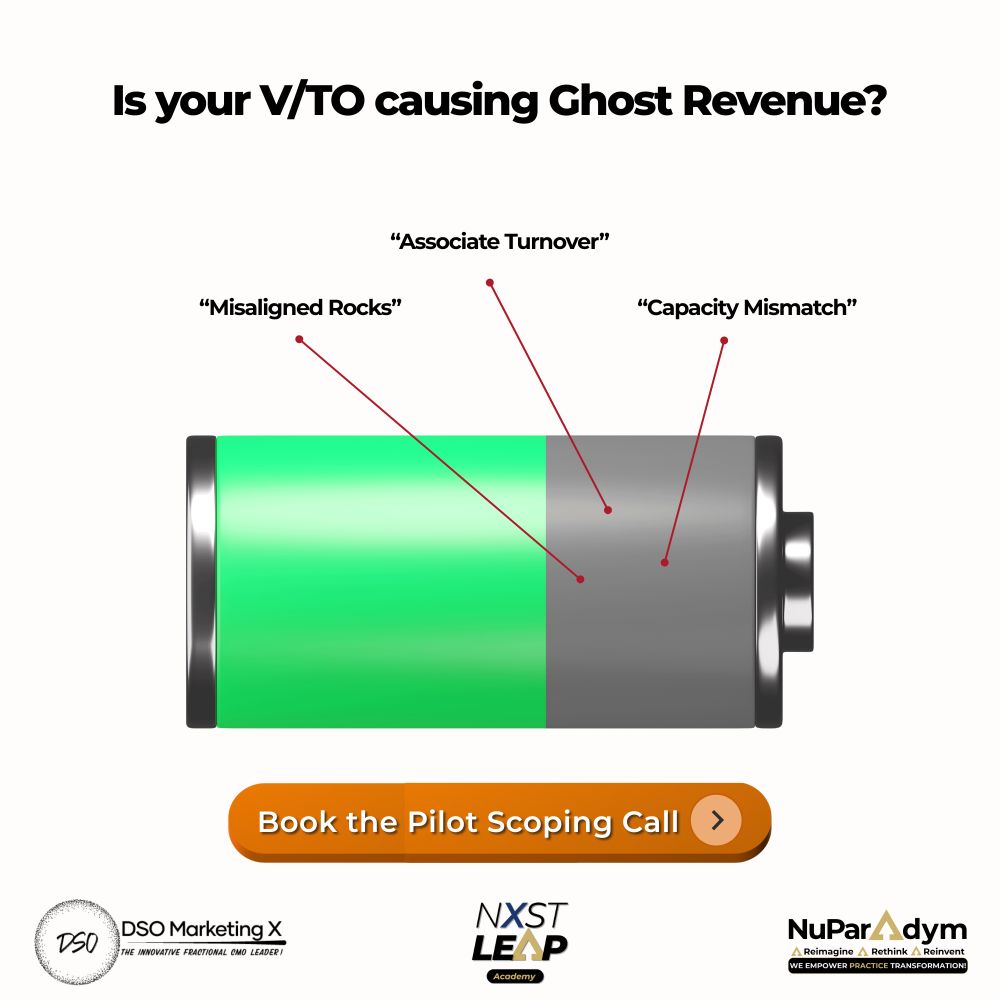
This isn't just a history lesson. This is about your bottom line. The reason you have "Ghost Revenue", capacity that sits on your schedule but never turns into cash, is that you are applying these tools mechanically, not philosophically.
Here are the six Peter Drucker concepts that invented the modern dental group, and how missing the nuance is costing you millions.
“The aim of marketing is to make selling superfluous.” Peter Drucker

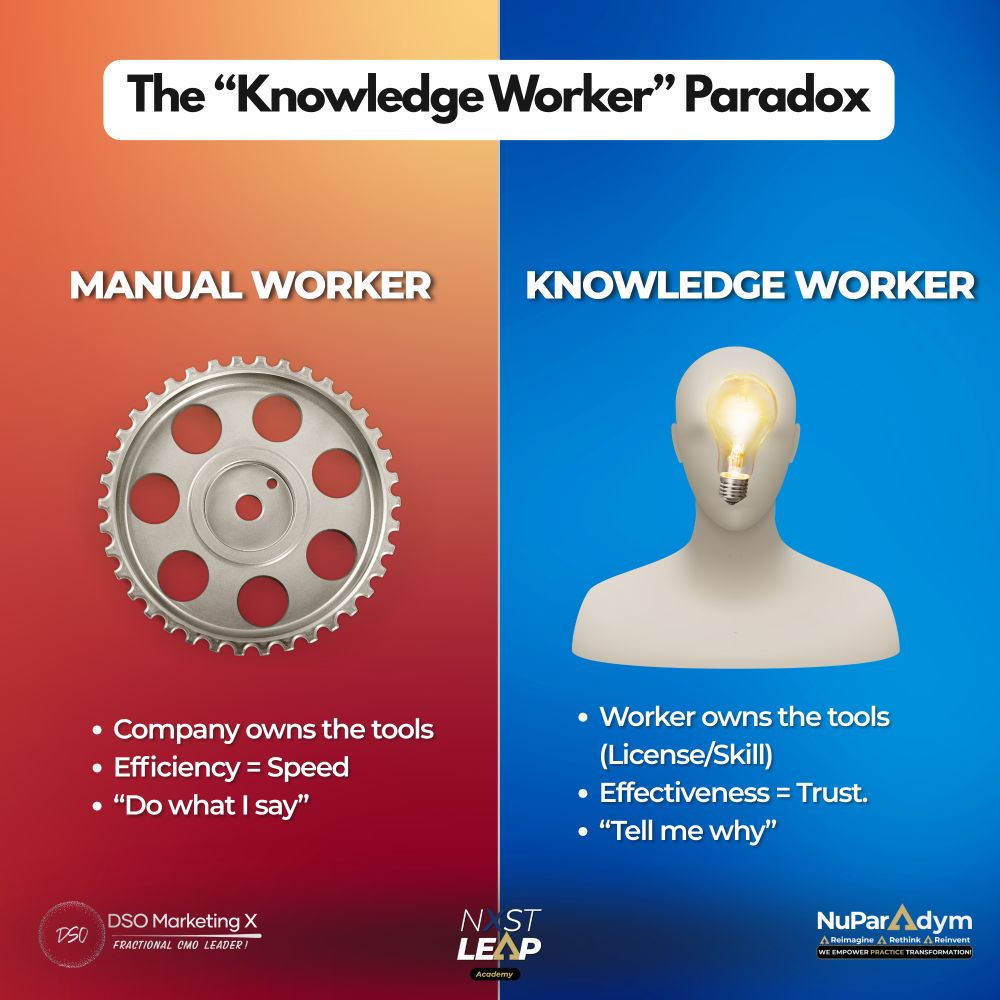
1. The "Knowledge Worker" (Or: Why Your Associates Quit)
The Drucker Origin: In 1959, Drucker coined the term "Knowledge Worker."
Before this, the world ran on manual labor. Efficiency was simple. You stood over a factory worker with a stopwatch. You told them to turn the bolt faster. If they didn't, you fired them. The worker owned the labor, but the company owned the tools.
Drucker saw a shift coming. He predicted an economy where the primary asset was the worker’s brain, not their hands. Crucially, he noted that the Knowledge Worker owns the means of production.
The Traction Application: In EOS, this is the "People Analyzer." It is "GWC" (Get it, Want it, Capacity). It is the concept of "Right People, Right Seats."
Where DSOs Fail: You fill out the Accountability Chart. You put names in boxes. But you still manage your associates and hygienists like factory workers.
You track them solely on production per hour. You dictate their clinical supplies. You micromanage their schedules to squeeze out efficiency.
Drucker explains why this fails. A dentist is a Knowledge Worker. They own their license. They own their clinical judgment. In Drucker's view, they are essentially "volunteers," even if you pay them. They can take their "means of production" and walk out the door to a competitor tomorrow.
If your retention is low, you are treating assets (brains) like liabilities (costs). Traction gives you the chart. Drucker gives you the emotional intelligence to keep the high-performers in the boxes.
2. Management by Objectives (Or: "Rocks")
The Drucker Origin: In 1954, Drucker published The Practice of Management and introduced Management by Objectives (MBO).
At the time, business was command-and-control. The boss said "Make more money," and the workers scrambled. Drucker argued that goals must be a "collaborative contract." The manager and the employee must jointly set the goal.
The Traction Application: This is your 90-Day World. These are your Rocks.
Where DSOs Fail: I see DSOs where the CEO walks into the quarterly meeting and hands out Rocks like rations.
"Here is your target for New Patients. Here is your target for EBITDA. Go get 'em."
That is not a Rock. That is a quota.
Drucker taught that if the employee does not help create the objective, they take no accountability for it. They view it as "your" number, not "theirs."
If your clinical directors are consistently missing their Rocks, it is usually because you skipped the Drucker step of "Joint Goal Setting." You skipped the buy-in. You treated a Knowledge Worker like a factory hand, and they responded with malicious compliance.
3. The "Two-Headed Monster" (Or: The Accountability Chart Tension)
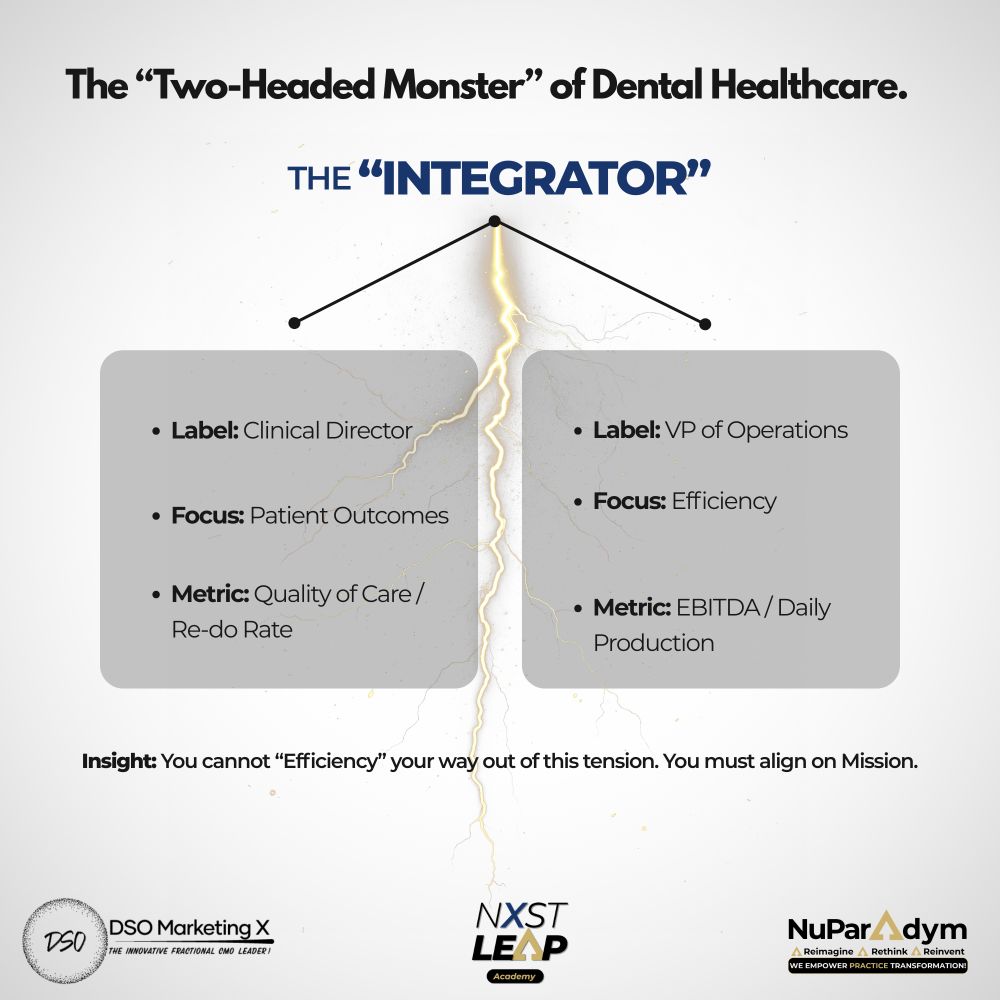
Drucker famously described healthcare organizations as a "Two-Headed Monster."
- Head 1 (Clinical): Focused on patient care, professional standards, and health outcomes.
- Head 2 (Admin): Focused on efficiency, cost control, and operational excellence.
These two heads naturally want different things. They are attached to the same body, but they are looking in opposite directions. The dentist wants 60 minutes for a complex case to ensure perfection. The Ops Director wants 45 minutes to hit the daily production goal.
The Traction Application: This is the tension in your Accountability Chart between the Integrator and the Clinical Director (or Visionary).
Where DSOs Fail: Most DSOs try to let one head eat the other.
If Admin wins (PE-backed aggregation), clinical quality drops, reputation tanks, and associates burn out. If Clinical wins (Solo practice mindset), margins vanish, overhead bloats, and the business fails.
Drucker’s advice was specific: You cannot "efficiency" your way out of this tension. You must "effectiveness" your way through it. You must establish a clear mission that both heads align around. Neither can win at the expense of the other.
4. The Marketing Paradox (Or: Why Case Acceptance is Low)
The Drucker Origin: This is where Drucker shows his genius in marketing. He famously said:
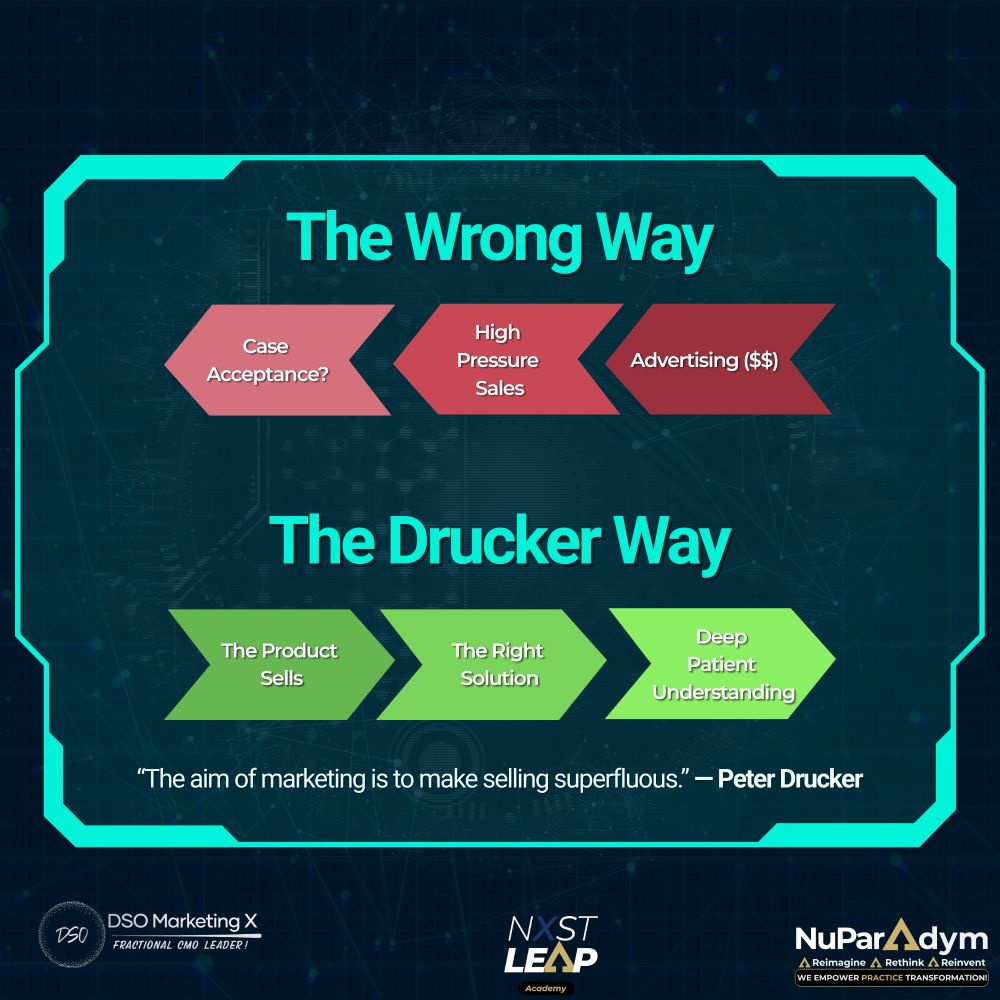
"The aim of marketing is to know and understand the customer so well the product or service fits him and sells itself."
He argued that Marketing and Selling are not the same thing. In fact, they are often adversaries. If you market perfectly, you shouldn't have to "sell" at all.
The Traction Application: This lives in the "Marketing Strategy" section of your V/TO. Specifically, your "Three Uniques" and your "Guarantee."
Where DSOs Fail: Most dental groups confuse Marketing with Advertising.
You spend thousands on Google Ads (Advertising) to get a patient in the chair. Then, you use high-pressure scripts (Selling) to get them to accept treatment.
Drucker would say this is broken.
If you have to use high-pressure sales tactics to get case acceptance, your marketing has failed. You haven't understood the customer (the patient).
"Marketing," in the Drucker sense, is the entire patient experience. It is the way the phone is answered. It is the clarity of the treatment plan. It is the trust you build.
If you focus on Drucker-style Marketing (deep understanding of patient values), the "sale" becomes unnecessary. The patient buys because the solution fits their problem perfectly.
5. The "Five Questions" (Or: The V/TO)
Late in his career, Drucker distilled his wisdom into five questions. If you look closely, you will realize this is the skeleton key to the EOS Vision/Traction Organizer (V/TO).
- What is our Mission? (V/TO: Core Focus) Drucker's Rule: It can't be about money.
- Who is our Customer? (V/TO: Target Market) Drucker's Rule: It's not just the patient. In a DSO, it is also the Associate Dentist. If you fail to serve the Associate, you have no product.
- What does the Customer Value? (V/TO: Three Uniques) Drucker's Rule: You don't get to decide this. The patient decides. You think they value "Clinical Excellence." They likely value "Not feeling pain" and "Being seen on time."
- What are our Results? (V/TO: Scorecard) Drucker's Rule: Measure effectiveness, not just efficiency.
- What is our Plan? (V/TO: 1-Year Plan / Rocks)
Where DSOs Fail: You fill out the V/TO as a homework assignment. You write "To be the premier dental provider in the tri-state area."
That is fluff. Drucker demanded brutal honesty.
If your "Core Focus" is financial arbitrage, admit it. But don't be surprised when your "Target Market" (patients) senses it and leaves.
6. "Systematic Abandonment" (Or: The Issues List)
There is one final Drucker concept that every dental leader needs to tattoo on their forearm. He called it "Systematic Abandonment."
He asked leaders to look at every process, every meeting, and every service line and ask:
"If we weren't already doing this, would we start doing it today?"
The Traction Application: This is the most aggressive way to use your Issues List during a Quarterly Planning session.
Where DSOs Fail: We hoard processes.
- We keep the weekly "alignment" Zoom call that everyone hates, just because we've always done it.
- We keep the legacy PPO contract that loses money, just because we are afraid of the drop in new patients.
- We keep the toxic Office Manager, just because we are afraid of the vacancy.
Drucker taught that innovation is impossible without abandonment. You cannot add the new (AI, new procedures, new growth) until you prune the old.
In your next L10 meeting, look at your "Issues List." Don't just solve them. Ask which ones should be abandoned entirely.
Why This Matters for Your P&L
The young CEO I spoke with realized something profound by the end of our call.
He had the mechanics of success. He had the V/TO. He had the meetings. He had the spreadsheets.
But he lacked the philosophy.
He was doing the steps, but he wasn't getting the results. He had "Ghost Revenue", capacity that should have been there but wasn't, because he was treating his people like cogs in a machine rather than Knowledge Workers in a system.
Drucker wrote the code. Traction provides the interface. You need both to win.
Management is not about finding the perfect software. It is about understanding human behavior.
Your Next Move
If you are "Running on EOS" but your retention is low, or your Rocks are consistently missed, you do not need another L10 meeting. You do not need a new integrator.
You need to fix your management design.
We need to inject Drucker’s logic into your Traction implementation.
We look at your capacity. We look at your alignment. We look at the math behind your marketing.
Book a 23-minute pilot scoping call.
We will audit your "management operating system" and identify exactly where you are misaligned with the principles that actually drive growth. Quick Meeting
Sources: Peter F. Drucker Institute; "The Practice of Management" (1954); "Management: Tasks, Responsibilities, Practices" (1973); EOS Worldwide (V/TO methodology); "Traction" by Gino Wickman.
Get the breakdown in your inbox. Join the Marketing+GenAI Power Brief Today!
📲 Check out our website: NuParadym
🎥 Get more info from our YouTube Channel: NuParadym YouTube
📲DSO Marketing X Website: DSOMarketingX
📲NXST LEAP Academy: NXST LEAP Academy
About the Author
Are you tired of your marketing not working, Let's talk now! Click the link. Quick Meeting
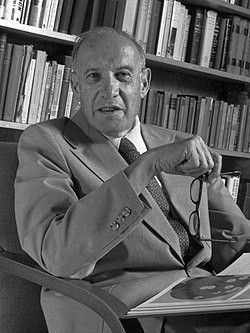
Peter Drucker Professor Claremont Graduate School (1975-2005)
To learn more about Peter Drucker, check out the Druker Institute https://drucker.institute/
Here is the chronological list of Peter Drucker’s books specifically focused on management and the organizational ecosystems in which management operates.
While he wrote 39 books in total (including fiction and autobiography), these are the essential Management titles, organized by their contribution to the field of Business Management.
The Foundation (The "Source Code")
These are the books that invented the discipline of management.
- 1946: Concept of the Corporation (His study of GM; the birth of "decentralization")
- 1954: The Practice of Management (The invention of MBO; the first real "management book")
- 1964: Managing for Results (The first book on business strategy)
- 1967: The Effective Executive (The definitive guide to personal productivity and decision-making)
- 1973: Management: Tasks, Responsibilities, Practices (His magnum opus; the encyclopedia of management)
The Innovation & Strategy Era
- 1985: Innovation and Entrepreneurship (First to treat innovation as a systematic discipline, not "inspiration")
- 1980: Managing in Turbulent Times
- 1995: Managing in a Time of Great Change
- 1999: Management Challenges for the 21st Century (Where he predicts the rise of the Knowledge Worker and the self-management era)
The "Social Ecologist" (Context for Management)
Drucker argued you cannot manage a business without understanding society.
- 1939: The End of Economic Man
- 1942: The Future of Industrial Man
- 1950: The New Society
- 1959: The Landmarks of Tomorrow (Coined the term "Knowledge Worker")
- 1968: The Age of Discontinuity
- 1993: Post-Capitalist Society
Sector-Specific & Anthologies
- 1990: Managing the Non-Profit Organization (Critical for mission-driven leadership)
- 2001: The Essential Drucker (The best single-volume starting point)
- 2008: The Five Most Important Questions You Will Ever Ask About Your Organization