 MARC

Most CMO hires are decided in the first ten minutes of the first interview. Everything after that is the hiring team looking for reasons to confirm what they already felt. I know, because I’ve been on both sides of that table. There’s a better way, and it fits on one page.
What is a CMO hiring scorecard?
A CMO hiring scorecard is a one-page tool that names the six things the job requires, weights them, defines what a 1 and a 5 look like for each, and tells you which evidence to use for each score. Every candidate gets scored the same way, by each interviewer alone, before anyone talks. Then you compare numbers and argue about the gaps.
It works for a full-time CMO, a fractional CMO or a VP of Marketing. I use it when I help CEOs hire, and I ask clients to use it on me.
Why gut feel loses
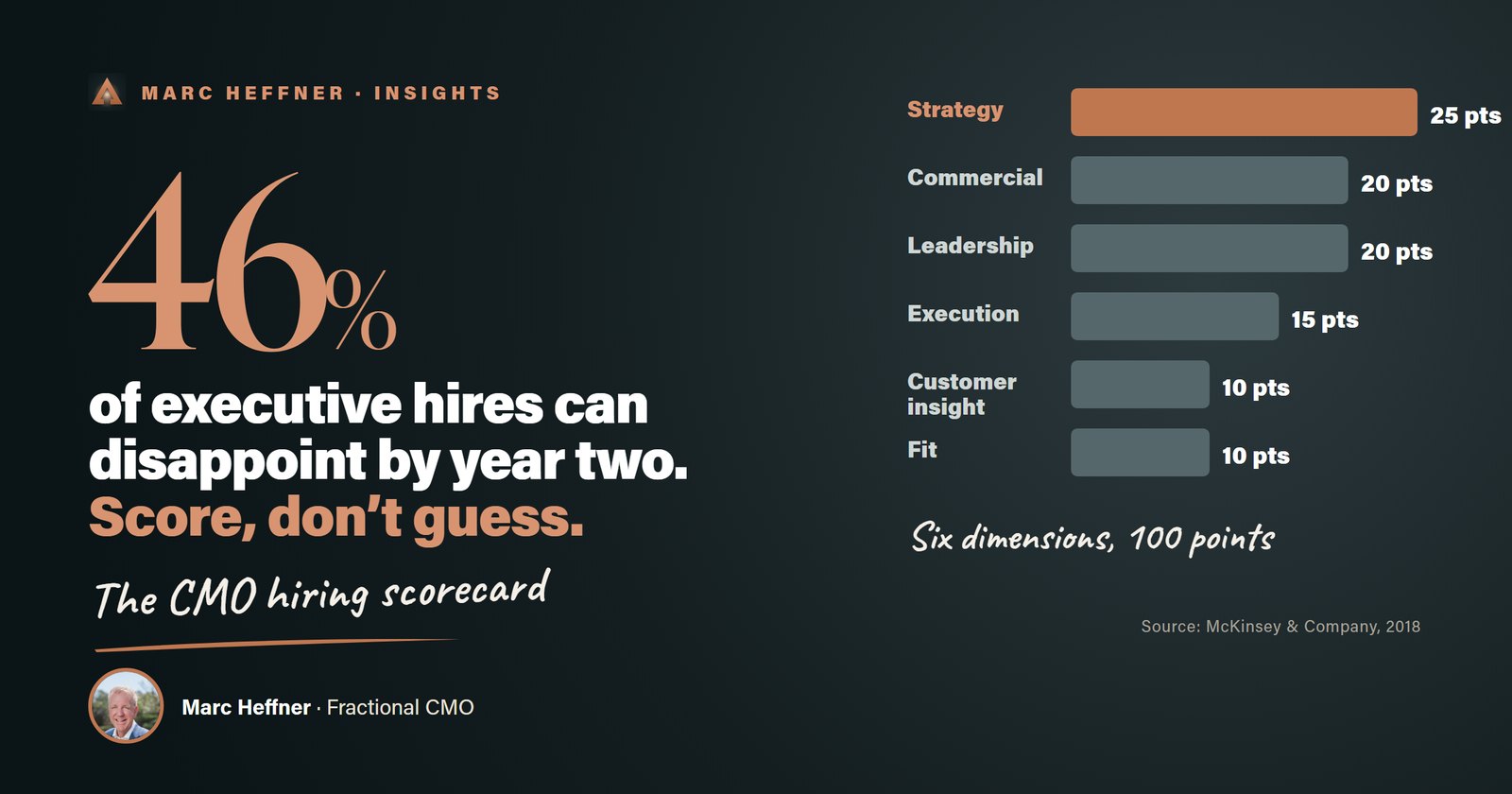
Executive hiring fails more than boards admit. McKinsey found that two years in, 27% to 46% of executive transitions are judged a failure or a disappointment (McKinsey, 2018). CMOs are near the front of that line. The average Fortune 500 CMO lasts 4.3 years, against 7.4 for CEOs, and Spencer Stuart found 31% of S&P 500 companies changed their CMO in a single year (Spencer Stuart, 2025 and 2026).
Part of the reason is that nobody defines the job. When Harvard Business Review reviewed 170 CMO job descriptions, only 22% said how the CMO would be measured (Whitler and Morgan, HBR, 2017). You can’t score a candidate against a target nobody wrote down. And the CEO and the CMO often aren’t even grading the same thing. McKinsey and the ANA (the Association of National Advertisers) found 70% of CEOs judge marketing on revenue and margin, while only 35% of CMOs track that as a top metric (McKinsey and the ANA, 2025).
A scorecard fixes that before the first interview. You decide what matters, how much and how you’ll know.
What the research says about how to score
This isn’t my opinion. Schmidt and Hunter reviewed 85 years of hiring research across thousands of studies. The methods that predict job performance best: work sample tests at .54 and structured interviews at .51. The usual free-form interview dropped to .38. Reference checks came in at .26, and years of experience at .18 (Schmidt and Hunter, 1998).
Read that last number again. How many years someone has held a title tells you almost nothing about how they’ll do in yours. What they did with those years, and how they think through a real problem, tells you a lot. That’s what the scorecard measures.
The six dimensions
Here are the six things I score, with the weight I give each. Adjust the weights for your business, but write them down before you meet anyone.
1. Strategy and judgment (25 points). Can they figure out where growth really comes from, pick a few bets and say no to the rest? Do they ask about customers before channels?
2. Commercial results (20 points). Have they moved revenue, margin, pipeline or share, and can they explain exactly how? Numbers with a story behind them.
3. Leadership (20 points). Have they built teams, led agencies, earned the trust of a sales leader and a CFO? Would people follow them again?
4. Execution (15 points). Do things ship on time at a quality level you’d put your name on? Can they run a launch, a trade show, a campaign calendar?
5. Customer insight (10 points). Do they go find out what buyers think, or do they assume? McKinsey found only 15% of companies consistently bring customer input into decisions (McKinsey and the ANA, 2025). You want the 15%.
6. Fit and candor (10 points). Will they tell you the truth when it’s uncomfortable? Do they match how your company works? Note the weight. Fit is real, but it’s where “I just liked him” sneaks in. Keep it small.
Rating anchors: what a 1, a 3 and a 5 look like
Weights don’t help if everyone scores on a different scale. For each dimension, write a short anchor for 1, 3 and 5. Here’s strategy as an example.
| Score | Strategy and judgment |
|---|---|
| 1 | Talks in channels and tactics. Has a plan for your company before seeing your numbers. |
| 3 | Asks good questions about customers and the business. Plan is sensible but generic. |
| 5 | Finds the real bottleneck fast, picks two or three bets, explains what they’d stop doing and why. You learn something about your own business. |
And commercial results:
| Score | Commercial results |
|---|---|
| 1 | Results are impressions, awards and “brand awareness.” No numbers tied to money. |
| 3 | Has revenue or pipeline numbers but can’t fully explain their own role in them. |
| 5 | Names the number, the decision they made, what it moved and what didn’t work. Can do it for a failure too. |
Write anchors for all six. It takes an hour and it’s the hour that makes the scorecard work.
Where the evidence comes from
Each dimension has a best source of evidence. Strategy and customer insight show up in a structured interview and a work sample. Commercial results come from the record: what the numbers did, confirmed where you can. Leadership and fit show up in references and in how they treat your team during the process. Execution is best seen in a work sample and in what references say about delivery.
Three rules for gathering it:
- Same questions for everyone. Six questions, asked in the same order, scored against the anchors. That’s what makes an interview “structured” and lifts its predictive power from .38 to .51.
- Score alone, then compare. Each interviewer fills in the scorecard before any discussion. The first person to speak in a debrief sets everyone else’s opinion. Numbers on paper first.
- Give finalists a real piece of work. Not a free strategy deck. A one-page summary of your business and an hour to think, then a 45-minute conversation about what they’d ask, do first and stop. Score it like an interview.
The six questions I ask every candidate
- “Walk me through a result you drove. What did you decide, and what would you do differently?” (Commercial, strategy)
- “What would you look at in your first 30 days here, and why?” (Strategy, customer insight)
- “Tell me about a program you killed. How did you know?” (Judgment, candor)
- “Marketing and sales disagree about lead quality. What do you do?” (Leadership, execution)
- “Explain our marketing ROI to a CFO who doesn’t trust marketing.” (Commercial, communication)
- “What’s a strongly held marketing belief you changed your mind about?” (Candor, learning)
Each question maps to at least one dimension. Each one has a 1, 3 and 5 anchor. Each interviewer scores before the debrief.
How to run the debrief
Put the scores on a whiteboard, interviewer by interviewer. Don’t average them yet. Look for the gaps. If three people gave a 4 on strategy and one gave a 2, that’s the conversation. What did the 2 see? Usually it’s the most useful ten minutes of the whole process.
Then total the weighted scores. A candidate who scores 80 and up is a strong hire. Sixty-five to 80 is a maybe, worth a second look at the low dimensions. Below 65, keep looking, no matter how good the logos were.
One more rule: no new criteria in the debrief. If “executive presence” wasn’t on the scorecard, it doesn’t get to decide the hire now. If it should have been, add it next time.
Use the same scorecard at day 90
Here’s the part most companies miss. The six dimensions you hired on are the six things to review at 90 days. Did strategy show up as a one-page plan? Did commercial results show up as a dashboard tied to pipeline? Did leadership show up as a team that’s clearer and faster?
That continuity is what makes CMOs last. The role was defined before the hire, the measures were agreed, and the first review checks the same things. Compare that with the usual pattern: hire on chemistry, measure on whatever the CEO is worried about this quarter, part ways at year three.
It also makes a fractional engagement easy to judge. Same six dimensions, reviewed monthly. My own first engagements run 120 days for exactly this reason: 90 days to prove it, then a 30-day review on the scorecard before anyone commits to a longer term. If the scores are moving, keep going. If they’re not, you know exactly where the problem is.
A worked example: two finalists
Say you’re down to two people for a fractional CMO role at a $40 million manufacturer.
Candidate A ran marketing at a well-known consumer brand. Polished, confident, great stories. Scores: strategy 3, commercial 4, leadership 4, execution 4, customer insight 2, fit 5. Weighted total: 73.
Candidate B led marketing at two industrial companies you’ve never heard of. Quieter. Asked to see your distributor sales data before the second interview. Scores: strategy 5, commercial 4, leadership 4, execution 3, customer insight 5, fit 3. Weighted total: 82.
Without the scorecard, most panels hire A. The logos are better and the room liked her. With the scorecard, B wins by nine points, and the gap is in the two dimensions that matter most for a company that sells through distributors: strategy and customer insight. The debrief should be about whether A’s low customer-insight score is real, and whether B’s execution gap can be covered by your marketing manager. That’s a good argument to have. “Who did we like more” isn’t.
Common mistakes
- Weighting fit too heavily. It’s the easiest score to inflate for a charming candidate.
- Letting the most senior person speak first in the debrief.
- Scoring from memory a day later. Score in the room.
- Skipping the work sample because the candidate is busy. The best predictor is worth 45 minutes.
- Hiring the highest total when one dimension is a 1. A great strategist who can’t lead will still fail.
Questions CEOs ask
Isn’t this a lot of process for one hire?
It’s about three hours of extra work: an hour on weights and anchors, an hour on questions, an hour on the debrief. Against a $600,000 first-year cost and a 27% to 46% miss rate, it’s the cheapest insurance you’ll buy.
Does it work for fractional CMOs?
Yes. Same dimensions, same anchors. Weight commercial results and strategy a bit higher, since you’re buying judgment more than presence.
Who should be on the panel?
The CEO, the sales leader, the CFO and one strong marketer if you have one. Four people, same questions, scores on paper before the debrief.
What if a great candidate scores low on one dimension?
Decide whether you can cover it. A 2 on execution is fine if you have a strong manager. A 2 on candor isn’t fine for anyone.
The bottom line
Define six dimensions, weight them, write anchors, ask the same questions, score alone, give finalists real work, debrief on the gaps and reuse the scorecard at day 90. It takes three extra hours and it’s backed by 85 years of research. It’s also how I’d want to be hired. Let’s talk if you want help running it.
Sources
- Schmidt and Hunter, Psychological Bulletin, The Validity and Utility of Selection Methods in Personnel Psychology: Practical and Theoretical Implications of 85 Years of Research Findings, 1998.
- Harvard Business Review (Whitler and Morgan), Why CMOs Never Last, 2017.
- McKinsey & Company, Successfully transitioning to new leadership roles, 2018.
- McKinsey & Company and the ANA, The CMO’s comeback: Aligning the C-suite to drive customer-centric growth, 2025.
- Spencer Stuart, CMO Tenure 2026: Snapshot of an Expanding Role for Marketing Leaders, 2026.
- Spencer Stuart, Fortune 500 C-Suite Snapshot 2024: Profiles in Functional Leadership, 2025.