 MARC
Hiring a fractional CMO is easier than hiring a full-time one. Less money, less risk, faster start. But easier isn’t the same as easy. I’ve watched CEOs pick the person with the best logos on their slide and regret it in sixty days. Here’s the process I’d use if I were sitting in your chair.
How do you hire a fractional CMO?
You hire a fractional CMO by naming the problem you need solved, writing a one-page brief, building a short list around relevant experience, testing judgment with a real work discussion, and putting authority and deliverables in writing before day one. Eight steps. Most of them take an hour or two. Skipping them is what costs you.
If you’re still deciding between fractional and full time, start with how to hire a CMO and come back here.
Step 1: Name the problem before you write the job
“We need marketing leadership” isn’t a problem. It’s a job title. Dig one level down. What’s actually broken?
- Growth has stalled and nobody can explain why.
- You spend real money and can’t tie it to revenue.
- The team and agencies are a mess and nobody directs them.
- Something big is coming: a launch, an acquisition, a sale.
Each one points to a different profile. A turnaround person. A numbers person. A team builder. Someone who’s run a launch like yours. Most good fractional CMOs can do all four, but every one of us is strongest at one or two. Hire for the one you need most this year.
This step also tells you whether you need a fractional CMO at all. If the problem is “nobody is writing content,” hire a content manager. If it’s “we need to be through a sale in nine months,” you might want an interim CMO full time.
Step 2: Write a one-page brief
One page. Not a job description with forty bullets. Mine has five parts:
- The problem in two sentences.
- What success looks like at 90 days and at one year, in numbers.
- What they’ll own: strategy, budget, team, agencies, the dashboard.
- What they won’t own: sales, product, the website build.
- Days per week, availability, start date and budget range. Ask whether they’re reachable every weekday, not just on their days in the business.
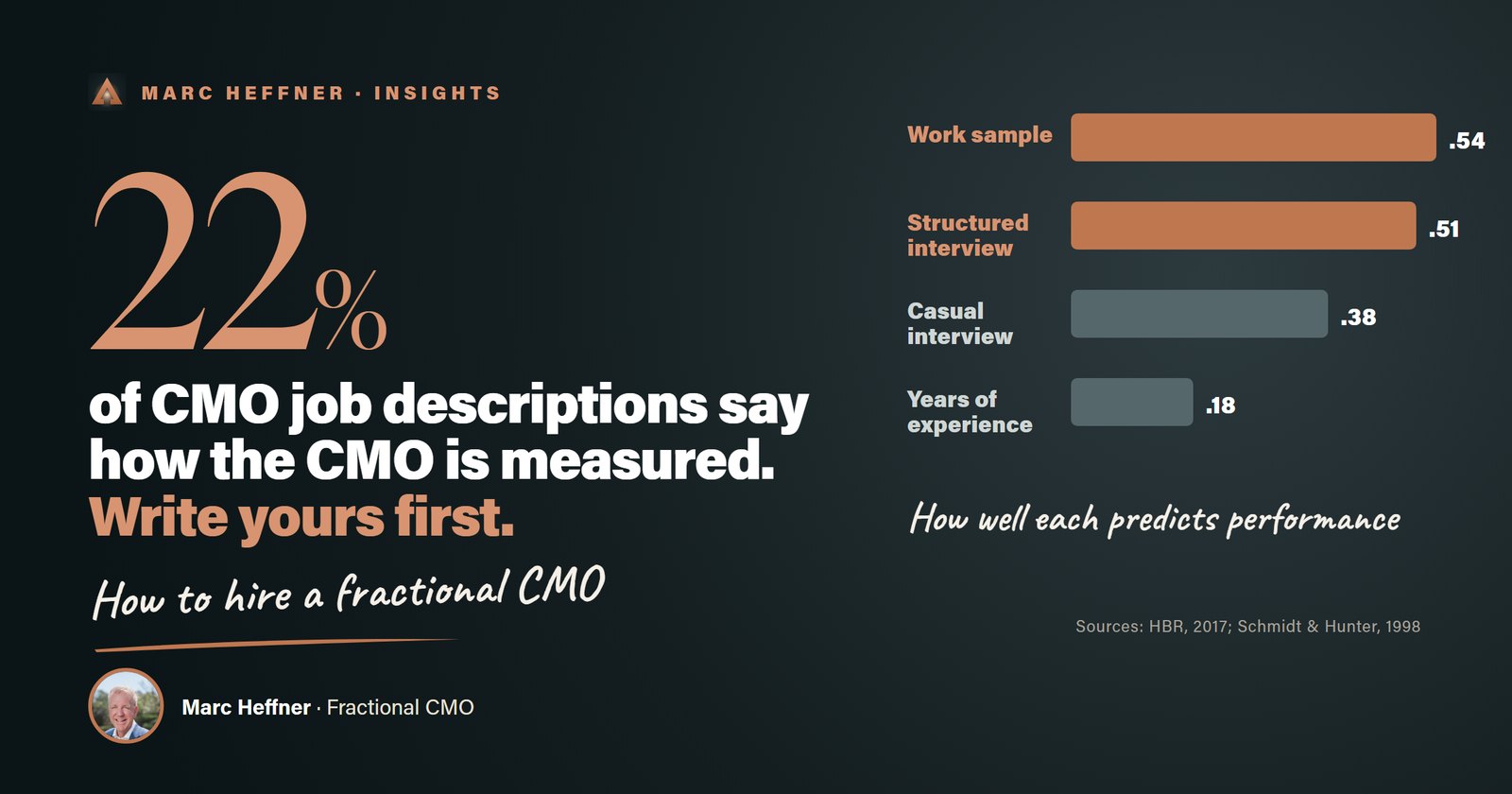
The second part is the one most companies skip. When Harvard Business Review reviewed 170 CMO job descriptions, only 22% said how the CMO would be measured (Whitler and Morgan, HBR, 2017). If you can’t write the measure, you’re not ready to hire. You’re ready to think.
Step 3: Build a short list around relevant problems, not familiar logos
The market is growing fast. Lightcast counted 677 US fractional job postings in 2025, more than double 2024, and nearly 1,000 in the first seven months of 2026 (Lightcast, 2026). That means more good candidates. It also means more people who added “fractional CMO” to a LinkedIn profile last month.
Where to look:
- Your network first. Ask your CFO, your banker, your PE sponsor and two CEOs you trust. The best fractional leaders get most of their work by referral.
- Fractional executive firms. Faster, more vetted, more expensive. Good when you need a start date in two weeks.
- LinkedIn, carefully. Search for people who held the title you need at a company like yours, and who show results, not activity.
What to look for in a background: they’ve solved your problem, in a company near your size, in a market that sells the way you sell. A CMO who ran a billion-dollar consumer brand may be lost in a $30 million industrial company that sells through distributors. The logos look great. The fit is wrong.
My own path is a good example of what to check. I led marketing at Lochinvar, a boiler and water heater manufacturer, and at Wilbur Curtis, a commercial coffee equipment maker. Then I ran marketing for a 14-office dental group and an oral surgery practice. If you make industrial products or run multi-location healthcare, that’s relevant. If you sell consumer apps, you should probably talk to someone else, and I’ll tell you so.
Step 4: Interview for judgment, using the same questions every time
Here’s the research most hiring managers never see. In the largest review of hiring methods ever done, Schmidt and Hunter looked at 85 years of studies on what actually predicts job performance.
Work samples came out on top at .54. Structured interviews, the same questions for every candidate with a scoring guide, scored .51. Unstructured interviews, the usual “tell me about yourself” chat, dropped to .38. Reference checks landed at .26, and years of experience at just .18 (Schmidt and Hunter, 1998). In plain terms: how long someone has done a job tells you very little. How they think through a real problem tells you a lot.
So write six questions and ask every candidate the same six. Mine:
- “Walk me through a result you drove. What did you decide, and what would you do differently?”
- “What would you look at in your first 30 days here, and why?”
- “Tell me about a time you killed a program you’d started. How did you know?”
- “Marketing and sales disagree about lead quality. What do you do?”
- “How would you explain our marketing ROI to a CFO who doesn’t trust marketing?”
- “What’s a strongly held marketing belief you changed your mind about?”
Score each answer one to five against a short written guide before you discuss the candidate with anyone else. That one habit removes most of the bias and most of the “I just liked her” hires. I lay out the full scoring system in the CMO hiring scorecard.
Step 5: Use a real work discussion
Since work samples predict best, give your two finalists one. Not a free strategy deck. That’s unpaid consulting and good people decline it. Instead, a bounded discussion:
“Here’s a one-page summary of our business and our marketing numbers. Spend an hour with it. Then let’s talk for 45 minutes about what you’d want to know, what you’d do first and what you’d stop.”
You’re not grading the answer. You’re grading how they think. Do they ask about customers before channels? Do they want to see the sales data? Do they say “I don’t know yet, here’s how I’d find out”? Or do they arrive with a ready-made plan that could apply to any company? The second kind will run the same play at your company they ran at the last three.
Step 6: Check how they worked with people, not just what they produced
Reference checks are weak predictors on their own, but they’re cheap and they catch the things interviews miss. Ask for three: a CEO they reported to, a peer like a sales leader, and someone who reported to them. Then ask each one the same three questions:
- “What did they change in the first 90 days?”
- “When did you disagree, and how did it go?”
- “Would you hire them again? For what?”
Listen for the pause before the last answer. It tells you more than the words.
Where fractional hires go wrong
I’ve seen four ways these engagements fail, and none of them is about talent.
The role was never defined. The CEO wanted a strategist. The team expected a doer. The fractional CMO spent three months being neither. This is the same reason full-time CMOs struggle. Spencer Stuart found 31% of S&P 500 companies changed their CMO in a single year, and the average tenure is about four years (Spencer Stuart, 2026). Unclear roles don’t last at any price.
No authority. Every budget move needed three signatures. Every agency change got debated for a month. The leader couldn’t lead.
No access. Left out of the leadership meeting, never saw the financials, met customers only by accident.
Too many clients. The person was sharp but spread across six companies. Yours got the leftover hours.
Every one of these is a hiring-process problem, not a people problem. Steps 2, 7 and 8 prevent them.
Step 7: Compare proposals on one scope sheet
You’ll get proposals in different formats with different prices. Don’t compare them as written. Rewrite each one onto a single scope sheet with the same rows: days per week, start date, named deliverables by day 90, decision rights and budget authority, who they manage, how often you review, and how either side exits.
Now the prices make sense. A proposal that costs 30% more but includes agency management and a weekly pipeline review may be the cheaper one. A proposal that lists twelve channels and no deliverables is telling you something. I go deeper on pricing in how much a fractional CMO costs.
Step 8: Put the working agreement in writing
Before day one, agree on four things and write them down:
- Authority. What can they decide alone? Budget moves under a set amount, agency changes, campaign calls. Without this, you’ve hired an expensive advisor.
- Access. The leadership meeting, the sales meeting, the financials, the customers. McKinsey and the ANA (the Association of National Advertisers) found only half of CMOs believe marketing is even involved in strategic planning (McKinsey and the ANA, 2025). Don’t make yours one of them.
- The scorecard. Three to five numbers, agreed with the CEO, reviewed monthly. The same numbers the CEO cares about. McKinsey found 70% of CEOs grade marketing on revenue and margin (McKinsey and the ANA, 2025). Start there.
- The exit. Thirty days’ notice either way, and what gets handed over. Clean exits make it easier to say yes.
The first 30 days
Onboarding a fractional CMO is mostly about speed of access. Week one is logins, data, the budget and introductions. Week two is a listening tour: sales, operations, finance, a few customers and a few lost deals. Week three is quick fixes, usually stopping waste you both can see, and starting the dashboard. Week four is the first review with you: what they learned, what they’ll do and how you’ll both measure it.
If you don’t get that fourth-week review, ask for it. It’s the moment you find out whether you hired a leader or a very experienced spectator.
Getting this right matters more than people think. McKinsey found that 27% to 46% of executive transitions are judged a failure or a disappointment after two years (McKinsey, 2018). The main causes aren’t skill. They’re unclear roles, slow access and no agreed measures. All three are fixable in the first month.
Red flags
- A plan for your company before they’ve seen your numbers.
- Every example is about tactics and channels, never customers or revenue.
- Results with no numbers, or numbers with no story.
- They won’t name a company where it didn’t work.
- They want to bring their own agency on day one.
- They’re running six other clients and can’t tell you which day is yours, or whether you can reach them on the others.
Questions CEOs ask
How long should the search take?
Two to four weeks if you use your network and move with purpose. A full-time CMO search often takes four to six months. The speed is one of the main reasons to go fractional.
Should I run a paid trial?
A short first engagement beats an unpaid trial. Mine is 120 days: 90 days to build and prove, then 30 days to review the scorecard and decide together whether to extend. You see real results before you sign anything longer.
How many clients should a fractional CMO have?
Two to four is normal. More than that and you’re sharing an inbox, not a leader. Ask directly and ask which days are yours.
What if it isn’t working?
Say so at the monthly review, with the scorecard in front of you. Good fractional leaders would rather fix it or leave cleanly than drift. That’s why the exit terms go in the agreement.
The bottom line
Name the problem. Write one page. Short-list for relevant problems, not logos. Ask the same questions, score them and give a real work discussion. Compare proposals on one sheet. Write down authority, access, the scorecard and the exit. Do those eight things and you’ll hire well, whether you hire me or someone else.
Sources
- Schmidt and Hunter, Psychological Bulletin, The Validity and Utility of Selection Methods in Personnel Psychology: Practical and Theoretical Implications of 85 Years of Research Findings, 1998.
- Harvard Business Review (Whitler and Morgan), Why CMOs Never Last, 2017.
- McKinsey & Company, Successfully transitioning to new leadership roles, 2018.
- McKinsey & Company and the ANA, The CMO’s comeback: Aligning the C-suite to drive customer-centric growth, 2025.
- Lightcast, The Rise of Fractional Leadership, 2026.
- Spencer Stuart, CMO Tenure 2026: Snapshot of an Expanding Role for Marketing Leaders, 2026.