 MARC
THE SHORT ANSWER
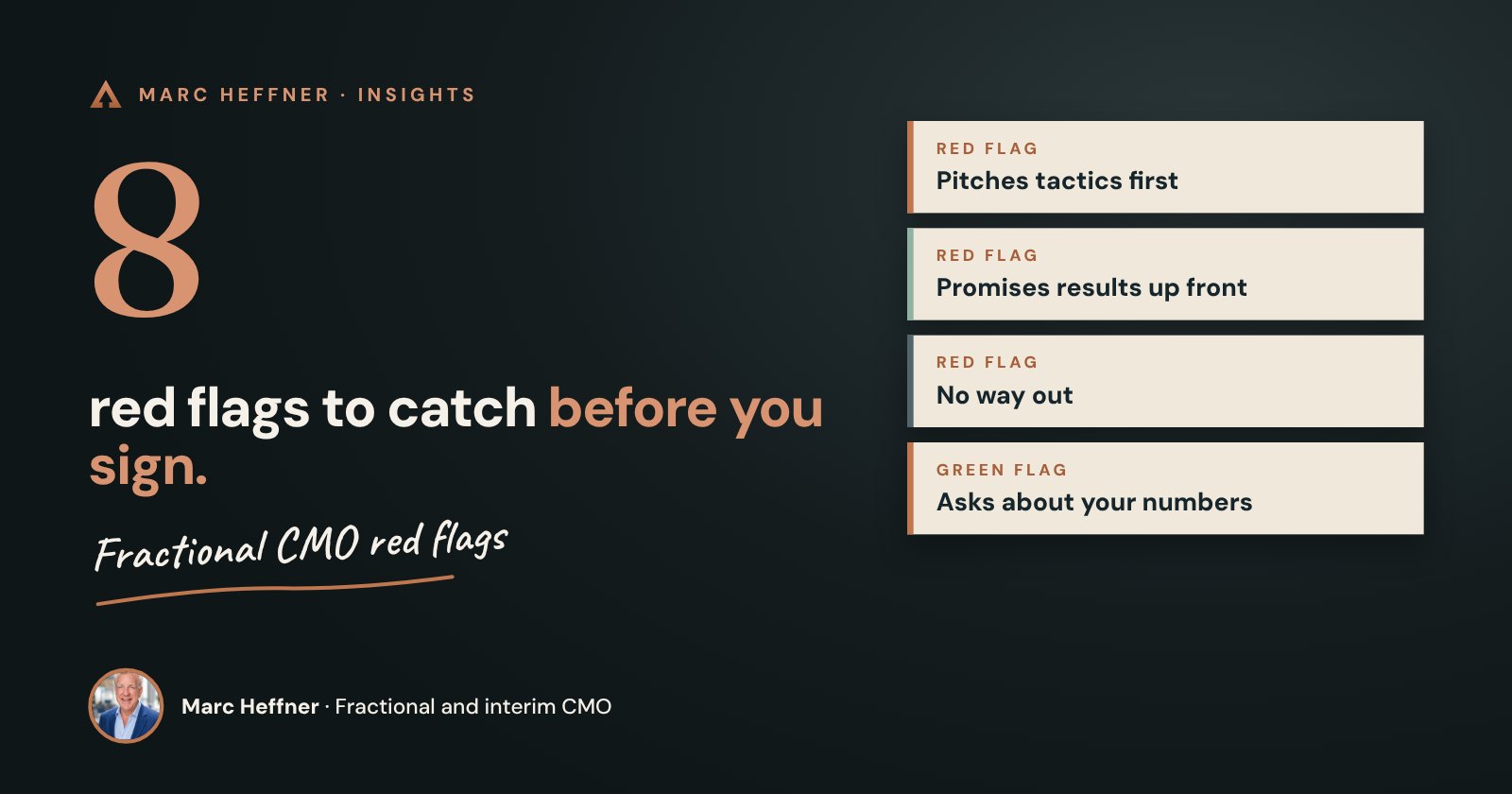
Watch for a fractional CMO who pitches tactics before asking about your business, promises results before seeing your data, can’t show results from a company like yours, wants a long lock-in with no way out or reports on activity instead of revenue. Any one is worth a hard question. Two or more, keep looking.
Demand for fractional leaders has taken off. Lightcast found fractional job postings more than doubled in 2025 (Lightcast, 2026). When demand grows that fast, a lot of people add “fractional CMO” to their profile. Some have run marketing at a senior level. Some haven’t. Here’s how to tell the difference before you sign.
The 8 red flags
1. They pitch tactics before asking about your business
If the first meeting is all about TikTok, AI tools or a new website, slow down. A real CMO asks about your customers, your numbers and your goals first.
2. They promise results before seeing your data
“I’ll double your leads in 90 days” sounds great. No one can promise that without looking under the hood. Honest people give a range after they’ve seen the numbers.
3. They can’t tell a story about a company like yours
Ask for an example with a before and after. If all you get is big logos and job titles, that’s a flag.
4. They want a long lock-in with no way out
A year-long contract with no exit protects them, not you. Look for a clear check-in at 30 or 90 days.
5. They’re vague about who does the work
Will they do the work, coach your team or hand it to an agency? If the answer is fuzzy, you may be paying for senior help and getting junior work.
6. They report on activity, not revenue
Posts, clicks and impressions are fine, but they’re not the goal. McKinsey and the ANA found 70% of CEOs judge marketing on revenue and margin, but only 35% of CMOs track that as a top metric (McKinsey and ANA, 2025). Hire someone who’s in the 35%.
7. They push their own agency or tools
Some fractional CMOs make money by sending work to an agency they own or one that pays them. That’s not always bad, but it should be out in the open. Ask directly.
8. They never talk about the handoff
A good fractional CMO builds your team and your playbook so you need them less over time. If they never mention how it ends, they’re planning for you to need them forever.
Red flags vs. green flags
What to do if you spot one
Don’t walk away right away. Ask about it. Sometimes there’s a good answer. A great fractional CMO won’t get defensive. They’ll explain, show you proof or change the terms. If they dodge, that tells you what you need to know.
Then check references. Ask two former clients what changed while this person was there and whether they’d hire them again. Reference checks predict job performance better than years of experience (Schmidt and Hunter, 1998).
Green flags look like results you can check. At one 14-office group, fixing how calls were handled cut missed calls 91%, with no new ad budget. See more results.
Questions CEOs ask
What’s the biggest red flag?
Promising results before seeing your data. It means they’re selling, not diagnosing.
Is it a red flag if they work with other clients?
No. That’s how fractional works. Just make sure you know their schedule and how fast they respond.
Should a fractional CMO have been a full-time CMO?
Not always, but they should have led marketing at a senior level and owned results. Ask what they owned, not just what their title was.
Is a month-to-month agreement a good sign?
Usually, yes. It shows they expect to earn the work. Some projects need a set length, and that’s fine if there’s a clear way out.
How do I check a fractional CMO’s results?
Ask for specific examples, then ask references about the same ones. Real results hold up when you ask twice.
The bottom line
The best fractional CMOs ask before they pitch, show proof from companies like yours, measure revenue and plan for the handoff. If you see two or more red flags, keep looking. Want a second set of eyes? Let’s talk.
Sources
- Lightcast, The Rise of Fractional Leadership, 2026.
- McKinsey & Company and the ANA, The CMO’s comeback: Aligning the C-suite to drive customer-centric growth, 2025.
- Schmidt and Hunter, Psychological Bulletin, The Validity and Utility of Selection Methods in Personnel Psychology: Practical and Theoretical Implications of 85 Years of Research Findings, 1998.