 MARC

THE SHORT ANSWER
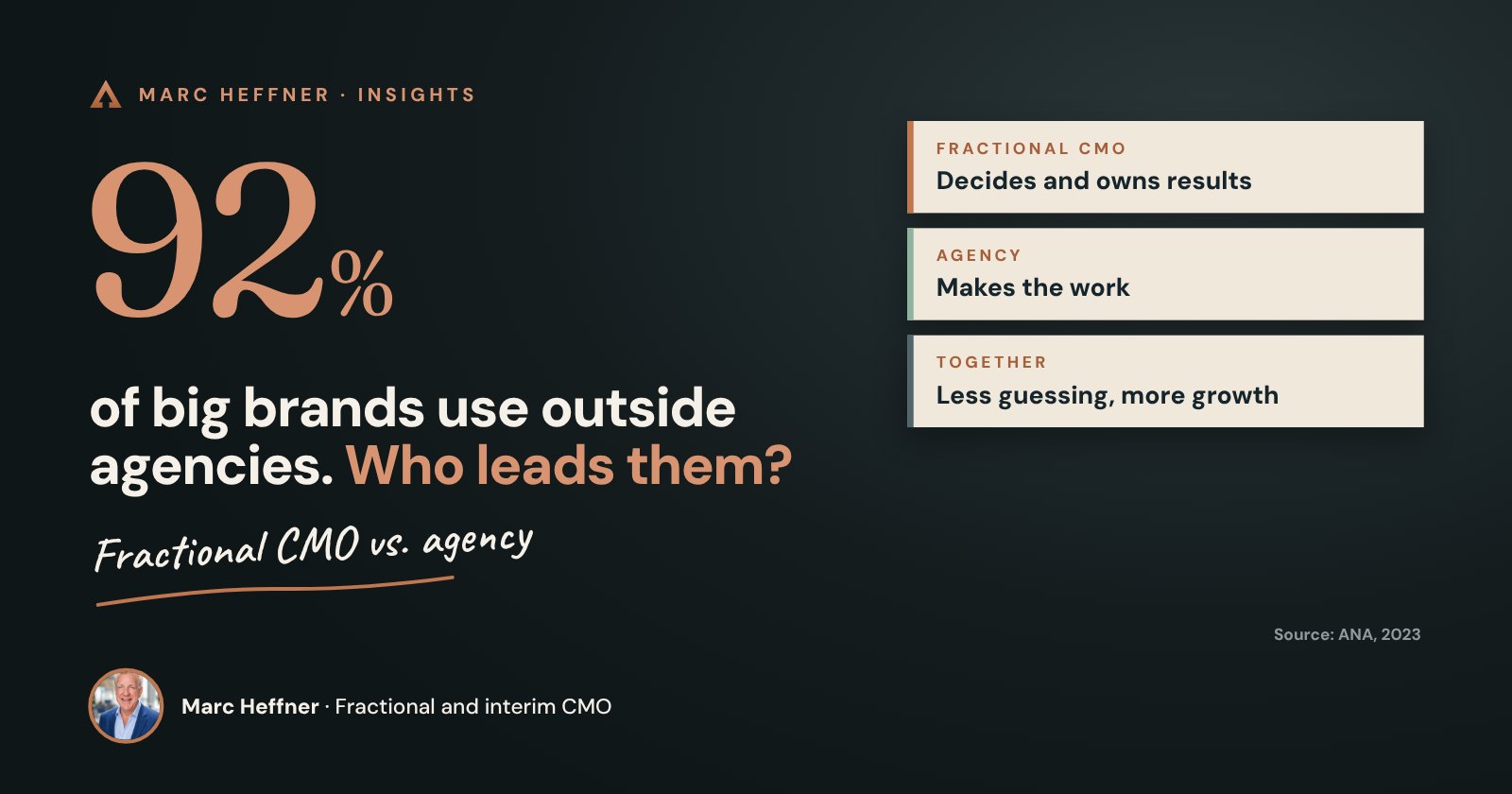
A marketing agency makes things: ads, content, campaigns, websites. A fractional CMO decides what to make, sets the budget and holds the agency to the results. They aren’t competitors. If your agency is busy but the numbers aren’t moving, you’re likely missing the leader, not another vendor.
I hear this a lot from CEOs: “We already pay an agency. Why would we need a CMO too?” Fair question. The answer comes down to one word: accountability.
What’s the difference between a fractional CMO and a marketing agency?
An agency is a team of specialists you hire to produce work. Designers, writers, media buyers, developers. Good ones are great at making things. A fractional CMO is a senior leader who works with you part time. They own the strategy, set priorities, decide where the money goes, lead your people and your agencies, and answer for the results.
Put simply, the agency is the crew. The fractional CMO is the general contractor.
| Fractional CMO | Marketing agency | |
|---|---|---|
| Main job | Decide what to do and own the results | Make the work and run campaigns |
| Works for | Your leadership team | Its own list of clients |
| The budget | Sets it | Spends what it’s given |
| Your team | Leads it, plus the agencies | Works alongside it |
| Measured on | Revenue, pipeline and the plan | Deliverables and channel numbers |
| How it’s priced | A monthly retainer tied to days per week | Retainers, projects or a share of spend |
Most companies need both
The biggest brands in the country still use outside agencies. The ANA found 92% of its member companies work with external agencies, even though 82% also run an in-house agency (ANA, 2023). Companies send work outside when they need more hands or a skill they don’t have inside.
So the question isn’t agency or CMO. It’s whether anyone on your side is setting the direction and checking the work. Without that, an agency fills the gap with what it does best: more activity.
Signs you need a fractional CMO, not a new agency
- You’ve switched agencies, and the results didn’t change.
- Reports are full of clicks and impressions, but no one can tie them to revenue.
- Your agency asks you what to do next, and you’re not sure.
- Sales says the leads are bad, marketing says sales doesn’t follow up, and no one settles it.
- You pay several vendors, and no one makes them work together.
If two or more of these sound familiar, another agency won’t fix it. The missing piece is a leader.
Signs an agency is the right fix
- You have a clear strategy and someone who owns it, but no one to make the work.
- You need a skill you’ll only use now and then, like video, paid media or a website rebuild.
- Your team has more good ideas than hours.
In those cases, an agency adds hands without adding headcount. That’s exactly what they’re good at.
How the two work together
When I’m the fractional CMO, the agency gets a sharper brief, clear goals and one person to answer to. I set the priorities and the budget. They make the work. We look at the same numbers every month, and we keep what works and cut what doesn’t. A good agency likes this setup. It means less guessing and more credit when things go right.
Budgets are tight, too. Gartner found 56% of marketing leaders say they don’t have the budget to deliver their strategy (Gartner, 2026). When money’s tight, someone has to decide what not to do. That’s a leadership job, not an agency job.
Leadership plus good partners is where the results come from. At Rahn Industries, rebuilding the website and lead flow took web quotes from closing 2.2% of the time to 16.6%. See more results.
Questions CEOs ask
Is a fractional CMO cheaper than an agency?
They do different jobs, so it’s the wrong comparison. The real question is whether your agency spend is working. A good fractional CMO usually makes it work harder.
Will a fractional CMO replace my agency?
Not usually. I’ll tell you honestly if an agency is the wrong fit, but most of the time the fix is a better brief, clearer goals and someone holding the work to a number.
Can a fractional CMO manage more than one agency?
Yes. That’s one of the main reasons companies bring one in: someone to make the web, media and content partners pull the same way.
Do I still need an in-house marketer?
Usually, yes. A day-to-day marketer or coordinator keeps things moving between the fractional CMO’s days.
How do I know which one I’m missing?
Ask who decides what marketing does next and who answers for the results. If the answer is the agency, or no one, you’re missing the leader.
The bottom line
An agency makes the work. A fractional CMO decides what to make, sets the budget and holds everyone to the results. Most growing companies need both. If your agency is busy and the numbers are flat, let’s talk about what’s missing.
Sources
- ANA, The Continued Rise of the In-House Agency, 2023 Edition, 2023.
- Gartner, 2026 CMO Spend Survey, 2026.