 MARC
Most dental groups tell me they’re already using AI. Then I ask what the plan is. That’s usually where the room goes quiet.
I sat down with Adrian Lefler on the Byte Sized podcast to talk about exactly this. The short version: buying better tools isn’t the win. Rebuilding how the team works is. Here’s the conversation in writing, with the research behind it.
Why this matters to a DSO right now
DSOs are growing fast. The American Dental Association’s Health Policy Institute found more than 1 in 4 newer dentists are affiliated with one (ADA Health Policy Institute, 2025). More locations means more phones, more leads and more people who touch the patient. It also means the old way of running marketing gets stretched thin.
That’s the gap I work in. I act as a fractional CMO for groups in the five to 50 location range. Growth is real. The marketing setup hasn’t caught up.
Start with the phones, not the tools
Before AI, I ran marketing for a 14-location DSO. When I got there, the 24-person call center sat under operations. It closed at 6 p.m. We were running ads at night, when they’re cheaper, and nobody was there to pick up.
So I moved the call center under marketing. We held a short daily meeting: what did we do yesterday, what’s the plan today, how are the numbers? We started listening to calls and coaching the team on what they did well and what they missed.
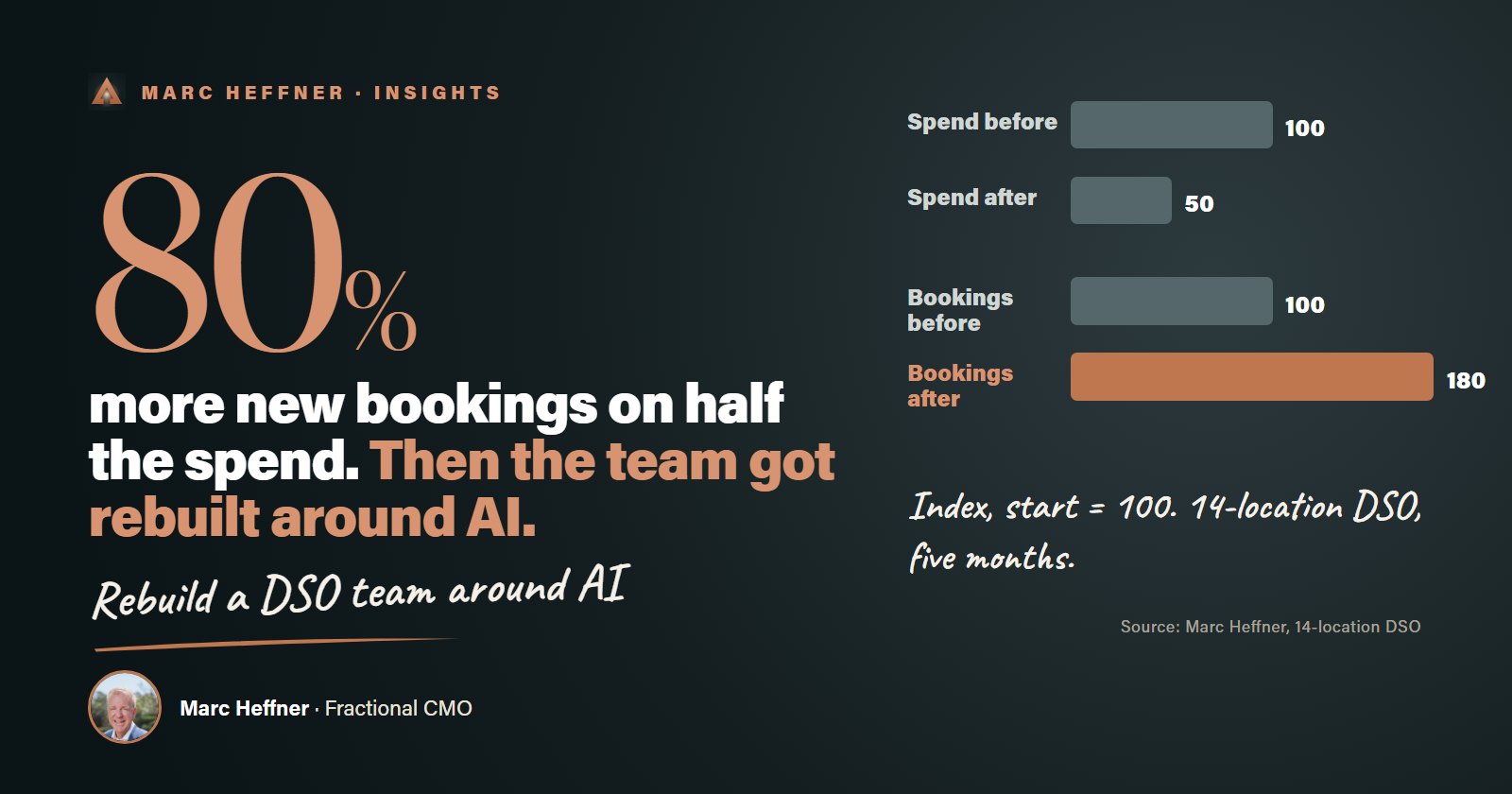
Marketing spend came down by half. New bookings went up 80% in about five months. It didn’t happen because of me. It happened because operations and marketing finally worked as one team.
Here’s my point. If the front desk can’t turn a lead into an appointment, no tool will fix that. Everyone who talks to a patient is part of the marketing team.
Using AI isn’t the same as having a plan
When I talk to executives, I hear the same thing. “We use AI. We have Pearl and Overjet.” Great. Those are diagnostic tools. They’re one sport in a very big league.
On the marketing side it’s even simpler. The team opens ChatGPT every morning and writes the posts from scratch. Again. Every day. That isn’t a strategy. That’s a very fast typist.
The research agrees. McKinsey surveyed 1,491 people in 101 nations and tested 25 factors. Redesigning workflows had the biggest effect on whether a company saw a profit impact from generative AI. Only 21% of those using it had done that (McKinsey, 2025).
The five layers I build
Think of the bottom layer as hiring a junior creative. I build an AI helper that writes content. I feed it a year of the practice’s own posts so it learns the voice. Then I let ChatGPT and Claude challenge each other’s ideas two or three times before I see anything.
Next I add other helpers for graphics, scheduling and reporting. On their own they don’t talk to each other. So I put an orchestrator on top. It runs the whole set, in order, and posts the work for review.
Then come the safety layers. A feedback loop records what worked. Governance rules spell out what the system can’t do. I’ve found a long “can’t” list makes it better, not worse.
The last layer is a person. There’s a simple check mark that says approved. Nothing leaves my computer until a human has signed off. It might sit overnight. That’s fine.
When I’m set up right, I walk in at 8 a.m. and ask what got done. I tweak a line of copy here and a photo there. About ten minutes later I’ve finished a week of work.
Why the human gate is not optional
At a DSO event this year, a panelist said all marketing would be automated within a year. I don’t buy it. You can’t turn an agent on and walk away. It drifts, and the work turns generic fast.
The data backs up my gut. McKinsey found only 27% of companies using generative AI say employees review all of its output before use. A similar share check 20% or less (McKinsey, 2025).
Gartner is blunt about the other side. It expects over 40% of agentic AI projects to be canceled by the end of 2027, because of rising costs, unclear value and weak risk controls (Gartner, 2025). It also says many vendors are “agent washing,” which means rebranding old chatbots and automation tools as agents.
So when a vendor tells you a $349 a month tool will replace your whole marketing team, ask who approves the work.
What happens to the team
People worry about jobs. I get it. Adrian told a story that mirrors mine. His team had two copywriters turning out hundreds of pages a month. Then he built an automation that wrote the copy.
One copywriter moved to other marketing work. The other became an automation editor. She stopped writing and started judging what the system produced, then told the engineer what to fix. Now one person produces about three times as much copy. Nobody was let go.
The new job is judging, not typing. Recently I read a paragraph that used the word “help” three times in four sentences. It was correct, but it wasn’t my voice. An editor catches that. A good editor then asks the AI to rewrite it in 20 seconds instead of doing it by hand.
The double-blind problem
Here’s something no one says out loud. Executives know AI is powerful, but they don’t know what’s possible. And no marketing manager is going to volunteer that half of the team’s work can be automated.
So the team keeps doing good work the old way, and the executive keeps signing off on it. Nobody is wrong. Nobody has a reason to change.
That’s one reason an outside leader helps. I can look at the whole team, ask what a new group would look like today, and say it without worrying about my job.
How I start with a DSO
I don’t start by changing things. A great teacher told me early in my career to understand where all the pieces are before you move any of them. So I sit in the office, visit locations and learn how the teams really work together.
Then we set a financial baseline and make sure the data exists. We map workflows, tools and owners. We pick one or two cases with clear value and human approvals. We run a pilot, measure it against the baseline, train the team and scale.
Two requirements. I need an executive sponsor, and I need access to the numbers. If a group isn’t willing to share information, we’re probably not the right fit. Marketing doesn’t work in a silo.
My goal isn’t to stay forever. Most engagements start at 120 days, so we can prove the work is paying off. Over time I want to get a group to the point where it can hire a full-time marketing leader. I’ll even help find my replacement. See how to hire a fractional CMO and the CMO hiring scorecard for how that goes.
HIPAA and your own data
This is the part that keeps owners up at night, and it should. I’m a marketer, not a lawyer or a security expert. I work with the people who are.
Here’s what I know. Don’t paste patient information into a free consumer chat tool. The U.S. Department of Health and Human Services says a cloud provider that stores electronic patient information needs a business associate agreement, even when the data is encrypted (HHS, Guidance on HIPAA & Cloud Computing).
That’s where retrieval augmented generation, or RAG, comes in. In plain English, the AI looks things up in a closed set of your own approved files instead of learning from the open internet. It’s a strong design choice. But it doesn’t replace the agreement, the access controls or a review by your compliance team.
The rules are still being written, often after lawsuits. Build it right the first time.
What to do this week
I closed the episode with the same advice I give every team. AI is a tool. Put it on your phone. Use it for something fun. I built my own version of Asteroids in about 30 minutes and used it to learn how to fix a power washer.
No one is an expert. The models change every few weeks. What you build today may need a refresh in three months, and that’s okay. The groups that wait for things to settle will fall behind the ones that learn now.
If you remember one thing, make it this: AI doesn’t forget. It builds institutional memory that stays with your organization long after any one person leaves. That’s the real asset.
Questions DSO leaders ask
What is an AI orchestrator in marketing?
It’s the layer that runs your AI helpers in order. One helper writes, another makes graphics, another schedules posts. The orchestrator manages the steps, passes work along and stops at the human approval gate.
Will AI replace my marketing team?
In my experience, it changes the jobs more than it removes them. A copywriter can become an editor who reviews three times the output. The people who judge quality, protect the brand voice and manage the system matter more, not less.
Is it safe to use ChatGPT or Claude with patient data?
Not in a free consumer account. Keep patient information out of those tools unless your compliance team has set it up with the right agreements. HHS says cloud providers that store patient data need a business associate agreement. Ask your lawyer and your security lead before you start.
Where should a DSO start with AI?
Start with a baseline and one or two clear use cases, like lead follow-up or content drafts. Run a pilot, compare it to the baseline, then train the team and scale what works.
How big should a DSO be before it needs a fractional CMO?
I work mostly with groups of five to 50 locations. That’s where growth is real but the marketing leadership hasn’t caught up yet. Bigger groups usually hire a full-time executive.
The bottom line
AI won’t fix a broken front desk, and it won’t replace judgment. It works when you start with the numbers, rebuild the work around a few clear layers, and keep a person in charge of what goes out. Do that and a week of work really can take ten minutes on a Monday morning.
Sources
- McKinsey & Company, The state of AI: How organizations are rewiring to capture value (1,491 respondents, 101 nations), 2025.
- Gartner, Gartner Predicts Over 40% of Agentic AI Projects Will Be Canceled by End of 2027, 2025.
- American Dental Association Health Policy Institute, The U.S. Dentist Workforce, summarized in ADA News: More new dentists affiliated with DSOs, 2025.
- U.S. Department of Health and Human Services, Office for Civil Rights, Guidance on HIPAA & Cloud Computing, 2026.
- Byte Sized Podcast, Episode 61: The Orchestrator: How to Rebuild a DSO Marketing Team Around AI (Adrian Lefler with Marc Heffner), 2026.