 MARC

THE SHORT ANSWER
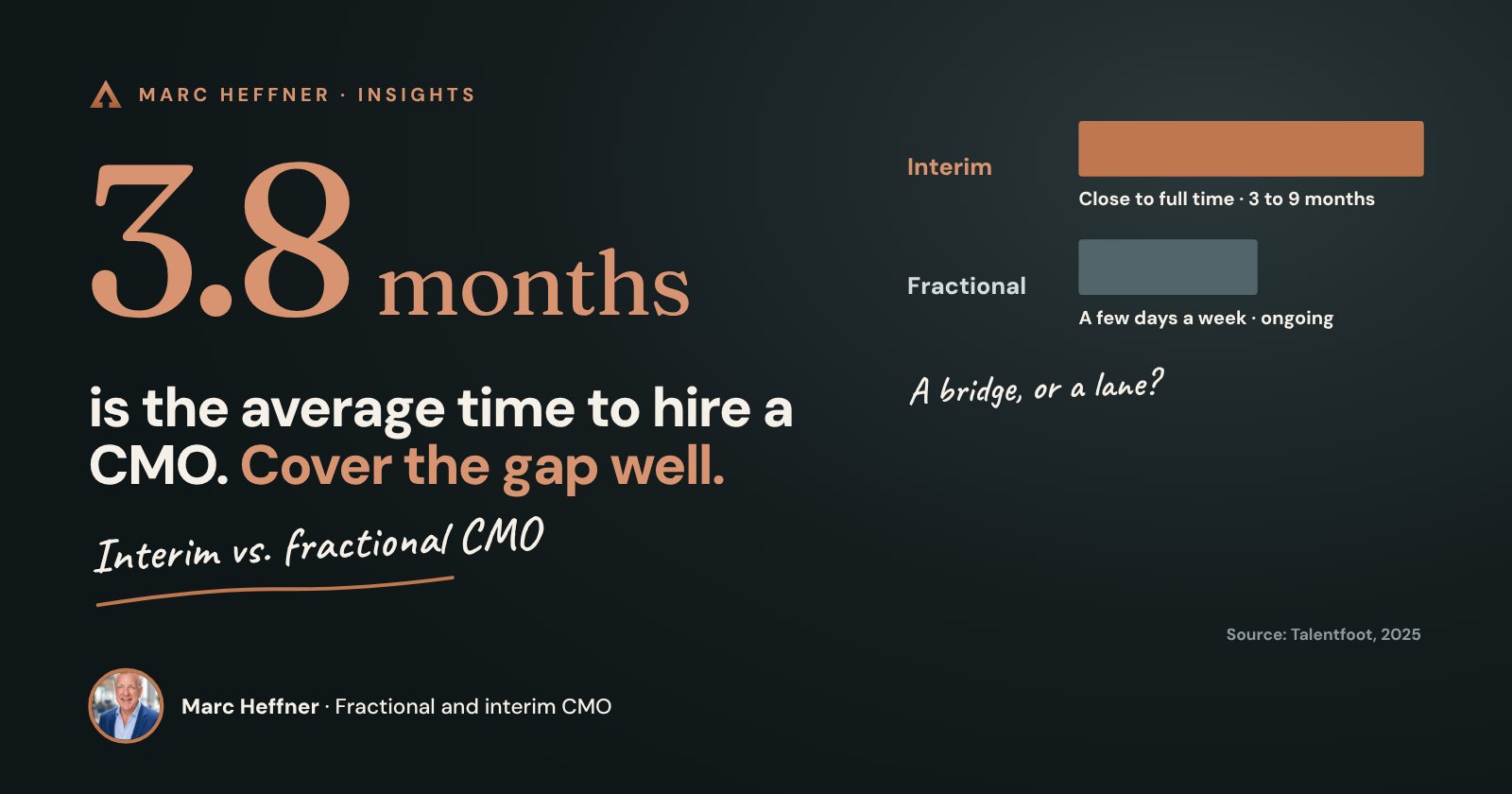
An interim CMO works close to full time for a set stretch, usually three to nine months, to cover a gap and hand off to a permanent leader. A fractional CMO works part time, a few days a week, with no end date. Pick interim when something can’t wait. Pick fractional when you need senior judgment but not a full-time seat.
I get this question a lot, usually right after a CMO gives notice. The two models sound alike, but they solve different problems. Here’s the plain version, then the details.
What’s the difference between an interim CMO and a fractional CMO?
An interim CMO fills an empty seat. They work close to full time for a set stretch, steady the team, keep the plan moving and hand off to your permanent hire. A fractional CMO is a senior leader you share. They work a few days a week, run strategy and the team, and stay as long as it pays off.
Think of it this way. Interim is a bridge. Fractional is a lane.
| Interim CMO | Fractional CMO | |
|---|---|---|
| Time | Close to full time | A few days a week |
| Length | A set stretch, usually 3 to 9 months | Ongoing, no end date |
| Main job | Cover a gap and protect momentum | Lead marketing without a full-time hire |
| Best when | A CMO left, a deal closed, a launch can’t slip | You’ve outgrown marketing by committee |
| How it ends | A clean handoff to your permanent CMO | When you’re ready for a full-time leader |
| How it’s priced | A monthly fee for near-full-time work | A monthly retainer tied to days per week |
A quick test: which one do you need?
Answer three questions.
- Is the seat empty right now, or about to be?
- Is there a date you can’t miss in the next six months, like a sale, a launch or an integration?
- Do you plan to hire a full-time CMO in the next year?
Two or three yeses point to interim. You need someone in the chair now and a plan to hand off. One yes or none points to fractional. You need senior judgment, not a full-time seat.
Why this decision comes up so often
Marketing seats turn over. Spencer Stuart found the average CMO at an S&P 500 company stays about 4.1 years (Spencer Stuart, 2026). So most leadership teams will face an open marketing seat more than once.
Filling it takes time, too. One CMO search firm puts the average time to hire a CMO at about 3.8 months (Talentfoot, 2025). That’s a full quarter or more with no one setting direction. Campaigns keep running, agencies keep billing and decisions pile up.
That’s the gap an interim CMO is built for.
When interim is the right call
- Your CMO or VP left, and the team needs direction this week.
- You closed an acquisition and have two brands, two teams and two sets of tools to merge.
- You’re getting ready to sell and need clean reporting and a growth story buyers believe.
- A launch can’t slip, and the person who owned it is gone.
In each case there’s a clock. Interim is about speed and a clean handoff.
When fractional is the right call
- You’re growing, and marketing is run by committee or by an agency with no one holding it accountable.
- You need a senior leader, but the budget or the workload doesn’t justify a full-time CMO yet.
- You have a solid marketing manager who needs a strategist and a coach above them.
There’s no clock here. Fractional is about steady senior leadership at a size that fits. If you’re weighing fractional against a full-time hire instead, read fractional vs. full-time CMO.
Can you start interim and switch to fractional?
Yes, and it’s one of the most common paths I see. Interim steadies things fast. Once the plan is working and the team knows its priorities, some companies decide they don’t need a full-time CMO after all. They keep the same leader a few days a week instead. Others hire their permanent CMO, and the interim hands off. Either way, nothing gets rebuilt from scratch.
That hands-on, steady work is where the numbers come from. See the results I’ve delivered.
Questions leaders ask
Is an interim CMO more expensive than a fractional CMO?
Per month, usually yes, because interim works close to full time. But it runs for a set stretch with no search fee and no severance. Fractional costs less each month and runs longer.
How fast can an interim CMO start?
Often within days. The first week is about learning what’s in flight and protecting what’s working.
Can an interim CMO help hire the permanent one?
Yes. A good interim writes the role, builds the scorecard, helps interview and onboards the new hire with a written plan.
Does a fractional CMO manage my team?
Yes. A fractional CMO leads your marketers and agencies, sets priorities and holds people to the numbers, just on a part-time schedule.
What if I’m not sure which one I need?
Start with what changed. If a seat is empty or a date can’t move, look at interim. If not, look at fractional. A 30-minute call usually settles it.
The bottom line
Interim fills a gap with near-full-time leadership for a set stretch and hands off cleanly. Fractional gives you a senior leader a few days a week for as long as it pays off. Pick by asking what changed and what can’t wait. Book a call and we’ll sort it out in 30 minutes.
Sources
- Spencer Stuart, CMO Tenure 2026: Snapshot of an Expanding Role for Marketing Leaders, 2026.
- Talentfoot, How Long Does It Take to Hire a CMO? CMO Time-to-Fill and Tenure Trends, 2025.
Some figures come from firms that sell executive search. I use them as a guide, not gospel.