 MARC

THE SHORT ANSWER
An interim CMO is usually priced as a flat monthly fee, set by how many days a week you need, how long it runs and how much is broken. The bigger cost to watch is the empty seat itself: months of drifting campaigns, unchecked agency spend and stalled decisions while a search runs.
When a CEO asks me what an interim CMO costs, the honest answer is that there’s no price list. Every engagement is different. But the things that set the fee are always the same, and so is the cost of waiting. Here’s both.
How interim CMO pricing works
Most interim CMOs charge a flat monthly fee. Not hourly. You agree on the scope, the days per week and the length up front, so the number doesn’t move when a week gets busy.
The fee covers a leader who runs your marketing, your team and your agencies for a set stretch, then hands off. There’s a clear end date built in. That’s the big difference from a full-time hire.
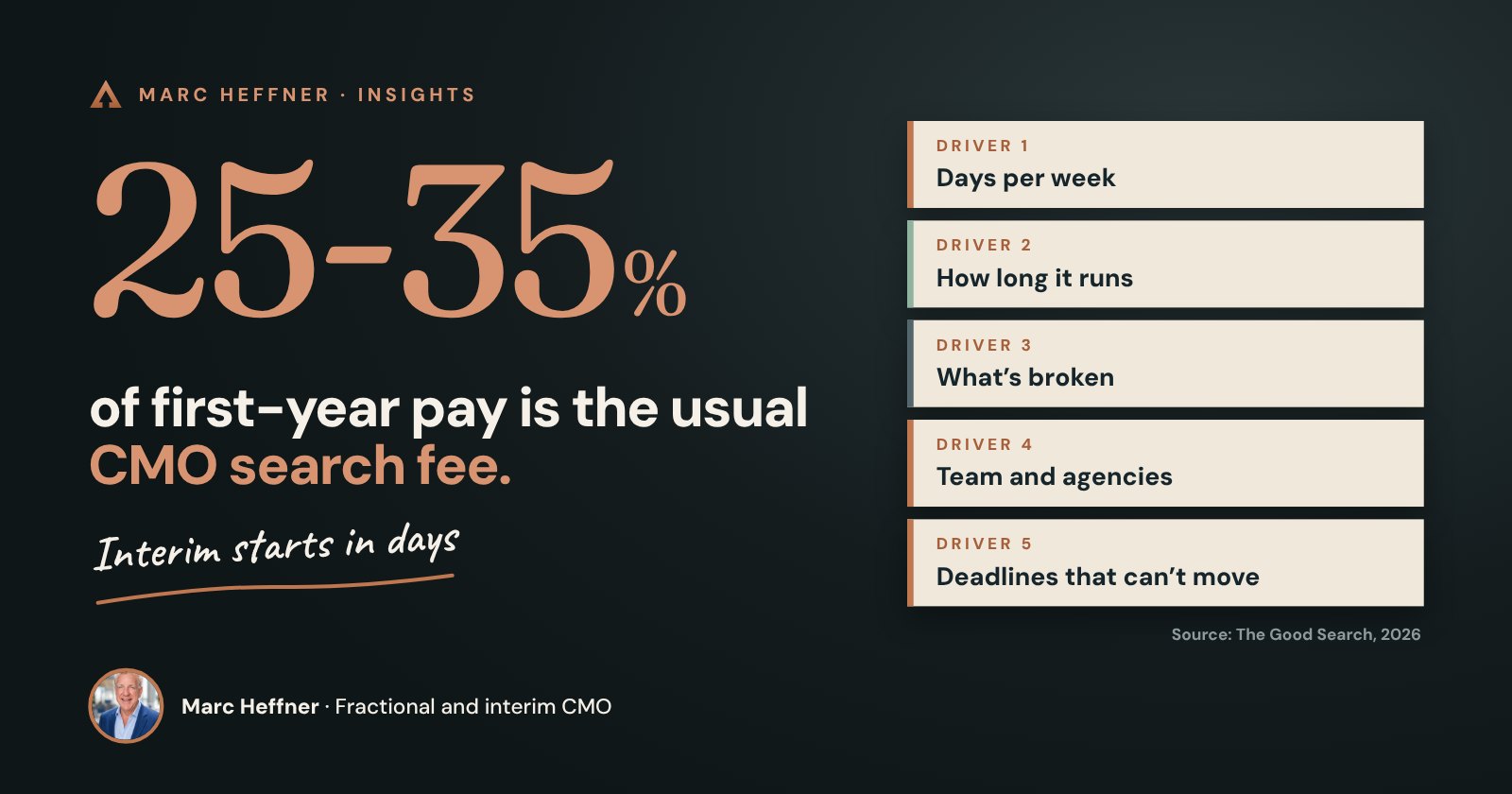
What drives the price
- Days per week. This is the biggest lever. Some situations need someone in the building every day. Others run fine at three or four.
- How long it runs. A short stretch to steady things is different from a longer turnaround or an integration.
- What’s broken. Keeping a working plan on track is lighter than rebuilding a funnel, a reporting system or a team.
- Team and agencies to lead. Leading two marketers is different from running a department and three agencies.
- Deadlines that can’t move. A sale, a launch or a board meeting on the calendar raises the stakes and the pace.
A few things bring the fee down, too: clear decision rights, access to your data from day one, and a strong director who can run the day to day.
What an empty seat costs
The fee is easy to see. The cost of waiting isn’t, and it’s usually bigger. One CMO search firm puts the average time to hire a CMO at about 3.8 months (Talentfoot, 2025). Here’s what piles up in that time:
- Pipeline drift. Campaigns run on autopilot. Lead flow slips quietly, and you feel it a quarter later.
- Unchecked spend. Agencies keep billing, and no one asks what the money is buying.
- People risk. Good marketers get nervous without a leader. Some start looking.
- Missed windows. A launch, a trade show or sale prep doesn’t wait for your search to finish.
- Stacked decisions. Budget, hiring and tool choices sit on someone’s desk until the new CMO arrives.
An interim leader turns those months into progress instead of drift. If you’re not sure interim is the right shape at all, read interim vs. fractional CMO.
What’s built in, and what you skip
A full-time hire comes with costs on top of salary. Interim doesn’t.
| Full-time CMO hire | Interim CMO | |
|---|---|---|
| Time to start | Months, after the search | Often within days |
| Search fee | Usually 25% to 35% of first-year pay | None |
| Benefits | About 30% on top of pay | Built into the fee |
| Commitment | Open-ended | A set stretch |
| The exit | Severance risk if it’s the wrong fit | A planned handoff |
Retained search firms typically charge 25% to 35% of first-year pay (The Good Search, 2026). Benefits make up about 30% of total pay for private-industry workers (BLS, 2026).
One honest note. If you plan to hire a permanent CMO, you’ll still pay for that search. Interim doesn’t replace it. It makes the wait productive, and it helps you hire the right person, which is the most expensive decision in the whole process.
How to judge the value
Don’t judge an interim fee against a salary. Judge it against a number you already watch: pipeline, booked meetings, missed calls, a launch date or a sale price. The first wins usually come from fixing what’s leaking. At one 14-office group, fixing how calls were handled cut missed calls 91%. At Lochinvar, the launch I led took 42% of its category in 15 months. See more results.
Questions leaders ask
Do you charge hourly?
No. Interim work is a flat monthly fee, scoped up front. You know the number before we start, and it doesn’t change because a week got busy.
Is an interim CMO more expensive than a fractional CMO?
Per month, usually yes, because interim runs closer to full time. It also runs for a set stretch and then ends. Fractional costs less each month and runs longer.
How long does an interim engagement last?
Usually three to nine months. It ends when your permanent leader is in the seat and up to speed, or when you decide a fractional setup fits better.
Does interim replace a search firm?
Not if you plan to hire a permanent CMO. You’ll still run that search. Interim makes the wait productive and helps you hire the right person, so the search fee buys a better hire.
How do I get a real price?
Book a 30-minute call. Tell me what changed, what can’t slip and how many days a week you think you need. I’ll scope it and give you a straight number.
The bottom line
An interim CMO is a flat monthly fee set by days per week, length, what’s broken, the team you need led and the deadlines you face. The bigger cost is the empty seat: months of drift while a search runs. Interim skips the search fee, the benefits load and the open-ended commitment. Book a call and I’ll give you a straight number.
Sources
- Talentfoot, How Long Does It Take to Hire a CMO? CMO Time-to-Fill and Tenure Trends, 2025.
- The Good Search, Executive Search Firm Fees and Pricing: The Definitive Guide, 2026.
- U.S. Bureau of Labor Statistics, Employer Costs for Employee Compensation, June 2026, 2026.
Some figures come from firms that sell executive search. I use them as a guide, not gospel.