 MARC
MARC
Why 81% of Patients Hesitate, and How Smart DSOs Are Using Neuroscience to Change That
What You Will Learn in 5 Minutes
- Why patients cannot tell you what actually drives their decisions
- The three brain regions that control treatment acceptance
- How visual content increases case acceptance by measurable margins
- Why fear outweighs aspiration 10 to 1 in patient decisions
- A simple framework to apply these insights in your practice this week
- The one metric that predicts treatment acceptance better than surveys
The Patient Who Lied Without Knowing It
Mrs. Patterson rated her visit 5 stars. She told the front desk the doctor was wonderful. She said she understood why she needed the crown.
Then she drove home and never scheduled the procedure.
Three months later, the tooth cracked. Emergency extraction. Implant discussion. A $5,000 problem that started as an $1,100 solution.
Here is what makes this story important. Mrs. Patterson was not lying when she said she understood. She genuinely believed she would schedule that crown. Her conscious mind meant every word.
But her subconscious had already made a different decision. And she had no idea.
This gap between what patients say and what patients do is not a mystery anymore. Neuroscience has mapped exactly what happens in the brain during treatment decisions. The findings should change how every DSO presents care.
The Limits of "Just Ask Them"
For decades, healthcare marketers relied on surveys, focus groups, and patient interviews. These methods share a fundamental flaw. Patients often cannot articulate the subconscious processes driving their choices.
A 2025 systematic review in Frontiers in Neuroergonomics found that traditional self-report methods are criticized for biases and fail to capture true responses at the unconscious level. People give answers they think others want to hear. Or they rationalize decisions made on pure instinct.
Harvard's Division of Continuing Education puts it plainly. Neuromarketing techniques remove the human choice element in research and expose real, unfiltered responses. This helps marketers understand consumer motivation in ways surveys never could.
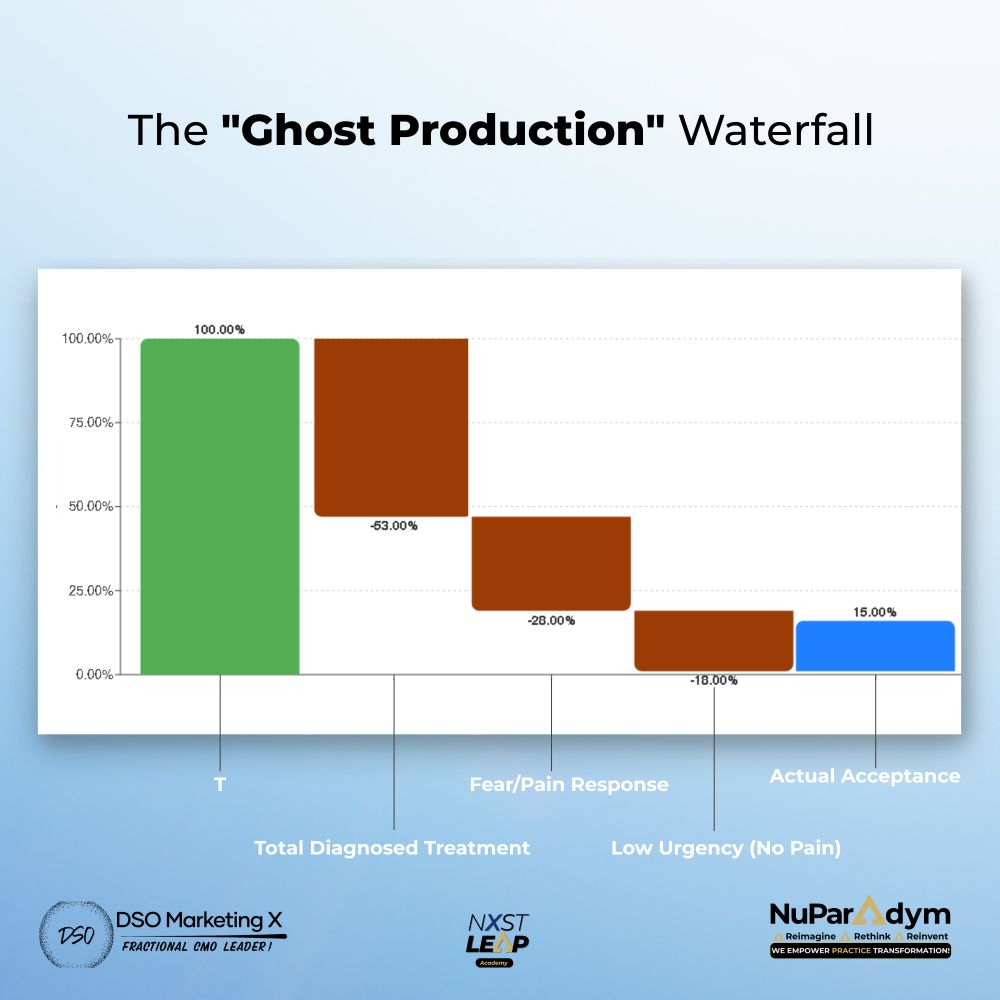
For dental practices, this matters because 81% of patients hesitate to follow their dentist's recommendations. The top reasons include cost at 53%, fear at 28%, and the perception that the problem was not painful enough at 18%. Only 11% cite lack of trust.
Notice what is missing from that list. Nobody says "I did not understand the benefits." Yet that is where most practices focus their energy.
Fear Beats Aspiration 10 to 1
Here is a finding that should reshape how you present treatment plans.
Research on dental patient behavior shows that fear of more tooth loss drives immediate action. Aspiration for a perfect smile creates "someday" thinking. The ratio is roughly 10 to 1.
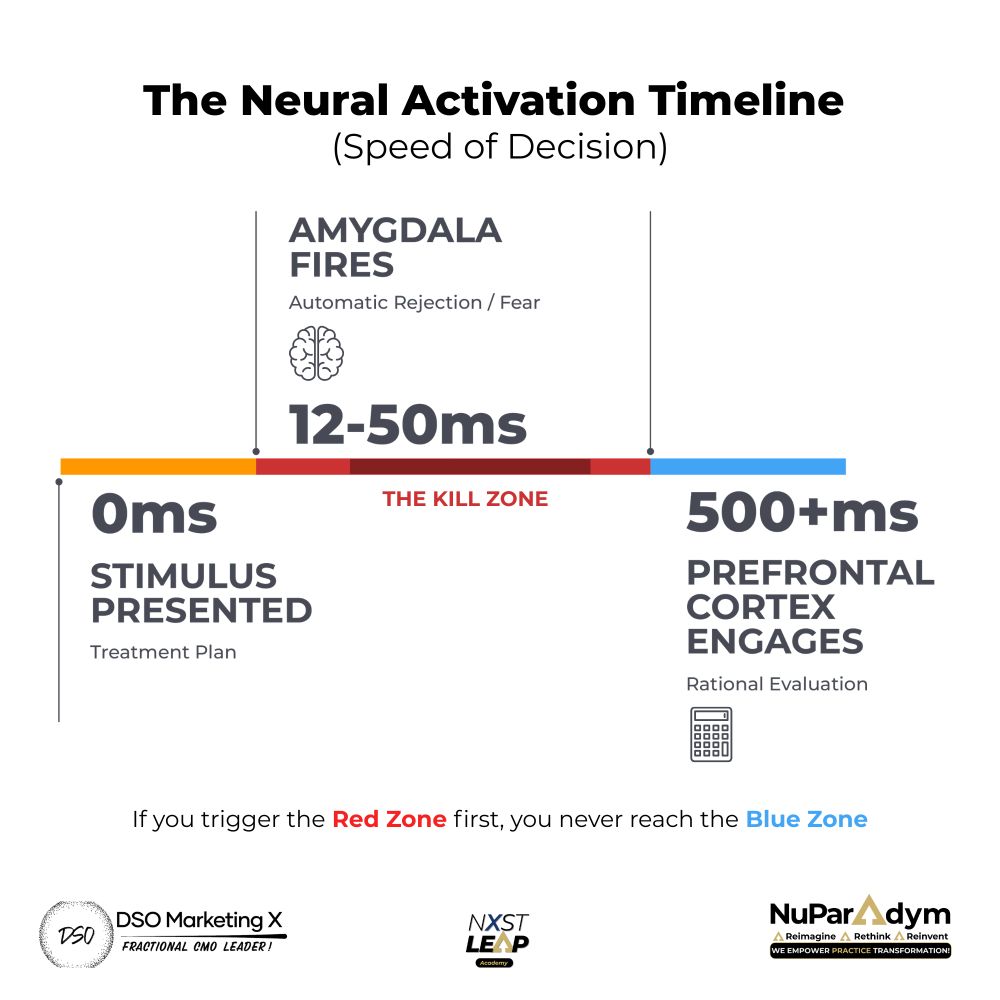
The brain's limbic system, which governs emotions, influences choices far more than rational analysis. This is not opinion. It is observable in brain imaging studies.
What does this mean for your treatment presentations?
Stop leading with cosmetic benefits. Start with what happens if the patient waits. Not as a scare tactic. As clear information about consequences. Then transition to the positive outcome.
The sequence matters because brains process threat information before reward information. Every time.
The 96% Factor: Reviews and the Social Brain
Here is a number that should guide your reputation strategy.
According to a Local Consumer Review Survey cited in Henry Schein One's 2025 Marketing Playbook, 96% of patients consider online reviews an integral part of their decision-making process when choosing a healthcare provider.
This is not surprising when you understand social neuroscience. The human brain evolved to weight peer opinion heavily. In ancestral environments, group consensus often determined survival. That wiring persists.
When a potential patient reads reviews, their brain activates regions associated with mentalizing and social evaluation. They are not just processing information. They are simulating what it would be like to be that reviewer. They are feeling what those patients felt.
This is why review management cannot be an afterthought. It is not about vanity metrics. It is about providing the social proof that allows patient brains to overcome the uncertainty that blocks action.
What Eyes Reveal About Decisions
Eye tracking studies confirm something dental marketers have suspected. Patients rarely choose what they do not look at.
Research published in BMC Oral Health in 2025 found that both female and male patients agreed that a dentist's social media presence was effective in their selection process. Viewing before and after photographs increased trust in the treating dentist.
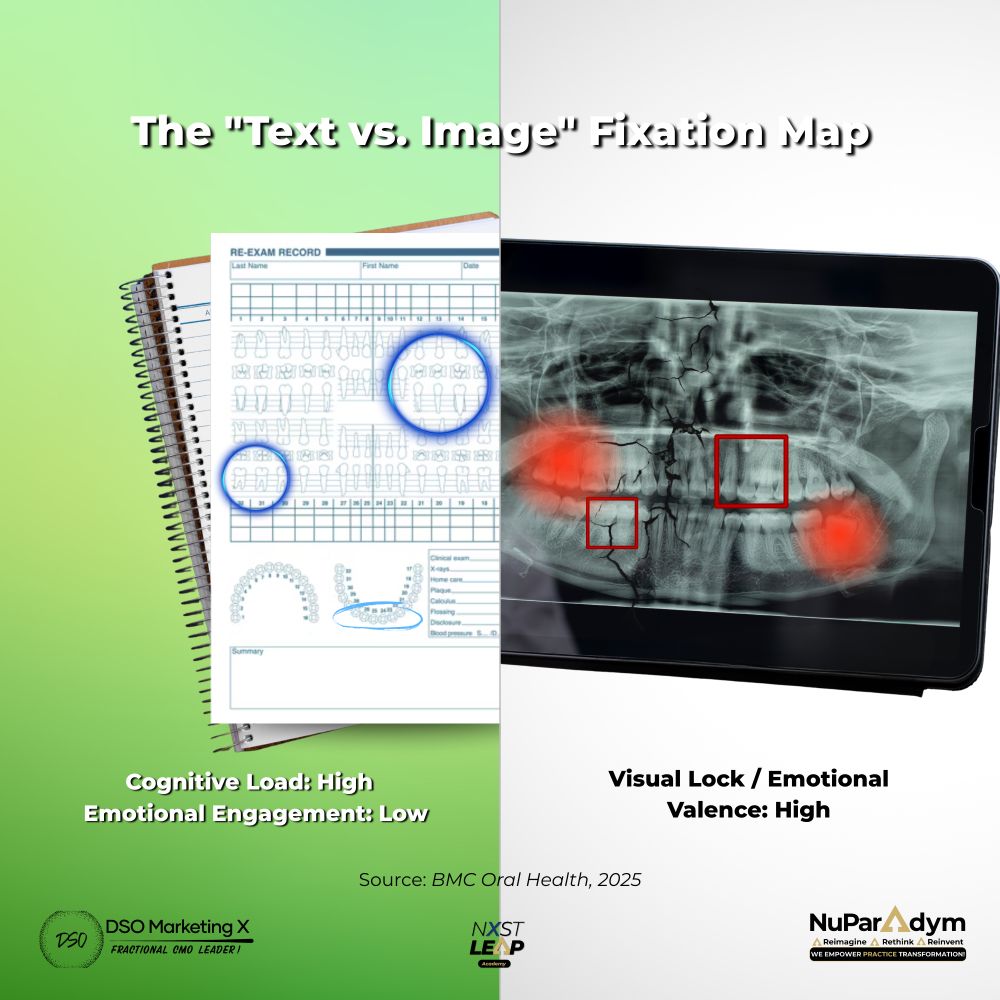
This aligns with broader neuroscience findings. A study combining electrodermal activity and facial expression analysis achieved over 80% accuracy in predicting consumer ad preferences. Visual content triggers measurable physiological responses that predict behavior better than stated preferences.
For DSOs, the implication is clear. Your treatment presentation materials, your website, your social content need to be designed around visual attention patterns. The intraoral photo that shows the problem. The before and after that demonstrates the outcome. These are not nice to have. They are decision drivers.
Where AI Meets Brain Science
Here is where the story gets interesting for modern practices.
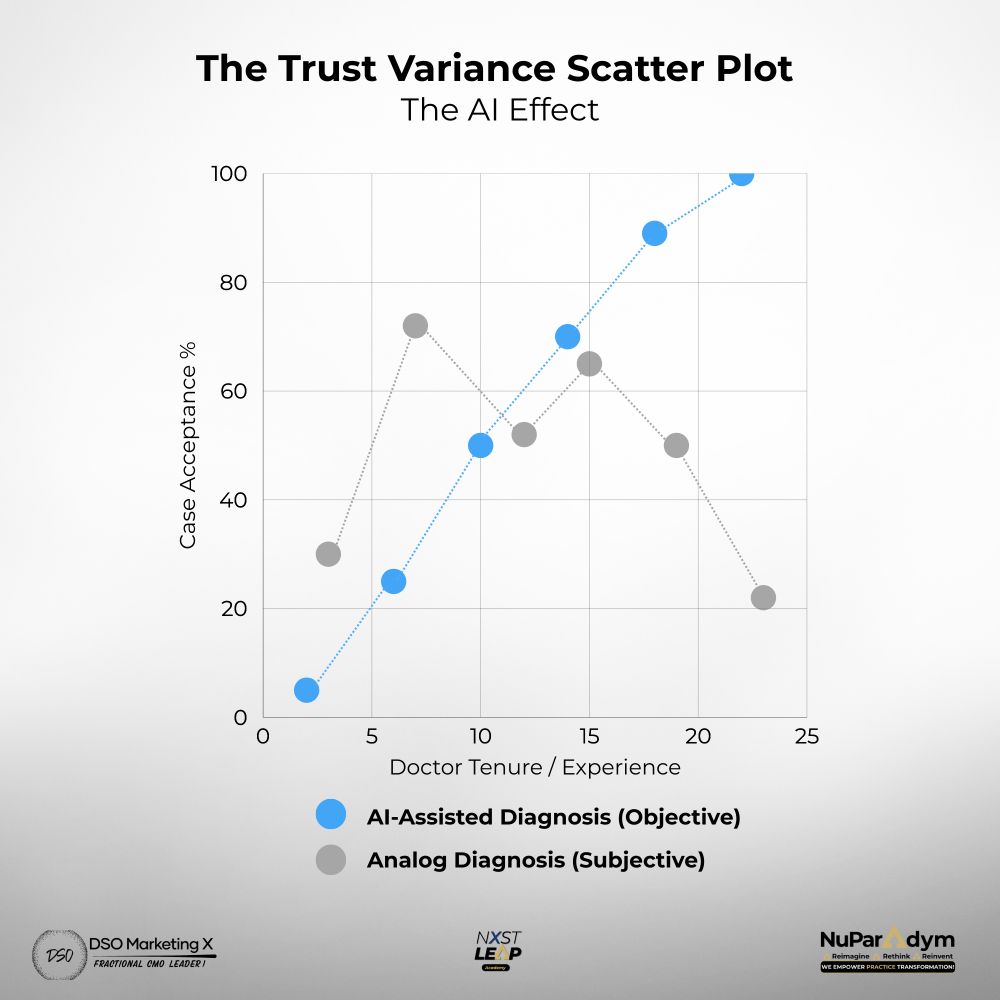
According to Henry Schein One's 2025 Dental Trends Outlook, 59% of patients are more likely to accept treatment recommendations backed by AI. Meanwhile, 77% of dentists using AI report positive practice outcomes.
Why does AI influence patient acceptance? Because it removes subjective doubt. When the imaging software highlights decay that the patient can see on screen, the emotional response shifts from skepticism to recognition. The brain processes visual evidence differently than verbal explanation.
Overjet reports their clinical AI users see significantly higher case acceptance on average, with fewer cavities missed on bitewings. The AI is not just improving diagnosis. It is changing the neurological response patients have to treatment recommendations.
The BRAIN Framework for Patient Communication
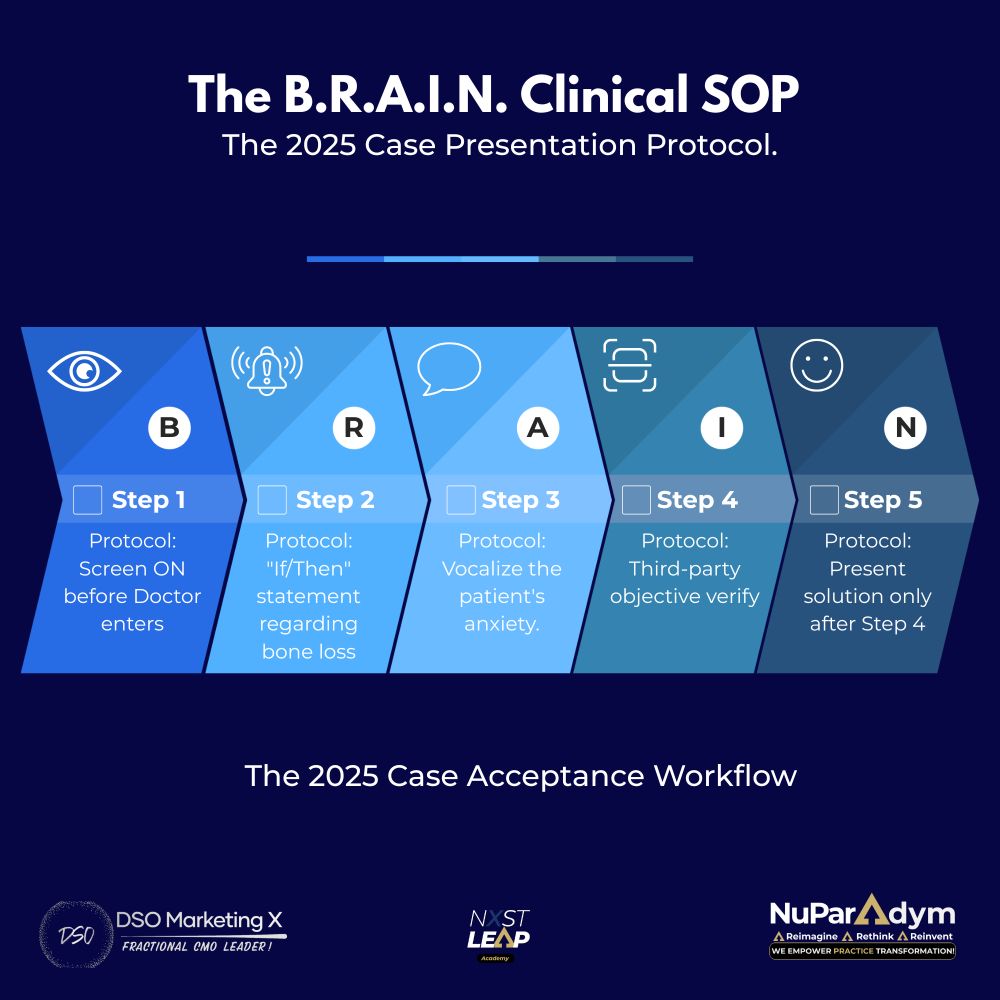
Based on neuroscience research and dental-specific data, here is a five-step approach to align your patient communication with how brains actually make decisions.
B: Begin with visual evidence. Show the problem before explaining it. Images activate different neural pathways than words.
R: Reference consequences first. What happens if they wait? The limbic system needs this information to trigger action.
A: Acknowledge the fear. Name the emotion. Research shows this reduces its power over decision making.
I: Introduce AI-assisted diagnosis when available. Third-party validation bypasses the skepticism response.
N: Navigate to the positive outcome. Now you can paint the picture of success. The brain is ready to receive it.
The Attention Economy in Your Waiting Room
Consider what happens before the patient even sees the dentist.
They scroll through their phone. They glance at the TV. They notice the magazines. Each moment is a competition for neural resources. And here is the challenge. According to SMC National data, dental practices face significant conversion challenges. The average practice loses potential patients at every stage, from missed calls to scheduling friction to no-shows.
An ADA Health Policy Institute study found that more than 80% of dental providers cite late cancellations and no-shows as a major barrier to maintaining full schedules. This is not just an operational problem. It is a neurological one.
When patients feel uncertain, anxious, or overwhelmed, their brains default to avoidance. The appointment gets rescheduled. The treatment gets postponed. The crown never gets placed.
Smart practices are using this insight to redesign their patient journey. Automated confirmations that arrive at optimal times. Visual content in waiting rooms that primes patients for treatment acceptance. Pre-appointment education that addresses concerns before they become objections.
Different Brains, Different Approaches
Not all patient brains respond the same way. Generational research reveals distinct patterns that matter for your marketing and communication strategy.
According to Henry Schein One's 2025 Marketing Playbook, 80% of consumers ages 18 to 34 are willing to use AI in their healthcare experience. That number drops to less than 60% for those over 55.
Gen Z patients respond to short-form video on platforms like TikTok. They search using voice and expect mobile-first experiences. Millennials use search engines, social media, and review sites to evaluate providers. They want authenticity and seamless digital experiences.
Gen X relies on search engines, online directories, and reviews. They want clear, factual information. Baby Boomers trust word of mouth, family referrals, and direct phone calls. They value easy navigation and large fonts on websites.
The neuroscience principle here is channel-appropriate messaging. The same information delivered through different channels triggers different neural responses. A TikTok video and a direct mail piece activate different brain regions even when the content is identical.
For DSOs with diverse patient populations, this means developing multiple communication pathways. One message, many formats, optimized for how each generation's brain prefers to receive information.
The Numbers That Matter
Here is what the data actually shows when practices apply these principles.
Overjet, which provides AI imaging analysis to tens of thousands of dentists, reports that practices using their platform see 25% higher case acceptance on average and 43% fewer cavities missed on bitewings. That is not a marginal improvement. That is a fundamental shift in diagnostic accuracy and patient response.
The industry baseline tells us why this matters. According to Becker's Dental + DSO Review, only 25 to 30% of necessary dental procedures are actually completed. Henry Schein One reports the average case acceptance rate sits at 46%. There is a massive gap between what patients need and what they say yes to.
Children's Dental Fun Zone, a 20-location DSO seeing over 35,000 patients monthly, shared this insight with the Catalyst Index: "One of my doctors told me that if they tell a parent their child has four cavities and can back up the diagnosis with AI, the parents are more likely to accept treatment quicker." Their offices have seen a rise in caries detection and faster treatment acceptance after implementing AI-based x-ray analysis.
What changed was not the treatment recommendation. What changed was how patients processed the information. Visual evidence plus AI validation creates a different neurological response than verbal explanation alone.
Your 14-Day Action Plan
Days 1-3: Audit your current treatment presentation materials. How much is visual versus verbal?
Days 4-5: Review your intraoral photography workflow. Is every patient seeing their own images?
Days 6-7: Rewrite one treatment script using the BRAIN framework. Start with your highest-value procedure.
Days 8-10: Train your treatment coordinators on consequence-first language. Role play the new approach.
Days 11-12: Implement the new workflow in two operatories. Track acceptance rates.
Days 13-14: Review results. Adjust language based on what patients respond to. Expand to remaining operatories.
Get the Complete BRAIN Framework Worksheet
I have created a one-page worksheet that maps the BRAIN framework to specific dental procedures. It includes sample scripts, visual checklist items, and tracking metrics.
Comment "BRAIN" below and I will send it to you directly.
If you want to discuss how to apply these neuroscience principles to your specific DSO or multi-location group, I am offering 23-minute pilot scoping calls this month.
Book right here: 23-Minute schedule
Are you tired of your marketing not working, Let's talk now! Click the link. Quick Meeting
Get the breakdown in your inbox. Join the Marketing+GenAI Power Brief Today!
📲 Check out our website: NuParadym
🎥 Get more info from our YouTube Channel: NuParadym YouTube
📲DSO Marketing X Website: DSOMarketingX
📲NXST LEAP Academy: NXST LEAP Academy
About the Author
Sources
Frontiers in Neuroergonomics. (2025). Neuro-insights: A systematic review of neuromarketing perspectives across consumer buying stages.
Harvard Division of Continuing Education. (2024). Neuromarketing: Predicting Consumer Behavior to Drive Purchasing Decisions.
Henry Schein One. (2025). 2025 Dental Trends Outlook: The Year of Smarter, Not Harder.
Planet DDS. (2025). 2025 Dental Industry Outlook.
Jarvis Analytics. (2025). The 2025 Catalyst Index Report.
Becker's Dental + DSO Review. The 'Golden Age' of Dentistry.
Alqabbani et al. (2025). The impact of dental photography in social media. BMC Oral Health.
ADA Health Policy Institute. (2024). Survey on practice operations and technology adoption.
IEEE Access. (2025). The Neuromarketing: Bridging Neuroscience and Marketing for Enhanced Consumer Engagement.
Curve Dental. (2025). Understanding Dental Patients: Psychology, Engagement, and Trust.
HIP Creative. (2025). Why Understanding Consumer Psychology Beats Every Marketing Trick.
#DentalMarketing #DSO #PatientExperience #NeuroMarketing #CaseAcceptance