 MARC
MARC

Ever wonder why patients choose your dental practice over the competition? It’s not just about trust or a friendly smile, large dental groups like yours have a secret weapon: scale, tech, and reliability. But here’s the catch: shouting about your corporate strengths can break the local charm patients love. In this issue of Marketing + GenAI Power Brief, discover a 6-step framework to craft a value proposition that resonates with patients while leveraging your hidden giant advantages, without losing that hometown feel.
The Hidden Giant Problem
When Cindy Alverz walks into “Rocky River Family Dentistry,” she believes she’s choosing Dr. Montgomery, the trusted hometown dentist. What she doesn’t realize is that Rocky River is part of a 156-multi-location organization with corporate systems powering it behind the scenes.
That’s the paradox large groups live with:
- Your biggest strengths (scale, tech, training, reliability) must stay invisible.
- Your patients are hiring you for emotional reasons (trust, comfort, “supporting local”).
- And most traditional UVP frameworks don’t account for this split reality.
When was the last time you thought about your Unique Value Proposition (UPV), or have you?
The real question is: How do you build a value proposition that resonates with patients while leveraging your hidden giant strengths?
Why Traditional UVPs Fail Large Groups
Most companies create UVPs behind closed doors. They guess what patients care about, wordsmith some clever phrasing, and call it a day.
That approach almost always fails DSOs.
Why?
Because the standard Value Proposition Canvas assumes you can show your capabilities openly:“We have advanced tech,” “We have corporate training standards,” “We have a network for emergencies.”
But you can’t shout those things from the rooftops without breaking the authenticity of the local brand.
Instead, DSOs fall back on generic promises:
- “We care.”
- “Personalized service.”
- “Trusted family dentistry.”
Meanwhile, patients might actually prioritize:
- Reliability: Can I count on them to be available when I need care?
- Access to technology: Do they have modern diagnostic tools?
- Consistency of care: Will I get the same quality every time?
The gap between what corporate leadership assumes and what patients really value is the heart of the UVP problem for large groups.
The Systematic DSO UVP Framework
Here’s the 6-step process I use with groups to cut through assumptions and build UVPs that work.
Step 1: Stop Guessing, Start Listening
Most UVPs get built in a boardroom. That’s the problem. The real answers live in patient stories and in reviews. It is what they say on the phone, in the reasons they give friends for why they chose your office.
Interviews and anonymous surveys aren’t just data collection , they’re how you hear the truth. And truth beats assumptions every time. Real insight doesn’t come from whiteboards, it comes from patients themselves.
- Interviews: 5–10 per location. Ask: “What made you choose this practice?” “What would make you switch?” “What matters most in your dental experience?”
- Anonymous surveys: Patients often admit more here than they will in person. You may discover they value consistency and corporate reliability more than “personal relationships.”
Patients “hire” practices for different kinds of jobs:
- Functional jobs: scheduling, insurance processing, clinical care.
- Emotional jobs: trust, comfort, being known.
- Social jobs: appearing responsible, supporting local businesses.
💡 Key insight: DSOs excel at functional jobs, but patients also need emotional and social jobs fulfilled.
Step 2: Map What Matters
Patients don’t think in frameworks, but we use them to see patterns. The “jobs” they hire you for are simple: get me in fast, handle my insurance, don’t make me wait, and make me feel safe.
Their pains? Missed appointments, inconsistent care, and confusion with billing.
Their gains? Peace of mind, the comfort of knowing it’ll be handled, and confidence they’re in good hands.
Mapping this isn’t about sticky notes. It’s about discipline, making sure you solve what they actually care about
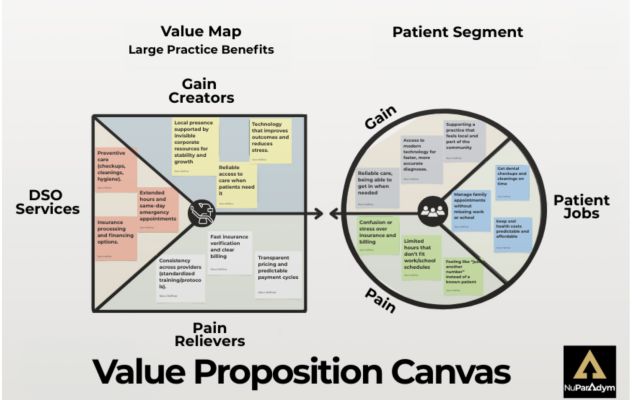
Use the Value Proposition Canvas:
- Jobs: managing family appointments, avoiding missed work, reducing stress.
- Pains: long wait times, inconsistent care, limited hours.
- Gains: peace of mind, reliable access, modern technology.
Then connect with your Value Map:
- Pain relievers: extended hours, provider backup, standardized protocols.
- Gain creators: same-day appointments, advanced diagnostics, smooth insurance handling.
This mapping forces you to see the world through the patient’s eyes, not corporate assumptions.

Step 3: Reframe Strengths as Patient Benefits This isn’t a tagline exercise. It’s an internal test: “How does this corporate capability show up for a patient in real life?” If you oversell the system, you sound like a chain. If you hide it, you miss your edge.
The real move is to translate systems into lived benefits. “Standardized protocols” becomes “No matter which dentist you see, your care feels the same.” “Corporate tech investment” becomes “We’ve got the latest tools in the office, right here in town.”
Instead of:
“Comprehensive dental care with advanced technology and multiple locations.”
Try one of these options instead:
- Straightforward:
“We help busy families get the care they need, when they need it, with the latest tools, from the same neighborhood dentist they already know and trust.”
2. Patient-centered:
“We help busy families get the care they need, when they need it, with the latest tools, delivered by the local dentist who knows their name.”
3. Reliability-focused:
“We help busy families get the care they need, when they need it, with the latest tools, all from the local dentist they see year after year.”
4. Community angle:
“We help busy families get the care they need, when they need it, with the latest tools, right here in the community they call home.”
See the shift? Corporate strengths (tech, scheduling systems, network size) are reframed as local practice benefits.
Step 4: Look at Competitors Through the Right Lens
Too many DSOs benchmark against independents by copying their “local, friendly, caring” messaging. But here’s the lens that matters: what are patients asking for that independents can’t deliver?
Independents can promise relationships and flexibility. You can promise consistency, reliability, and advanced resources, and you can back it up. The opportunity is always in the gap between patient needs and what only you can bring to the table.
Don’t just copy independent practice messaging. Use a Three-Circle Framework:
- Patient needs: trust, reliability, convenience, and technology.
- Independent strengths: authentic local ownership, personal relationships, and flexibility.
- Your hidden strengths: corporate training, scale testing, investment power, and provider backup.
Your sweet spot = where patient needs overlap with your strengths that independents can’t match.
Step 5: Choose Differentiators Patients Can Feel
Patients don’t care about slogans like “clinical excellence” or “cutting-edge technology.” They care that when they show up, the x-ray machine actually works, their appointment runs on time, and they don’t get different answers from different providers. Your differentiators should be the things a patient would notice without ever reading your website. Patients don’t want buzzwords. They want reliability they can experience.
Examples that land:
- Clinical consistency: “Every dentist follows the same high standards.”
- Technology access: “We’ve invested in advanced tools to improve your care.”
- Operational reliability: “Count on us for same-day emergencies and continuity of care.”
Keep it clear, measurable, and patient-centered.
Step 6: Test at Scale, Your Unfair Advantage
Here’s the one edge independents will never have: you can test across dozens of practices at once. That means you don’t have to guess which message will land, you can know. A/B test headlines, calls-to-action, and even email subject lines.
Watch what drives appointments, retention, and referrals. Then roll out the winners across your network. Testing isn’t an afterthought, it’s your unfair advantage. This is where DSOs can do what independents can’t.
- A/B test messaging across multiple practices (“personal relationship” vs. “reliability & access”).
- Use landing pages, social ads, and email variations to measure what sticks.
- Scale the winning message across your network quickly.
Your ability to test at scale is a built-in moat. Independents simply don’t have that option.
The Push–Pull Reality
Think of patient decisions as a push–pull dynamic:
- Pull factors (DSO advantages disguised as practice benefits): extended hours, insurance efficiency, and clinical consistency.
- Push factors (independent weaknesses): limited emergency coverage, inconsistent protocols, outdated tech.
- Blocking factors (anchors keeping patients loyal): personal relationships, insurance networks, and treatment continuity.
Winning UVPs frame your advantages as solutions to independent weaknesses, without ever breaking the illusion of local ownership.
The Research Advantage
Multi-location practices aren’t just hidden giants. They also have:
- Scale testing capacity: run experiments across dozens of locations.
- Data analytics: measure what’s actually working.
- Resource investment: fund research and technology most independents can’t.
- Rapid rollout power: spread successful approaches across the network fast.
Used well, this makes your UVP a living system, not a one-time exercise.
The Big Shift
When you treat UVP work as marketing copy, you get slogans. When you treat it as translation, you get clarity that guides every part of the business, from front desk scripts to ad spend
The Huge Takeaway
Clarity beats cleverness.
Patients don’t care about slogans. They want reliability they can feel.
For large groups, the winning UVP formula is simple:
- Start with patient language.
- Map jobs, pains, and gains.
- Translate hidden strengths into visible benefits.
- Test at scale and refine relentlessly.
Do this well, and your UVP becomes your compass, guiding every marketing decision and keeping you aligned with what patients actually value.
Your Move
How have you built your UVP? Did you lean on patient feedback, competitor analysis, or trial and error? I’d love to hear your experience.
👉 This is Issue #1 of Marketing + GenAI Power Brief. Subscribe now so you don’t miss next Monday’s deep dive: How AI Can Help You Scale Your Marketing Clarity.
👉 You want to talk more about how to reframe your UPV, let’s talk. Click this link. https://calendly.com/mheffner-dsomarketingx/nuparadym-discovery-call-li