 MARC
MARC

A single VIP patient’s botched appointment spirals into CEO apologies and finger-pointing. The culprit? AI tools that don’t talk to each other. If this sounds familiar, here’s the blueprint top healthcare leaders are using to turn chaos into 41% ROI gains.
The Q3 earnings report lay untouched on the conference room table. All eyes in the boardroom were on the Chief Operations Officer, who was echoing a sentiment the entire leadership team had been privately voicing for months. This same conversation is happening in similar rooms across the country, sounding like this:
"We have GenAI tools everywhere. ChatGPT, Gemini, Claude subscriptions across departments. An AI scheduling system that doesn't talk to our PMS. Marketing automation that creates content in the wrong voice. Clinical wants AI for patient education, but it contradicts what the front desk says. Nothing connects, and I think our patients are starting to notice the gaps."
This boardroom anxiety isn't happening in a vacuum. It’s a direct response to the immense pressures facing modern healthcare. With shrinking reimbursements, critical staffing shortages, and the rise of the consumer-savvy patient who expects seamless digital experiences, AI isn't a luxury; it's a critical tool for survival. This makes the failure to integrate it properly all the more perilous.
While leaders deliberate in the boardroom, the real cost of this disjointed approach is felt on the front lines.
In one location a veteran office manager named Sarah spent thirty minutes calming a confused patient who received one set of post-op instructions from an educational chatbot and a different printed guide from the practice. Trust took a hit. Sarah lost time she needed for clinical care. This human cost is what tool sprawl looks like.
The chaos is reflected in the data. Gartner's 2024 survey reveals that 43% of leaders are struggling with rising tech costs, while 68% of DSOs report their biggest challenge is maintaining consistency across locations. Organizations are spending more on AI, only to get less coordinated results.
Yet, a select few are cracking the code. They're seeing 41% improvements in marketing ROI and delivering content three times faster. The difference isn't the tools they buy. It's how they think.
This is the story of what separates strategic AI success from expensive AI waste.
Tool sprawl feels like progress until the patient meets the seams. The fix is not another platform, it’s a weave. Below, I give you the framework. Now, let’s make it real for your organization. Book time with me here: Fast call to discuss your Marketing & AI Strategy, it free!
The Expensive Mistake: A Cautionary Tale of a Group Practice
I see a familiar story play out in organizations over and over. It's the story of a client that is growing and has problems they need to solve. This client’s journey began with excitement and ended in frustration, a cautionary tale in twelve months.
It started in September 2024, when an enthusiastic CMO unveiled a stunning report. "Look at this engagement!" she declared. "Our new AI content engine is producing five times the volume at forty percent of the cost. This is the win we needed." The board was thrilled. The success was tangible, celebrated, and seductive.
December, the COO, seeing marketing's triumph, made a logical leap. "If they can get those gains, imagine what a dedicated AI scheduler can do for patient flow and reducing no-shows. It's a no-brainer." A top-rated scheduling bot was purchased and implemented in record time. Shortly after, customer service, not wanting to be left behind, launched an AI chatbot to handle inbound queries.
March, the Chief Clinical Officer championed a pilot for an AI-powered patient education platform. Each decision, viewed in isolation, was smart, proactive, and aimed at improving a specific metric.
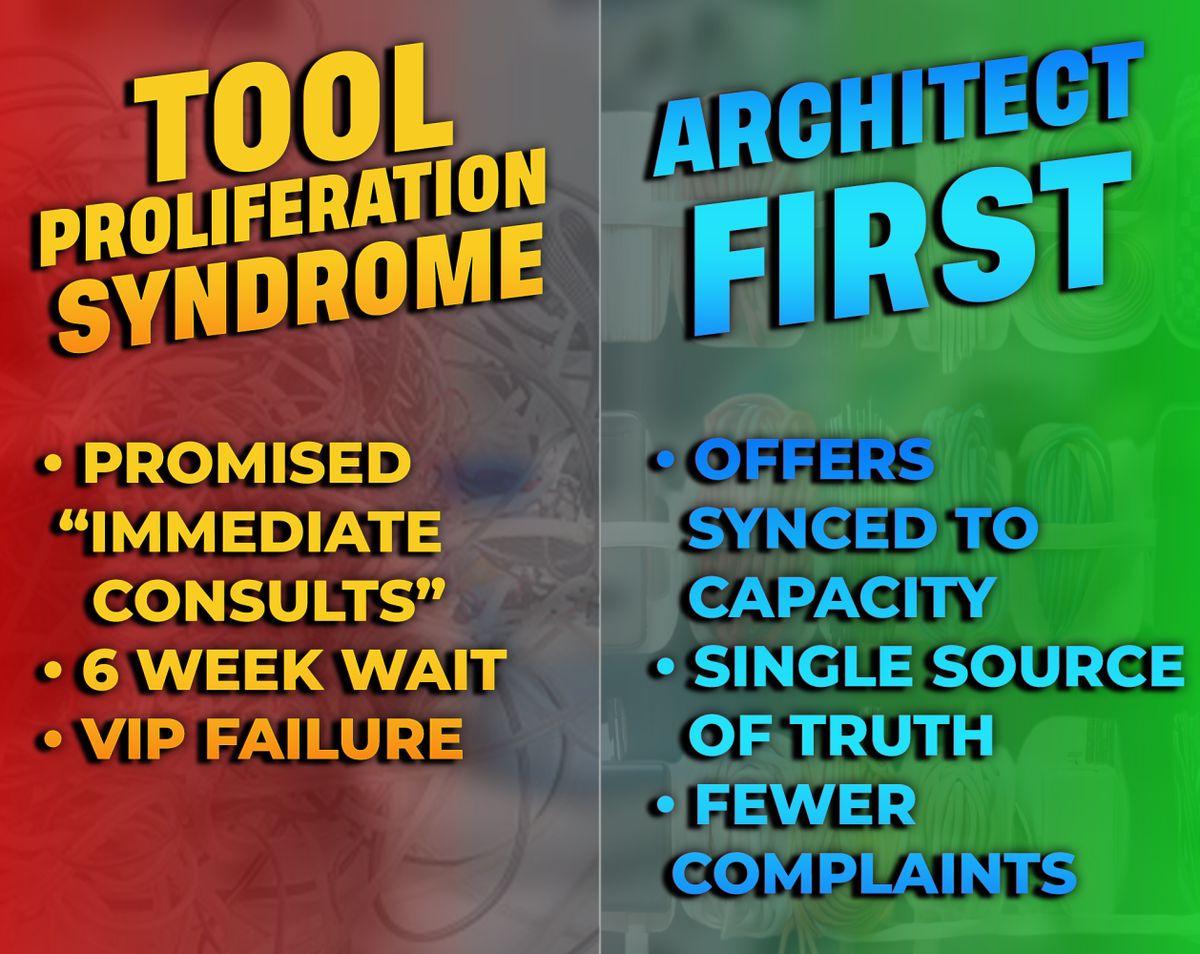
June. Marketing promoted “immediate consultations” for a new All-on-X service. The scheduler showed six-week wait times. Patients grew frustrated. Then the VIP failure. A close friend of the CEO confirmed a 9:00 a.m. specialist slot with the chatbot. She arrived to find the doctor in surgery all morning. Scheduling AI was never connected to the clinical schedule. Apologies. Finger pointing. One angry CEO.
By August the truth landed. They had not built a symphony. They had funded a circus. Smart people. Logical decisions. No architecture.
This is a classic case of what I call "Tool Proliferation Syndrome (TPS)": a downward spiral caused by smart people making logical, isolated decisions.
The problem wasn't the tools. It was the complete absence of an architecture.
The Secret Pattern of AI Success
Another client, let’s call them Cohesion, brought me in before a single purchase. We mapped a shared blueprint. We codified how AI would think, what it would be allowed to do, and where a single source of truth would live. Same budget. Same timeline. Different outcome. Cohesion delivered consistent messaging, fewer patient complaints, and higher appointment conversion.
The difference was not the software. It was the system.
Before they ever looked at a single piece of software, we first mapped out their "GenAI Strat Tapestry." We designed the architecture, the shared intelligence, the rules of engagement, and the single source of truth for every piece of AI they would ever use.
With the same budget and in the same timeframe, the results were profoundly different. Cohesion saw dramatic improvements in content consistency, a sharp reduction in patient complaints about mixed messaging, and measurable increases in appointment conversion rates.
The difference wasn't the technology. It was the architecture.
The Nine Threads of a Strategic AI Tapestry
Think of your organization's AI as a symphony. Individual instruments can be beautiful, but without a conductor and sheet music, you only get noise. The GenAI Strat Tapestry™ provides both, weaving together nine critical threads to ensure every AI interaction serves one unified strategy.
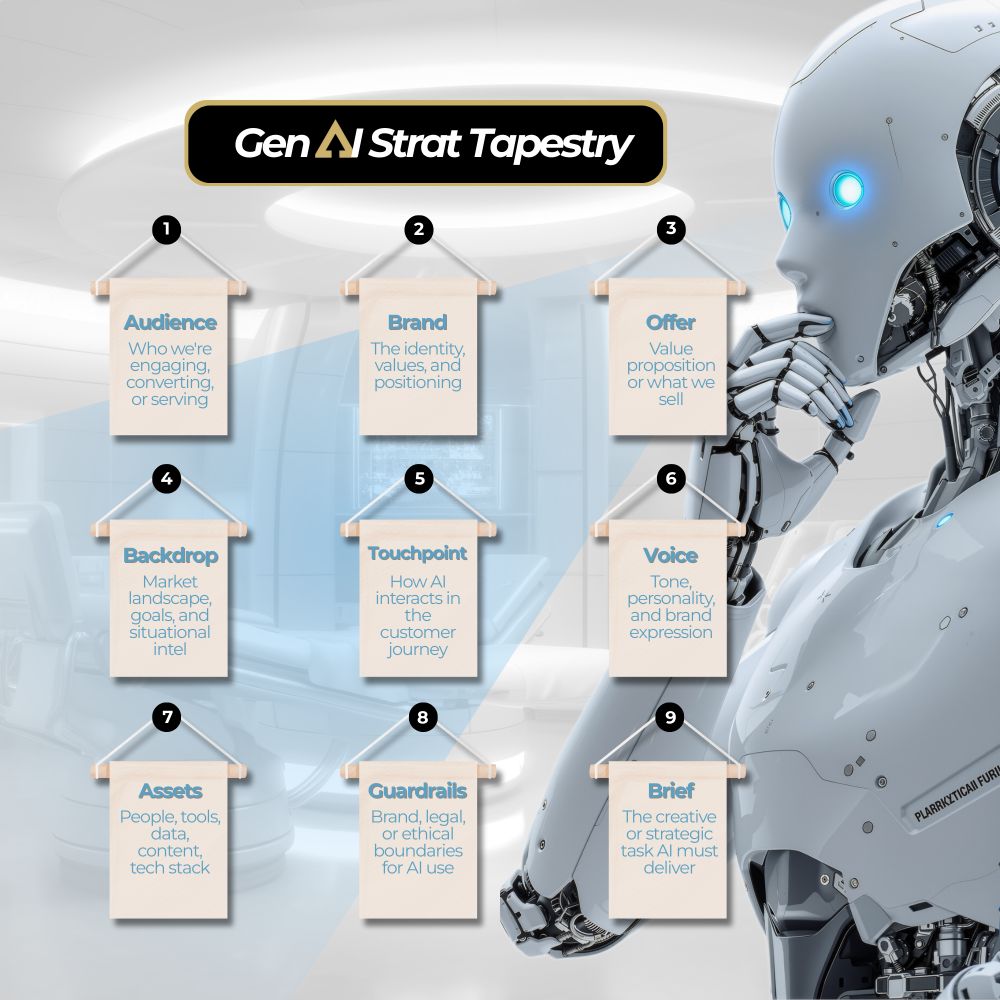
1. Audience: Designing for the Entire Ecosystem
The common mistake is to see the audience simply as "patients." The strategic view understands that any piece of AI-generated content is consumed by a complex ecosystem.
- Failure Example: An AI-generated discharge summary was written in simple, patient-friendly language, which was great for the patient. However, it omitted specific medical codes that the billing department's AI needed to process the claim, causing a 30-day delay in reimbursement and requiring manual intervention.
- Success Example: A successful organization designs its AI outputs with "layers." The primary text is for the patient, but embedded metadata contains the necessary codes for billing, structured data for clinical research analysis, and version history for compliance audits. One output serves four audiences simultaneously.
- Guiding Question: Who, besides the patient, needs to understand or process the information your AI is generating?
2. Brand: Replicating Reasoning, Not Just Voice
Most organizations tell their AI to "use our friendly and authoritative brand voice." But true brand alignment is far deeper. It's about replicating your organization's core decision-making patterns.
- Failure Example: A health system's AI, told to be "optimistic," generated marketing copy for a new extraction procedure that bordered on promising pain free. While technically adhering to the brand's positive tone, it violated the clinical team's deeply held principle of managing patient expectations ethically.
- Success Example: Cohesion trained its brand AI not on marketing copy, but on five years of their ethics board’s meeting minutes. Now, when their content AI drafts a post about a new treatment, it automatically flags language that might inadvertently over-promise, perfectly mirroring the board's risk-averse and patient-centric reasoning.
- Guiding Question: What is a core ethical or operational principle your leadership team follows, and how can you teach that reasoning pattern to your AI?
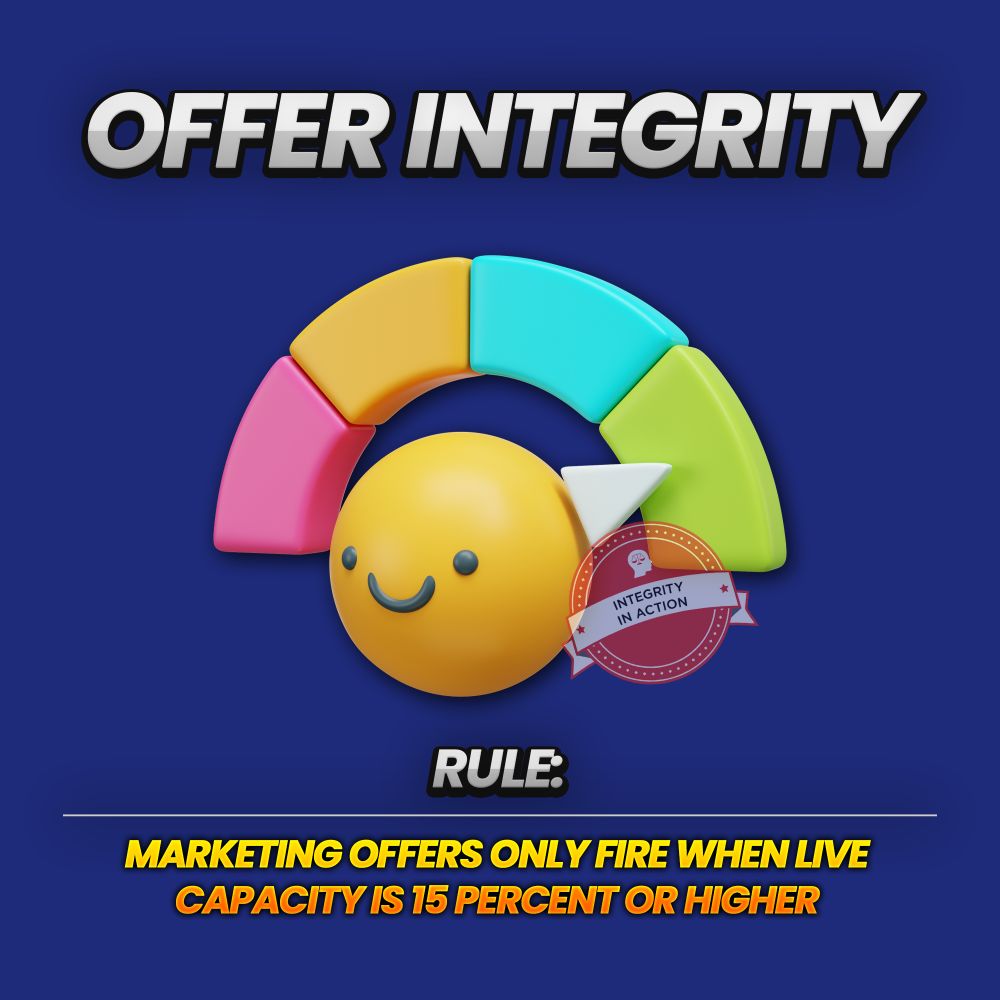
3. Offer: Promising Only What You Can Deliver
It's tempting to task an AI with helping you sell more or book more appointments. The successful mindset is that an AI’s primary role is to create trust by only promising what the organization can actually deliver in real time.
- Failure Example: The 14-location DSOs story is a perfect illustration. Their marketing AI promised "same-day consultations" because it was disconnected from the scheduling AI, which knew the reality was a six-week wait. The result was a surge in patient frustration and a decline in brand trust.
- Success Example: A leading dental service organization (DSO) architected its system so the marketing AI could only create an offer (e.g., "Book a cleaning this week!") after pinging the central scheduling database to confirm that at least 15% of appointment slots were actually available across their key locations that week. The promise is always in sync with reality.
- Guiding Question: How does your AI verify that the service or appointment it's offering is actually available right now?
4. Backdrop: Grounding AI in Reality
Many AI models operate in a clean-room vacuum, devoid of real-world context. A strategic AI is constantly referencing the messy reality of operations, compliance, and the competitive landscape.
- Failure Example: An AI chatbot for a clinic in Minnesota continued to send out "Get you family in before school starts" reminders to patients well into a cold late October because it wasn't programmed with local seasonal awareness. It made the clinic look incompetent.
- Success Example: A successful 24/7 dental care chain integrates its AI with a "backdrop module" that includes local health trends, competitor promotions, and even staff vacation schedules. When a flu outbreak hits the local news, the AI automatically prioritizes content about flu shots and adjusts scheduling predictions based on anticipated staff shortages.
- Guiding Question: What are the top three real-world factors (e.g., staff capacity, local events, supply chain issues) that should influence your AI’s decisions today?
5. Function: Defining Clear Roles and Boundaries
Is your AI an educator, a router, an analyst, or a creator? Organizations that struggle let their AI drift between these roles, leading to confusion and risk.
- Failure Example: A patient asked a scheduling chatbot, "Do I need to see a dentist for this chip tooth?" The AI, drifting from its function as a scheduler to an unqualified educator, responded with, "It's probably nothing to worry about, but I can book you an appointment." This is a massive clinical and legal liability.
- Success Example: A well-architected system defines clear handoffs. When a patient asks the same question, the AI is programmed to respond: "As a scheduling assistant, I cannot provide medical advice. However, I can connect you immediately with a triage nurse or book the next available dental appointment. Which would you prefer?" It stays in its lane and executes a safe, effective handoff.
- Guiding Question: For each AI tool, have you explicitly defined what it is allowed to do and, more importantly, what it is not allowed to do?
6. Voice: Engineering Consistency at Scale
True vocal consistency across an organization doesn't come from a PDF style guide. It comes from a modular prompt architecture that can be systematically applied across thousands of interactions.
- Failure Example: A small dental practice marketing team used one set of prompts for its blog, while the patient portal team used a slightly different set for its FAQs. The result was that a "cracked tooth" on the blog was called a "coronal fracture" in the patient portal, creating subtle but damaging patient confusion.
- Success Example: A leading multi-location system built a central "Prompt Library" asset. Every team building an AI application must use these pre-approved, modular prompts. The prompt for "Describe a dental procedure with empathy" is standardized, ensuring that whether it's a blog post, a chatbot script, or a pre-op email, the tone and terminology are identical.
- Guiding Question: If a new AI tool were added tomorrow, what system ensures it uses the exact same communication style as your existing tools?
7. Assets: The Single Source of Truth
An AI doesn't "know everything." It only knows what you systematically feed it. Its performance is entirely dependent on the quality and structure of your internal knowledge architecture.
- Failure Example: A dental office’s public-facing chatbot was inadvertently trained on its own outdated blog posts from five years ago. When a patient asked about the process for dental implants, the chatbot confidently provided information about an older, multi-stage surgical process. This advice was dangerously out of date, contradicting the practice's current standard of care, which involved more modern, single-stage techniques.
- Success Example: A successful clinic established its internal clinical protocol wiki as the "single source of truth." All AI tools are exclusively connected to this wiki via an API. The AI is architecturally forbidden from accessing the public internet for medical information. When a protocol is updated in the wiki, every AI in the organization instantly uses the new information.
- Guiding Question: What is your single source of truth for critical information, and is your AI systematically connected to it?
8. Guardrails: Architecting for Safety
Compliance isn't just about not violating HIPAA. A robust architecture includes multiple, automated layers of protection to prevent the spectrum of clinical, legal, financial, and reputational risks before they happen.
- Failure Example: An AI designed to summarize patient-doctor conversations accidentally included the name of another patient in a summary sent to the patient portal, causing a clear HIPAA breach that resulted in a fine and significant reputational damage.
- Success Example: An organization implemented a "Guardrail AI" that acts as a final checkpoint for all other AI outputs. Before any communication is sent to a patient, this second AI scans it specifically for PII (Personally Identifiable Information), checks it against a list of unapproved medical claims, and flags it for human review if it detects any ambiguity.
- Guiding Question: What is the automated system that reviews your AI's work before it's seen by a patient?
9. Brief: The Art of the Precise Request
The performance of any AI depends entirely on the precision of the request. Teams that master systematic "request engineering" can get expert-level results from their tools, while others get mediocre output from the exact same software.
- Failure Example: A marketing assistant asked ChatGPT to "write a blog post about the benefits of dental implants." The result was a generic, bland article that could have been written by anyone.
- Success Example: A trained marketing specialist used a structured brief: "Acting as a cosmetic dentist with 20 years of experience, write a 1,200-word article for a 55-year-old patient who feels self-conscious about their missing teeth and is worried about the cost and pain of the procedure. Use an empathetic tone, address their common fears, use our practice's specific patient testimonials and financing options, and conclude with a call to action to download our 'A New Smile: Your Guide to Dental Implants' guide." The result was a nuanced, expert-level article that performed exceptionally well.
- Guiding Question: Have you created standardized brief templates for your most common AI tasks to ensure high-quality, repeatable results across your team?
Every conference room I walk into starts with the same frustration: “Too many tools. Not enough connection.” The ones who win are the ones who choose to architect, not just adopt. If you’re ready to stitch your systems into a growth engine, let’s talk. I can take that pain away, click here .
From Whiteboard to the Balance Sheet: The Real Economics of Architecture
How does this architectural thinking translate into real economic value? Ignoring AI architecture is like building a new hospital wing without consulting the master blueprint. The plumbing doesn't connect to the main line, the electrical systems are incompatible with the central grid, and eventually, you have to tear down the walls to fix the foundation. The initial "savings" on planning are dwarfed by the eventual cost of reconstruction.
The ROI of a systematic approach unfolds in three phases:
- Months 1-6: You achieve the expected ROI through direct productivity gains and time savings.
- Months 7-18: Network effects kick in. Adding a new AI tool is now 10x cheaper and faster because it plugs into your existing architecture of data, prompts, and guardrails. Your prompt libraries become priceless, compounding organizational assets.
- Months 19-36: You build a strategic moat. Your ability to maintain quality at scale, ensure operational consistency, and respond to the market with incredible speed becomes a deep competitive advantage.
Implementation: The Path from Chaos to Coherence
The journey begins not with a massive, multi-year transformation project, but with a focused commitment to doing things right, starting now. It begins with a leadership summit, not to discuss technology, but to map the patient journey and define the "rules of intelligence" for the organization. This is where the nine components are debated and codified into your unique blueprint. From there, you launch a systematic pilot on a single, high-impact area, like patient communication, to prove the architecture works. Success is measured not just by AI metrics but by business metrics: patient satisfaction, staff retention, and operational efficiency.
Simple Implementation Plan
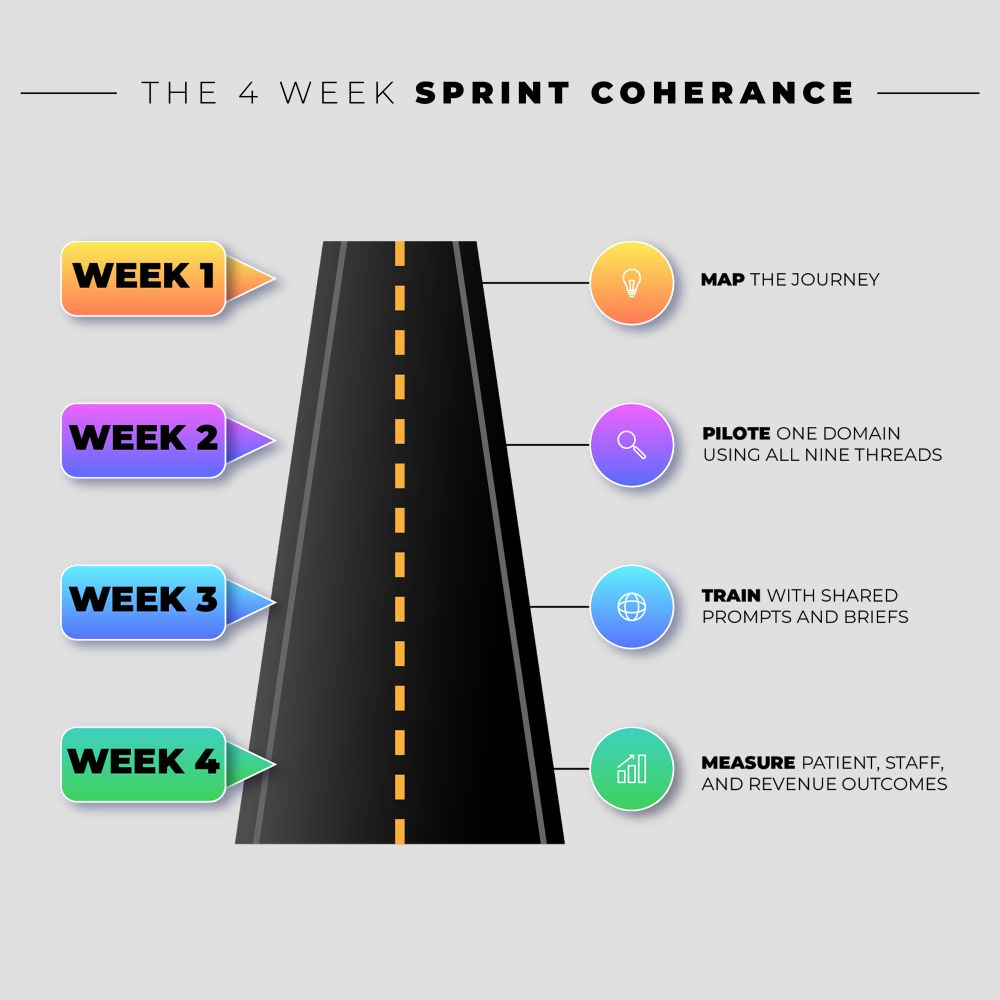
Week 1: Leadership works through the nine components for your most visible AI use case. This isn't strategy theater. It's operational planning that identifies exactly how AI decisions get made.
Week 2: Implement one systematic pilot using all nine components. Usually patient communication or content creation. The goal is proving the architecture, not achieving massive scale.
Week 3: Train your team to use the framework for any new AI application. The architecture becomes the quality standard, not an afterthought.
Week 4: Measure against business metrics, not AI metrics. Track patient satisfaction, staff efficiency, conversion rates, and operational consistency.
Weeks 5-12: Scale systematically. Every new AI application goes through the nine-component framework. No exceptions.
The organizations that succeed treat AI like infrastructure, not experiments. If you need more time, just spread it out. This is not a sprint, it is a marathon. Take the time for training and corporate understanding. The bigger the organization, the longer the implementation, since training and understanding are central to GenAI success. At the heart of AI integration is change management.
The Question That Changes Everything
When I work with executives, I ask them one question that cuts through all the noise:
"If you walked through your patient journey right now, how many different AI systems would they encounter, and do those systems know about each other?"
The honest answer reveals everything you need to know about your current strategy.
The Architect's Advantage
Let's return to the boardroom. Imagine the conversation a year after committing to an architectural approach. It's no longer about fixing disconnected tools. It's about a strategic decision: "We have an opportunity to launch a new preventative care service. Let's deploy an AI module on our existing platform. It will inherit all our brand, voice, and clinical guardrails. We can have it live in six weeks." That is the language of confidence, speed, and strategic advantage.
The future of great dentalcare will not be defined by the organizations that simply buy AI, but by those that architect it with wisdom and foresight. The question is no longer if you will use AI, but how you will build with it. Will you build a collection of brilliant but isolated tools, or will you build a lasting, intelligent system?
Your patients, your staff, and your competitors will notice the difference.
The smartest leaders are not waiting for the AI chaos to “fix itself.” They are building the architecture now that will define their growth curve for the next 36 months. If you want to see how the GenAI Strat Tapestry™ can apply to your practice or DSO, let’s map it together. Grab 30 minutes with me here: Quick meeting to talk about your AI strategy!
Here is a link to our education videos. NuParadym NXST LEAP Academy
Check out our websites: NuParadym DSOMarketingX