 MARC
MARC
How "invisible staff" can turn dental chaos into compounding growth!
If I stole this much from your P&L, you would call the cops
Quick thought experiment.
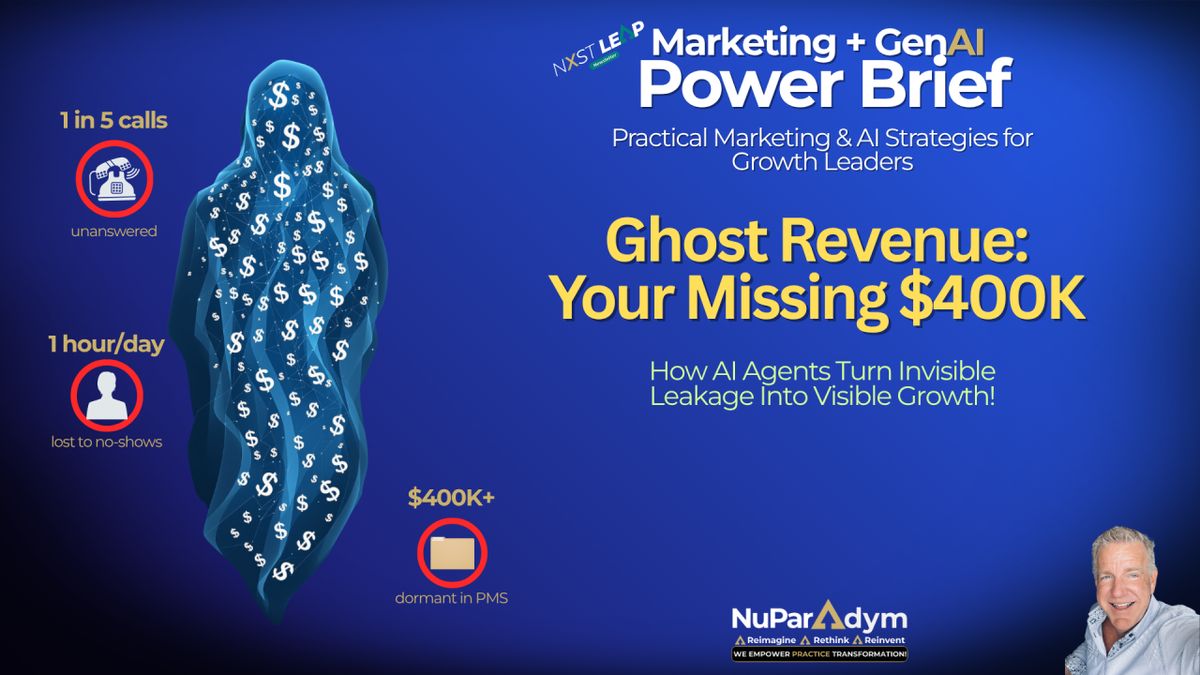
If I walked into your one of your practices and dropped one new patient call in five directly into the void, let one chair an hour sit empty that could have been filled, and left a seven figure pile of unscheduled treatment in the charts, how long would it take you to notice?
Here is the punchline. That is already what your data is telling you.
You do not see it as theft. You see it as culture, staffing, "the market", or "that is just how it is right now."
I call that gap ghost revenue.
Want to solve the "Ghost Revenue" problem? Click here and lets talk:Calendar Link
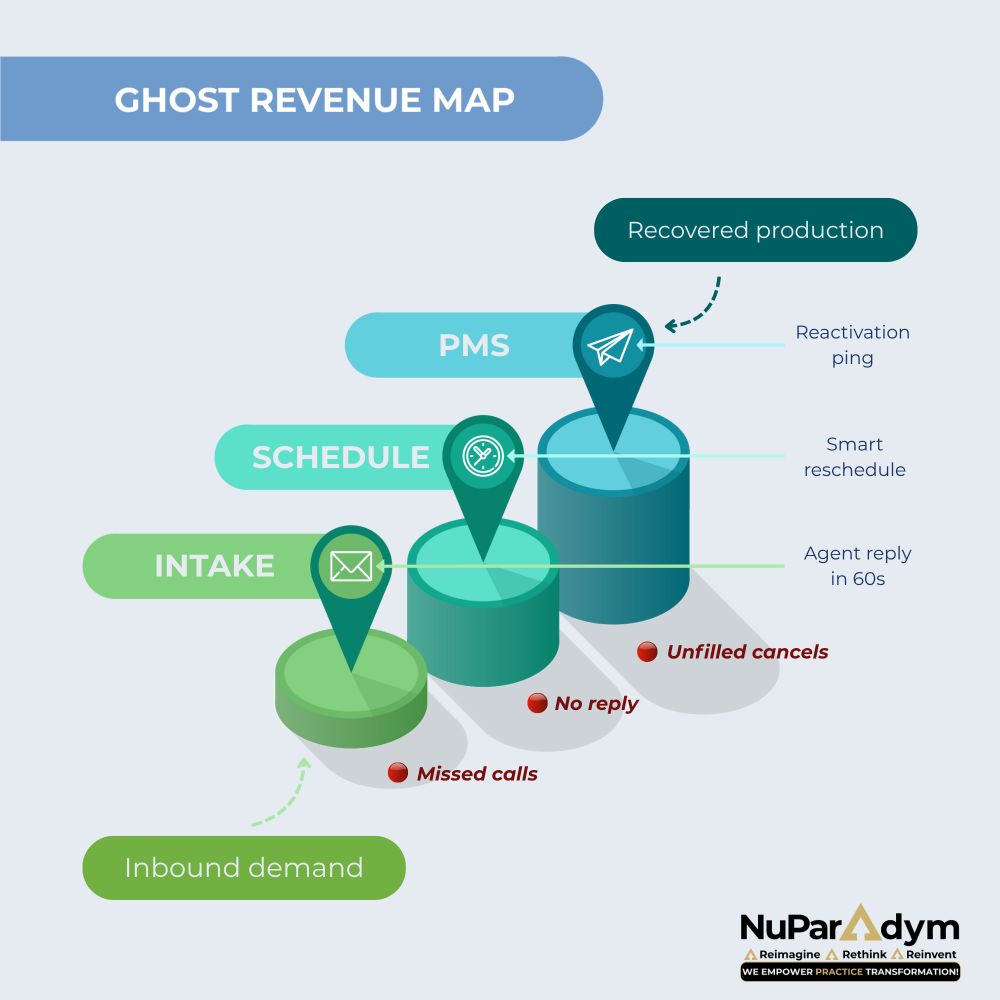
It lives in three places. Missed and mishandled calls, especially new patients. No shows and late cancels that never get backfilled. Dormant patients and unscheduled treatment hiding in your PMS.
Traditional marketing tries to pour more leads into that system. AI agents, used properly, act like invisible staff whose whole job is to hunt down ghost revenue and pull it back onto your P&L.
This paper is about that team. What they are, what they are not, where the real upside is, and how to roll them out without blowing up your people or your brand.
The three places your money quietly disappears
Let us make this painfully concrete.
Ghost revenue bucket one: the phone
First leak: You already know the script. A campaign hits, Google traffic spikes, phones light up. The team is short staffed, the front desk is juggling walk ins, forms, and insurance questions. New patient calls sit in a queue or go to voicemail. The patient hangs up and calls the next practice.
At a single practice level, that is annoying. At a platform level, stretched across 40, 80, 120 locations, it is a silent tax on everything your marketing team does.
Ghost revenue bucket two: the schedule
Second leak. Your schedule looks full every morning, then the day happens. Same day cancels. "I forgot." Weather. Kids. Work.
Your people scramble. A few holes get plugged. Most do not. Clinical payroll is already committed. Production is not.
The most brutal version of this is hygiene. You have invested years in building a recall base, then you let the schedule bleed out in slow motion.
Ghost revenue bucket three: the graveyard in the PMS
Third leak. This one is the quietest. Patients who have not been seen in 12, 18, 24 months. Treatment plans that were accepted in principle, then never scheduled. Patients who moved or changed numbers, but many who did not.
Every DSO that actually runs the report has the same moment. The total unscheduled treatment and lapsed hygiene inside the system is larger than a brand new practice.
You do not need a bigger funnel. You need a smarter way to work what you already own.
Why this is not a "better script" problem
Up to now, the industry answer has been some version of this. Train your team harder. Add another reminder. Write tighter scripts. Buy another widget for online scheduling.
That helps, but only to a point, because the constraint is not motivation. It is physics.
Humans cannot answer every call, around the clock, without delay. They cannot remember to follow up with every "I will call you back." They cannot keep a perfect mental picture of every at risk patient across thousands of charts. They cannot run twenty versions of an outreach script and remember which one worked best.
This is where AI agents are different from what you have seen before. They are not toys that write emails. They are not chatbots parked in the corner. They are software workers connected to your systems, paid to chase specific outcomes, at huge scale.
Think of them as hunters, always looking for the next high value patient to bring back. Or shepherds, protecting your schedule from falling apart. Or concierges, catching inbound interest so humans can focus on the tricky stuff. Or accountants, grinding through the RCM work humans hate.
They do not replace your people. They change what your people spend their time on.
Meet your new revenue team: the GRACE System
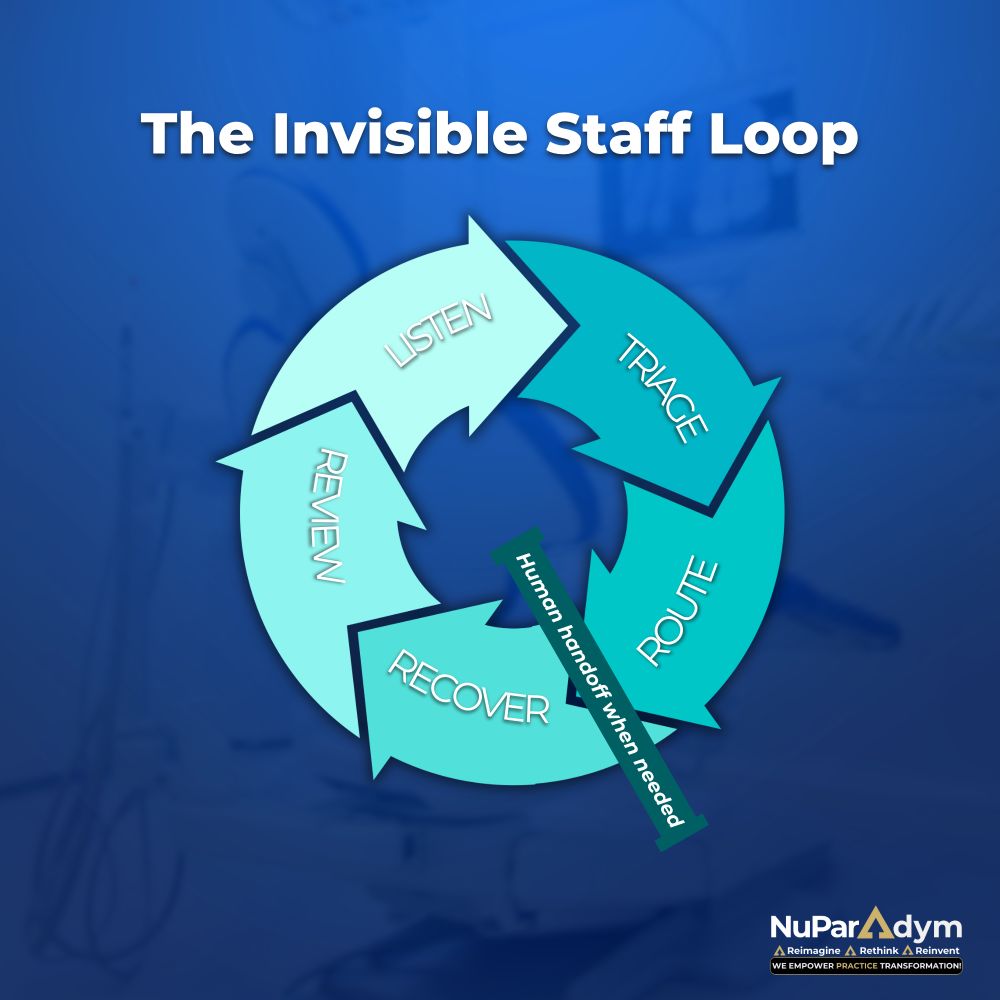
There are a lot of products on the market. To cut through the noise, I have organized AI agent capabilities into a framework I call GRACE: Ghost Revenue Action Crew for Excellence. These five roles map directly to where revenue leaks in dental operations. Your org chart should come before your tech stack. Decide which roles you need, then match tools to those roles.
1. The Hunter: reactivation agent
Job description: find patients who have drifted away, bring them back, and get them on the books.
The Hunter pulls lists from your PMS: overdue hygiene, unscheduled restorative, perio follow ups. It prioritizes by value and urgency. It reaches out by text and phone with natural language. It handles basic questions about scheduling, location, and timing. It books directly into your PMS or hands off to staff when needed.
Here is what this looks like when it works in the real world. One multi location group ran a simple reactivation campaign with an AI agent and, over a few months, it brought more than four hundred patients back in and booked over seventeen hundred visits. According to the company that ran the program, that translated into a few hundred thousand dollars in added production. The exact numbers will vary in your world, but it is a useful reminder that your “old” patient list might be the highest yield asset you own.
2. The Bodyguard: no show and backfill agent
Job description: protect chair time, predict risk, and fill holes.
The Bodyguard scores upcoming appointments by no show risk, based on past behavior and cohort patterns. It starts higher touch confirmation for high risk visits. It uses a standing waitlist of patients who want sooner times. When a hole appears, it matches the waitlist to the open slot and offers it in near real time.
One no show a day might not sound like much inside a single office. Multiply it across a platform and you quickly see why this role belongs in your org chart.
3. The Concierge: inbound and lead conversion agent
Job description: greet every new patient, answer basic questions, and remove friction from booking.
The Concierge answers overflow calls and after hours calls. It handles simple questions that do not need clinical input: hours, insurance accepted, directions, parking. It captures lead information from web forms and campaigns. It nurtures these leads if they are not ready to book.
This is your antidote to the "we are short staffed at the phones" story that every operator tells at some point.
4. The Coordinator: treatment follow through agent
Job description: make sure treatment plans turn into treatment completed.
The Coordinator watches for patients with accepted but unscheduled treatment. It follows up politely, with context, not pressure. It helps align calendars, work schedules, and financing options. It loops in humans when the conversation becomes nuanced.
This is where AI agents intersect directly with case acceptance. The clinical team can give a great consult. If nobody follows up when the patient goes quiet, you have simply created a very well documented ghost.
5. The Accountant: RCM and admin agent
Job description: work the boring pile, so humans do not have to.
The Accountant automates eligibility checks where your systems allow it. It monitors claim status. It flags denials and missing information. It builds worklists for humans in order of value and likelihood of recovery.
According to the Council for Affordable Quality Healthcare (CAQH), a non-profit organization that works to streamline healthcare administration, administrative transactions are a huge cost center in healthcare and providers carry most of that cost. Automating even a portion of those transactions is a direct margin play for DSOs.

What the serious research actually supports
Let me draw a clear line between three tiers of evidence, because this is where a lot of "AI in dentistry" content goes off the rails.
Tier one: hard research and standards
This is the stuff you can put in front of a board and not flinch. Big consulting work that shows marketing, sales, and customer operations are where most of the economic value from generative AI sits. Healthcare AI work that shows major value in admin automation, triage, and personalized communication. Professional bodies, like the ADA, publishing standards and technical reports for AI systems in dentistry, including guidance on how to evaluate image analysis tools for safety, accuracy, and fairness.
Takeaway: AI is not a toy, it is moving toward infrastructure. Using it thoughtfully is starting to look like good practice, not a gimmick.
Tier two: industry and market data
Here we have CAQH and similar organizations documenting the cost of manual admin work. Healthcare and marketing surveys about adoption, comfort, and impact. DSO and group dentistry benchmarks on no shows, attrition, and unscheduled treatment.
Takeaway: there is plenty of room for efficiency and growth, especially where you combine automation with better coaching and processes.
Tier three: vendor case studies
This is where the Jazas of the world live. It includes reported reactivation numbers like the three practice example above. Claims of uplift in case acceptance or production from specific tools. Pricing and ROI claims.
Takeaway: treat this as directional evidence and story fuel, not as universal truth. Use it to shape hypotheses, then test those hypotheses on your own data.
When we build your content and your strategy, we anchor the story in tier one and tier two, then we use tier three as color, clearly labeled.
The DSO playbook: 90 days that actually change something
You do not need a twelve month transformation plan. You need a tight experiment that proves this is real.
First 30 days: count the ghosts
No tech yet. Just brutal clarity.
For 10 business days,
- Track how many new patient calls went unanswered or to voicemail.
- Track how many clinical hours were lost to no shows.
- Track how many overdue hygiene and unscheduled treatment patients you have per location.
Translate those into money.
- Average revenue per new patient.
- Average revenue per hygiene hour.
- Average revenue per typical restorative plan.
You do not need perfect precision. An honest estimate is enough to expose the order of magnitude.
Days 31 to 60: hire your first invisible employee
Pick one agent type and one pilot cohort. If ghost revenue from lapsed patients is huge, start with the Hunter. If your schedule is chaos, start with the Bodyguard. If your phones are a disaster, start with the Concierge.
Then shortlist two or three vendors. Connect to your PMS and call routing, with tight scope. Define exactly what the agent is allowed to do on its own and where it must hand off. Have one person on your team own the pilot.
Run it live in a small group of locations. Review transcripts and results often. Fix weird conversations quickly.
Days 61 to 90: decide like an investor
- At the end of ninety days, treat this like any other investment.
- How much additional production did we attribute to the agent, conservatively?
- How much staff time did it free, realistically?
- What did it cost, fully loaded, including internal time and vendor fees?
- How did staff feel about working with it?
- Did patient complaints go up, down, or sideways?
If the answer is "we moved real dollars and the experience was acceptable", you scale. If the answer is "small movement, big hassle", you either tune or kill it and move on.
The point is to stop talking about AI as concept and start talking about it as a line item in your P&L.
What to tell your people so they do not freak out
If you roll out agents with no narrative, your team will fill in the gap with the worst story they can imagine.
Here is a better story to give them, in plain English.
- "We are not trying to replace you. We are replacing the hundred boring things that keep you from doing the parts of the job that actually need a human."
- "If a conversation is simple, the agent will handle it. If it gets emotional, confusing, or clinical, it goes to you."
- "We will review transcripts and tweak things together. If you see the agent doing something dumb, we want to know."
- "If this works, the whole point is to make your day less chaotic and your work more valuable."
You know this intuitively, but it is worth saying out loud. AI will not kill your culture. Silence will.
The question to ask at your next ops meeting
I will leave you with one question.
Forget AI for a moment. Forget hype. Forget vendors.
Ask this in your next ops or executive meeting:
"If we did not add a single new lead for the next twelve months, what percentage of our current opportunity could we realistically convert into production, just by running the revenue engine we already have more intelligently?"
If the honest answer is "we are leaving a lot on the table", then AI agents are not a shiny object. They are simply the most realistic way to give your existing team more arms, more ears, and more attention span, without burning them out or blowing up payroll.
Once that clicks, the tech conversation gets a lot simpler.
You are not buying artificial intelligence. You are hiring invisible staff whose only job is to bring your own ghost revenue back home.
7-day action plan
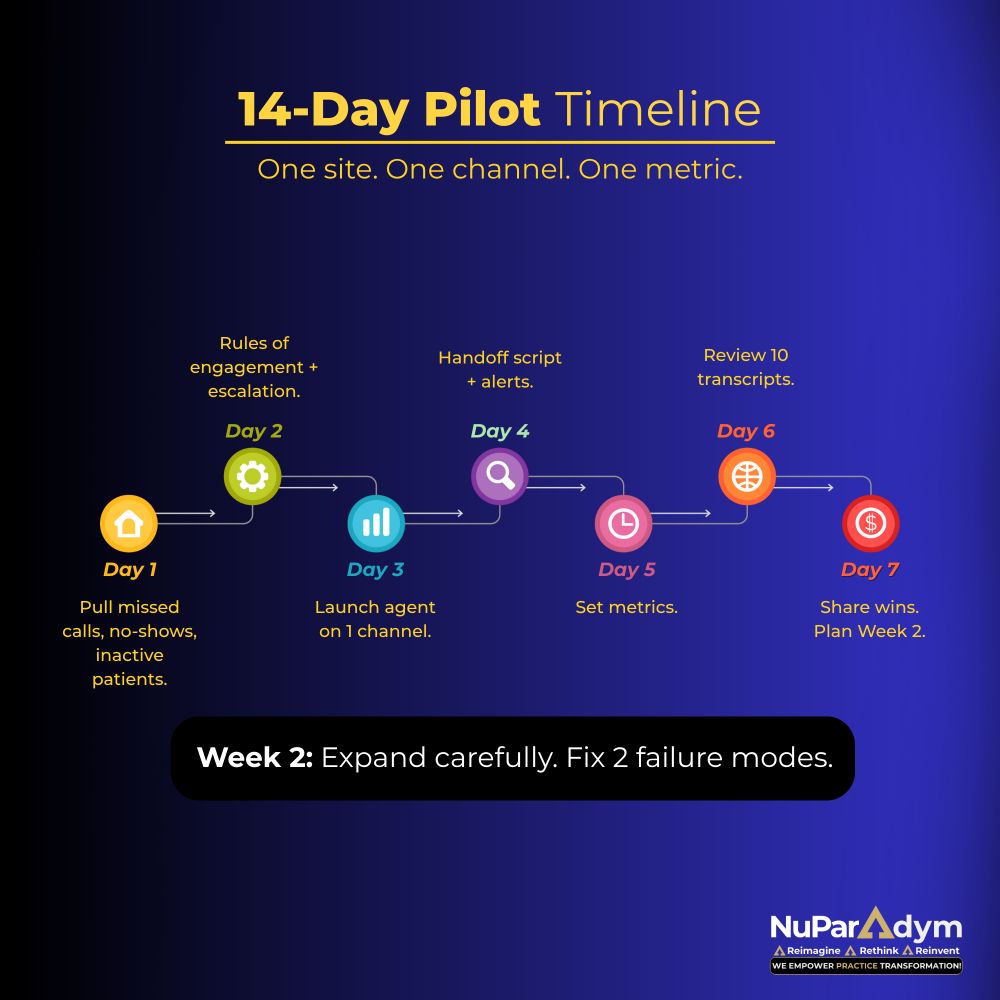
Day 1: Pull last 30 days of missed calls, no-shows, inactive patients.
Day 2: Write rules of engagement and escalation paths.
Day 3: Stand up one agent on one channel at one location.
Day 4: Create a "human handoff" script and Slack/Teams alerting.
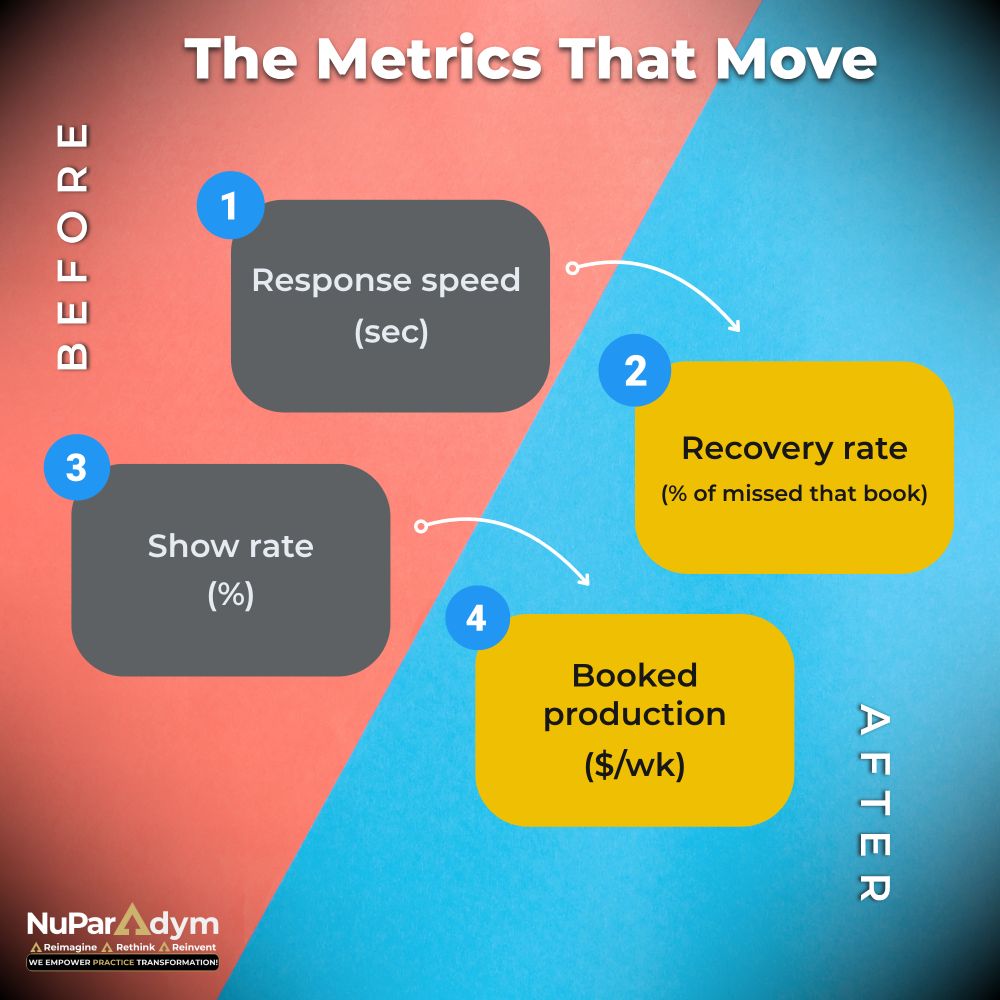
Day 5: Set metrics: answer time, recovery rate, show rate, booked production.
Day 6: Review 10 transcripts; fix two failure modes.
Day 7: Share wins with ops; plan Week-2 expansion.
Ready to put invisible staff on your org chart?
If you are running a DSO or multi location group and this hit a nerve, you do not have to white knuckle this alone.
This is the work we do with operators. We map your ghost revenue, design your first AI agent “org chart,” and stand up a pilot that protects your P&L instead of your ego.
If you want help pressure testing your numbers and building a sane rollout plan:
1. Comment “PILOT” and I will send you my AI agent pilot checklist and playbook.
2. Or Click here so we talk, Calendar Link
No fluff. No hype. Just an honest look at how much money you are leaving in the chair and what invisible staff could realistically bring back.
Bonus for newsletter readers If you want to zoom out from AI agents and see how they plug into a bigger 2026 growth engine, grab my playbook “Stop Being Ignorable: Your 2026 Marketing Playbook. ”

It walks through the full marketing system DSOs are using to turn attention into production, with AI agents as one piece of the Momentum Engine. Download it here: Stop Being Ignorable
Are you tired of your marketing not working, Let's talk now! Click the link.
Get the breakdown in your inbox. Join the Marketing+GenAI Power Brief Today!
📲 Check out our website: NuParadym
🎥 Get more info from our YouTube Channel: YouTube | NuParadym
📲DSO Marketing X Website: DSOMarketingX
📲NXST LEAP Academy: NXST LEAP Academy
About the Author